



Public and private sectors put their heads together to revitalize Eeum 5G
 Published2022.12.02 11:02
To promote Eeum 5G, the public and private sectors met to share overseas implementation cases and discuss regulatory innovation measures, such as simplifying frequency allocation procedures.
The Ministry of Science and ICT (Minister Lee Jong-ho) held a 'Public-Private Meeting for the Activation of Eum 5G' at a conference room in Gangnam-gu on the 1st.
Since announcing the Eum 5G (5G specialized network) policy plan last year (2021), the Ministry of Science and ICT has been making efforts to prepare a plan for supplying Eum 5G frequencies, improve related systems, and support the establishment and operation of the 'Eum 5G Support Center'.
In addition, in accordance with the current government's national agenda of 'building a differentiated 5G network and expanding convergence services, including the nationwide expansion of Eum 5G,' policies to promote the use of Eum 5G, such as supporting Eum 5G demonstration projects, are being established and implemented.
While demand was predominant in the robotics and intelligent factory sectors during the early stages of the business, the need for close communication between the public and private sectors has increased as demand has recently expanded across various industries, including healthcare, media, aviation, industrial safety, energy, and R&D. Accordingly, this public-private meeting was held.
Twenty-six people attended the meeting, including Eum 5G operators, public and private demand agencies, and experts from related and directly affiliated organizations. They shared insights on the future of convergence services based on 5G specialized networks and engaged in in-depth discussions on ways to expand 5G specialized networks.
The first presentation of the day covered demonstration cases in 12 sectors, including agriculture, forestry, factories, power plants, airports, and ports, as well as the current status of 28 GHz band construction in Japan, which introduced Eum 5G two years earlier than Korea.
Citing the examples of Tokyo Metropolitan University and NTT East Central Training Center, it was explained that these institutions are preparing for phased network upgrades to enable real-time video transmission without data compression using the 28 GHz band, and that such cases of operation and construction of the 28 GHz band are increasing in Japan.
The second presentation shared the progress of regulatory improvements and policy implementation resulting from proactive administration aimed at revitalizing Eeum 5G, after which attendees continued discussions on policy recommendations for Eeum 5G activation measures and on-site difficulties.
Eum 5G operators and public and private demand companies requested the government to provide testbeds for the development of optimized equipment and terminals, as well as support for radio certification costs to facilitate the early launch of equipment. Participants suggested that close cooperation with relevant agencies and the Eum 5G Support Center is necessary for comprehensive support, including Eum 5G demonstration projects, administrative and technical consulting, standardization, and testing and certification.
Meanwhile, the Ministry of Science and ICT promptly processed the simplification of the supply procedures for commercial and public spectrum—which was reflected as a task for "Eum 5G Activation" in the "Regulatory Innovation Plan to Enhance Digital Industry Vitality" at the "Regulatory Innovation Strategy Meeting" held on November 9—through proactive administration, issuing notices and directives on November 29. The main details of the order were announced.
The existing Eeum 5G frequency supply procedure applied the same complex process as new applications even when existing frequency users requested additional frequencies, which acted as a constraint on the expansion of Eeum 5G infrastructure.
With the amendment of this notice and directive, commercial Eum 5G users will undergo a simplified procedure when applying for additional Eum 5G frequencies, and public Eum 5G users will undergo a relaxed supply procedure where existing supply cases exist, enabling the rapid deployment of customized 5G services.
Accordingly, the time required for supplying additional commercial (1 → 0.5 months) and public (over 1 year → 1 month) frequencies will be shortened, and it is expected that approximately 1,000 5G specialized networks will be built by 2030 and about 3 trillion won in investment will be promoted.
Choi Woo-hyuk, Director General of the Radio Policy Bureau at the Ministry of Science and ICT, who presided over today's meeting, stated, "We plan to support the supply of Eeum 5G frequencies to 30 locations by the end of the year through the sharing of excellent domestic and international implementation cases, regulatory improvements, and active promotion to ensure that Eeum 5G is integrated across all industries." He added, "To this end, the government plans to continuously strive to build the foundation of the industrial ecosystem through comprehensive Eeum 5G activation policies involving administration, technology, and demonstration projects in collaboration with relevant agencies, and we will support more companies so that they can lead the digital transformation through cooperation."

Comments
Related news
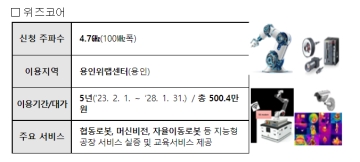
SMEs Fully Join 'Eum 5G' Operators
The Ministry of Science and ICT announced that it completed the allocation of WizCore Co., Ltd.'s (CEO Park Deok-geun) IEEUM 5G frequency and registration as a general telecommunications service provider, as well as the frequency designation for Korea Water Resources Corporation (CEO Park Jae-hyeon) on October 28.
2022.10.31by 김예지 기자

Innovation in regulations related to electromagnetic waves for wireless charging, IoT, and 5G
The government is moving forward in earnest with improvements to frequency-related regulations that have been a barrier to the spread of advanced digital technologies, and this is expected to accelerate digital-based economic innovation.
2022.11.10by 배종인 기자

5G, nuclear power plant safety management, etc. to be expanded nationwide
NewGens, Korea Hydro & Nuclear Power, SK Networks Service, and Unangela have received 5G frequency supply through Eeum 5G.
2022.11.28by 배종인 기자
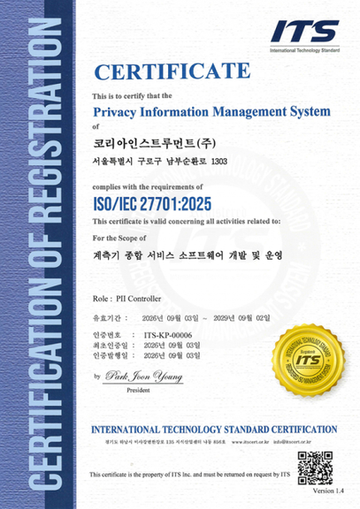
Korea Instrument, KOLAS Accredited Calibration Agency First to Simultaneously Acquire ISO/IEC 27,001·27,701
Korea Instrument has become the first among KOLAS accredited calibration agencies to simultaneously acquire ISO/IEC 27,001 and ISO/IEC 27,701 certifications. Through its proprietary platforms CWIZ Enterprise and CWIZ Partners, the company has embedded information security and personal data protection requirements across all business processes including customer information, equipment data, and calibration reports, with plans to continuously advance its management system through regular audits and security inspections.
2026.10.12by 배종인 기자
TeamViewer One, IT Incident Automation Workflow and Resolution Center Enhanced
TeamViewer has added IT incident automation capabilities and an advanced Resolution Center to its integrated digital workplace management platform 'TeamViewer ONE'. Recurrent service disruptions, configuration errors, and capacity shortages are automatically handled according to preset policies, and device status verification through script deployment can be managed in a unified interface, significantly reducing repetitive tasks for IT teams.
2026.10.12by 배종인 기자











