



KIMS, “Producing Hydrogen from Waste Water”
 Published2022.12.05 15:49
.jpg)
▲ The researchers who conducted this study (from left): Dr. Yang Ju-chan, Dr. Choi Seung-mok, Researcher Jeong Jae-yeop, and Dr. Park Yu-se of the Korea Institute of Materials Science.
The Korea Institute of Materials Science (KIMS, President Lee Jeong-hwan), a government-funded research institute under the Ministry of Science and ICT, has developed a system capable of producing high-purity hydrogen from waste water, brightening the prospects for future green hydrogen production.
The Korea Institute of Materials Science announced on the 5th that a research team led by Dr. Yang Ju-chan and Dr. Choi Seung-mok of the Green Hydrogen Materials Research Laboratory developed high-performance non-precious metal catalyst/electrode materials and applied them to a waste alkaline water electrolysis system, succeeding in developing the first non-precious metal-based waste alkaline anion exchange membrane water electrolysis technology in Korea.
Anion exchange membrane water electrolysis is an ideal technology that combines the advantages of using non-precious metal-based electrodes found in conventional alkaline water electrolysis technology with the ease of operation and simplicity of cation exchange membrane water electrolysis technology. It can be considered a next-generation water electrolysis system capable of obtaining high-purity hydrogen along with improving the economic efficiency of green hydrogen production.
Research on water electrolysis, a method for producing green hydrogen, has so far used purified water (clean water)-based electrolytes. On average, about 9 tons of purified water are required to produce 1 ton of hydrogen through water electrolysis, and about twice that amount of water is required to obtain 9 tons of purified water. As green hydrogen production requires a massive amount of water in addition to the electricity needed for electrolysis, the cost associated with water usage also becomes a crucial factor in determining price competitiveness.
Waste alkali is defined as strong alkaline waste with a pH of 12.5 or higher, and its emissions are increasing every year due to the surge in demand for semiconductors and the development of the electronics industry. The research team applied key source materials and components for water electrolysis using waste alkali as a direct electrolyte to a unit cell modeled after a commercial system.
First, to simultaneously secure the activity and durability of non-precious metal catalysts, a composite catalyst was developed by uniformly coating a high-conductivity carbon layer on the surface of the catalyst. The catalyst exhibited high uniformity during the electrode formation process and demonstrated approximately 2.8 times better activity and high durability compared to existing electrodes in anion exchange membrane water electrolysis unit cell evaluations. The research team applied this technology to a waste alkali electrolyte-based water electrolysis unit cell to achieve a high current density of 1,420 mA/cm² (non-precious metal applied, based on 2V), and confirmed that it exhibited improved durability even at current densities capable of smoothly producing hydrogen. As a result, analysis of metal ions present in waste alkali revealed that increased electrolyte ion conductivity improved water electrolysis performance.
"By using waste alkaline electrolytes, we can not only recycle and process them but also drastically reduce the cost of using high-concentration pure alkaline salt electrolytes," said Yang Ju-chan, a senior researcher at the Korea Institute of Materials Science and Technology, who is the principal investigator of the study.
Choi Seung-mok, the project leader and principal researcher (Head of Green Hydrogen Materials Research Lab), stated, “Once this technology is commercialized, it can be immediately utilized in existing alkali-based water electrolysis systems, enabling mass production and entry into the hydrogen production market.”
This research achievement was carried out with support from the Ministry of Science and ICT through the Korea Institute of Materials Science’s major project (Project name: Development of high-durability electrodes and evaluation technology for AEM water electrolysis for green hydrogen production) and the Ministry of Trade, Industry and Energy’s materials and components technology development project (Project name: Development of high-performance catalyst electrodes and component technology for 2.5kW-class waste alkaline AEM water electrolysis for hydrogen production).
In addition, the research results were published on November 10 in the 'Journal of Materials Chemistry A' (IF=14.511, first authors: doctoral student Jae-Yup Jeong and Dr. Yu-Se Park (currently a professor at Chungbuk National University)), a prominent international academic journal in the field of materials and energy. The research team is currently conducting follow-up research for the application and commercialization of a waste alkaline water electrolysis stack system through large-area uniform electrode fabrication.
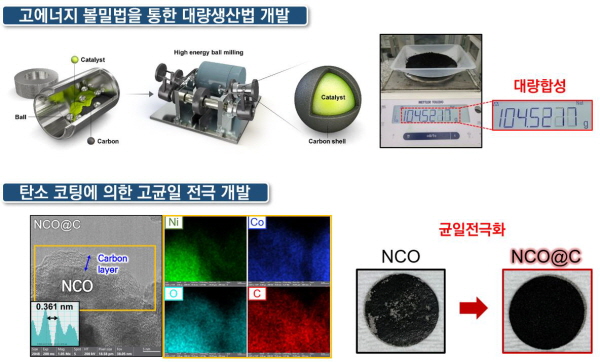
▲ Catalyst development method developed to simultaneously ensure activity and durability (Top) and analysis and electrodeization of the developed catalyst (Bottom)

Comments
Related news
KIMS, Hyundai Heavy Industries, and Pusan National University Join Hands for Carbon Neutrality
The Korea Institute of Materials Science (KIMS, Director Lee Jung-hwan), a government-funded research institute under the Ministry of Science and ICT, is joining forces with Hyundai Heavy Industries Engine & Machinery Business Division (Business Head Ahn Kwang-heon) and Pusan National University (President Cha Jung-in) to realize the carbon-neutral era centered on green hydrogen.
2021.09.07by 배종인 기자
KIMS Accelerates the Era of Green Hydrogen Production
A domestic research team has successfully developed the nation's first long-lifespan, high-efficiency anion exchange membrane water electrolysis stack technology based on non-precious metals.
2022.08.11by 성유창 기자
Korea's first 10MW large-scale green hydrogen demonstration project
For the first time domestically, demonstration of large-scale green hydrogen production at the 10MW class has been conducted, and it is anticipated that future development of water electrolysis design technology and expansion of the related industry and market will be achieved.
2022.10.04by 성유창 기자
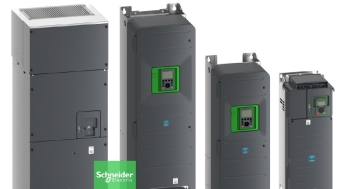
Schneider Aims for Building Energy Savings and Operational Stability with Next-Generation HVAC Drives
Schneider Electric has unveiled its next-generation HVAC drive product line 'Altivar HVAC'. The new product line's key features center on enhanced energy savings, system operational stability, and building management system integration. The products are divided into 'ATH200' for OEM and small equipment applications, and 'ATH600' for environments requiring continuous operation and advanced control. The company plans to expand the application scope from commercial buildings to facilities where HVAC system stability is critical, such as hospitals, airports, and data centers. The announcement includes over 30% energy savings, operation from -10°C to +60°C, Modbus and BACnet support, and compatibility with low global warming potential refrigerants.
2026.03.26by 명세환 기자
Ecolab Expands AI Data Center Cooling Business Through Acquisition of CoolIT
Ecolab has agreed to acquire CoolIT Systems, a liquid cooling company for AI data centers, for approximately $4.75 billion. The transaction is expected to close by Q3 2026, subject to regulatory approvals. CoolIT has been supplying direct-to-chip cooling-based coolant distribution units, cold plates, and manifolds, serving hyperscale data centers and colocation operators as customers. This acquisition is a measure to address the high-heat and high-density server environments created by AI proliferation. Ecolab plans to combine its water management and digital monitoring capabilities with CoolIT's hardware technology to expand its data center cooling business.
2026.03.26by 명세환 기자











