


[Technical Contribution] Texas Instruments (TI) - V2G Vision Unlocking the Potential of Electric Vehicles
 Published2022.12.05 16:55
Using WBG for Faster Charging and Smaller System Design
Securing Up to 20% More Capacity Through SOC Without Battery Damage

Through TI's wide bandgap power, sensing, and connectivity technologies, engineers can now realize V2G (vehicle-to-grid) energy storage technology, contributing to more sustainable, efficient, and cost-effective energy management.
Aging grids face unprecedented demand worldwide, and the burden can only increase with vehicle electrification. But what if electric vehicles (EVs) could return power to the grid to ease this burden?
This concept, called V2G (vehicle-to-grid), envisions EV fleets that strengthen the grid by supplying battery power, especially during peak demand periods. This vision is gaining traction as new charging and battery storage solutions emerge and proven technologies are redeployed.
V2G is also being driven by environmental goals as many countries work to reduce emissions and expand renewable energy sources. As vehicle electrification is included in this process, managing the power demands of millions of EV owners will become a challenge. The energy required for a typical EV to drive 100 miles is roughly equal to the amount of energy needed to power an average household daily. If everyone charges simultaneously, the grid could face a severe situation.
Henrik Mannesson, TI's overall responsible director for grid infrastructure, explained: "The issue is not the total capacity of the grid, but the peak capacity. We all know that the more dependent we are on electricity, the higher and more frequent the peaks become. Extreme weather adds more burden to the grid. Using semiconductor technology, V2G bidirectional charging can improve these peaks, which will ultimately benefit us all."
Semiconductor technology that supports bidirectional charging can transform EVs and batteries into energy storage systems that can return power to the grid when needed. Wide bandgap power management, sensing, and connectivity technologies can optimize power load management and lay the foundation for expanding renewable energy sources, ensuring a more reliable, smarter, and safer grid.
■ Supporting Faster and More Energy-Efficient Charging Through GaN
One of the components for creating more efficient V2G solutions is wide bandgap technology such as gallium nitride (GaN). Compared to conventional silicon devices, GaN effectively triples the power density (the amount of power managed in a given form factor) of power supply or power management systems in areas such as EV onboard chargers, EV charging stations, and energy storage systems. As a result, designs with faster charging speeds, smaller system sizes, and lower costs become possible.
David Snook, TI's GaN product manager, explained: "GaN helps engineers triple the power density of conventional transistors and significantly reduce the size and cost of applications like DC wallboxes. The reduction in size and weight is an interesting aspect of GaN in this field."
Smaller and lighter charging stations increase flexibility, making it easier for grid operators to deploy charging infrastructure in more locations.
Additionally, more portable systems like DC wallboxes mean greater convenience for EV owners, who can charge at home or power their homes when needed.
■ Energy Savings Through Current Sensing Technology
Sensing technology is also key to improving efficiency when moving energy between EVs and the grid. To establish voltage and current control loops in power conversion systems, isolated, fast, and accurate voltage and current readings are required by the microcontroller. TI's isolated amplifier and analog-to-digital converter (ADC) portfolio, working in conjunction with small current shunt resistors, reduces power loss and supports high-resolution measurements, enabling precise control when power is returned to the grid.
Navin Kommaraju, portfolio manager for isolated ADC and amplifier solutions, said: "Thanks to accurate current sensing, battery energy storage can be converted to AC (alternating current) that can be used from the grid."
State of charge (SOC) monitoring helps EV owners manage energy more effectively. Accurate monitoring can help secure up to 20% more capacity from the battery without permanent cell damage. For example, an EV owner who only commutes may not always need to keep their vehicle's battery fully charged. As the accuracy of smart sensing technology improves, EVs can tell owners the optimal time to return power to the grid or charge their homes.
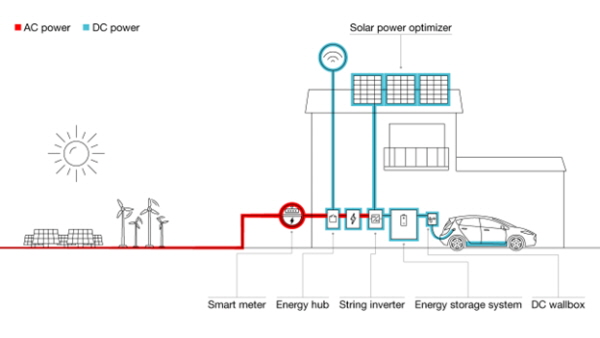
While efficiency is important, safety is paramount in producing V2G solutions. EV owners need assurance that power movement from their vehicles is reliable and consistent. Along with sensing technology, battery management systems can monitor the battery's state of health (SOH) by managing voltage, current, temperature, and other performance metrics.
Spencer Hu, TI's automotive battery monitoring product manager, explained: "The battery management system is the first line of defense. If the battery condition is not good, owners may be reluctant to connect their battery to the grid due to concerns that battery aging could accelerate and ultimately affect driving range per charge."
■ Advanced Connectivity Solutions Managing Power Load
Making V2G a reality is ultimately a data-driven task that requires smart communication between EVs, charging infrastructure, and the grid. Advanced connectivity solutions and smart energy metering are critical for grid operators to predict and adjust power loads required by EVs at different times, locations, and situations. Billing EV owners for charging or compensating them for returning power to the grid requires large-scale, reliable, secure, real-time communication.
Meanwhile, EV owners need human-machine interfaces (HMI) such as displays and touchpads that can connect through various protocols like WiFi®, Bluetooth®, and Sub-1GHz. An application processor that handles multiple functions on a single chip is needed to ensure high-quality user experience during charging while managing various communication interfaces. TI's Sitara™ AM62 processor serves as the central decision maker when managing communications across the human-machine interface and EV-charger interface areas, as well as communications between the charging station and the cloud. Thanks to this processor, engineers can meet global standards and protocols for V2G communication such as ISO15118 Plug and Charge (PnC) and OCPP (Open Charge Point Protocol).
Thanks to processors like the AM62, grid operators can now optimize power load management while simultaneously sending notifications to EV drivers through smart HMI about the optimal time to charge or return power to the grid. Processors with edge AI capabilities allow more intelligence to be embedded in the grid as V2G data is collected over time.
Artem Aginskiy, TI's Sitara processor product line manager, explained: "Through AI, we can find patterns in a year's worth of data. Based on this, we can predict the optimal location to charge tomorrow depending on the current situation of the grid and charger."
■ Semiconductor Technology That Can Make V2G a Reality
While some situations like power outages are difficult to predict, EV users will still benefit from semiconductor technology when outages occur. Thanks to innovative technologies in connectivity that support V2G, homes can be powered by vehicle batteries during outages. This V2H (vehicle-to-home) solution has the potential to accelerate renewable energy adoption by complementing bidirectional charging between homes and the grid through solar panels and battery storage systems.
While building the infrastructure to lead vehicle electrification takes time, from a technical perspective, all the pieces are in place. The environmental benefits of V2G through more efficient power load management are also strong.
Henrik Mannesson, overall responsible director, explained: "Semiconductor technology can help the grid cope with the power demands that accompany vehicle electrification. Meanwhile, smart solutions can make it easier for EV users to return power to the grid."
■ Passion for Building a Better World
Helping engineers realize V2G energy storage solutions is just one way TI's innovators are putting into practice their passion for creating a better world by making more affordable electronics through semiconductors. Through smaller, more efficient, more reliable, and more affordable technologies, TI is building on the innovations of past generations to lead the innovations of new generations. We call this engineering progress, and it is something we have been doing for decades.
※ This contribution was originally published in the Texas Instruments newsroom and has been recontributed to e4ds.

Comments
Related news

Intel Unveils Next-Generation 'Core Ultra Series 3' and vPro Platform for Enterprise PCs
Intel has officially unveiled the "Intel Core Ultra Series 3" for next-generation enterprise PCs and the latest vPro platform, addressing a wide range of demands from enterprise notebooks to high-performance workstations.
2026.03.26by 배종인 기자

ROHM Launches ESD Protection Diode Compatible with High-Speed Interfaces of 10Gbps or Higher
Semiconductor specialist ROHM has developed the 'RESDxVx series' of ESD (electrostatic discharge) protection diodes capable of responding to next-generation high-speed data communication environments exceeding 10Gbps, simultaneously enhancing both signal quality maintenance required in high-speed interfaces and IC protection performance.
2026.03.26by 배종인 기자
ST Launches 75V Drive IC Targeting 48V Industrial Motor Driving
ST Microelectronics has unveiled the 'STSPIN9P' series of 75V motor drive ICs tailored for 48V-class industrial drive system design. The new product family is characterized by half-bridge and full-bridge configurations that enable design scalability according to motor type and output conditions. Power supply circuits, protection functions, and current sensing circuits are integrated on-chip to simplify system configuration, and the devices are designed to support applications up to 500W maximum. The company plans to provide reference designs and demo boards to support development and evaluation in industrial automation, robotics, pumps, fans, lighting, and textile machinery.
2026.03.26by 배종인 기자
Nordic supports security updates for the entire lifecycle of IoT devices at a single fixed cost
Nordic Semiconductor, a global leader in low-power wireless connectivity solutions, has unveiled a single fixed-cost licensing model that delivers FOTA (Firmware Over-the-Air) and device management capabilities throughout the device lifecycle via nRF Cloud, and introduced a new firmware update solution to prepare for the enforcement of the European Union's Cyber Resilience Act (CRA).
2026.03.26by 배종인 기자
Practical Training in Low-Noise, Low-Power Circuit Design All in One Place… Training Fee Support
The "2026 Advanced Engineer Practical Masterclass" to strengthen competencies in high-sensitivity analog circuit and sensor-based system design will be held on April 16 at the e4ds Conference Center in Gasan-dong, Seoul. This program will be conducted as an offline paid hands-on training session, not online, and is targeted at engineers seeking on-site intensive learning. Texas Instruments will provide educational support for this training, allowing participation at 150,000 won, a 100,000 won discount from the original price of 250,000 won.
2026.03.26by 배종인 기자











