



LG Innotek Develops World's First Plastic-Based ADAS Lens
 Published2022.12.07 16:49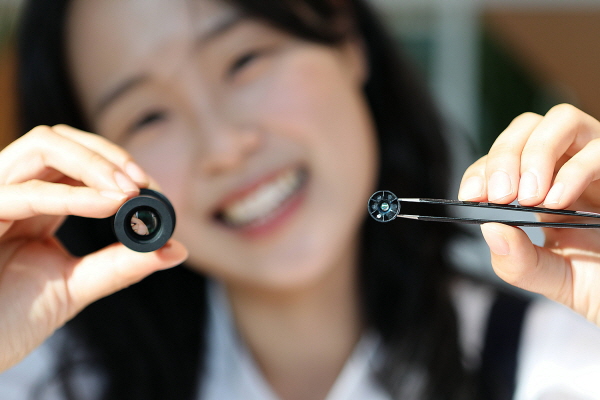
Plastic lenses are smaller, thicker, and more competitively priced than glass lenses.
"We will actively pursue the global automotive camera module market."
LG Innotek announced on the 7th that it has developed two types of 'high-performance hybrid lenses for autonomous driving (hereinafter referred to as high-performance hybrid lenses)'.
The 'high-performance hybrid lens' developed by LG Innotek is for two types: one for DMS and one for ADAS (Advanced Driver Assistance System).
It features improved performance by cross-applying thin plastic and glass inside the lens.
Existing autonomous driving lenses were made only of glass that does not deform due to temperature or external force.
In particular, LG Innotek is the first in the world to apply plastic to ADAS lenses to achieve high performance.
■ Size and thickness ↓, performance and price competitiveness ↑
LG Innotek's 'high-performance hybrid lens' is 20-30% thinner than all-glass products.
As it gets thinner, it is suitable for the interior of our customers' vehicles.middot;It has the advantage of increased freedom in external design.
An LG Innotek official explained, “As the level of autonomous driving increases, more sensing devices are attached, so it is important to reduce the size of the components themselves.”
This is because there is an increasing demand from automakers to apply parts in a way that is not visible on the vehicle body, such as on the front pillar (the long frame on the front left and right of the vehicle body that connects to the ceiling) rather than on the dashboard.
Plastic, which changes its performance and shape depending on heat and pressure, is known to be less stable than glass and difficult to make into a strong lens.
Because vehicle parts must maintain performance in various driving environments, including deserts, extreme cold, and extreme heat, it was difficult to introduce plastic into vehicle lenses.
LG Innotek's 'High-Performance Hybrid Lens' has performance equivalent to that of all-glass products, maintaining consistent performance regardless of temperature and enabling accurate object recognition.
Additionally, by using plastic, which is relatively cheaper than glass, we are able to supply high-performance products to our customers at reasonable prices.
This allows auto parts and complete vehicle manufacturers to install more cameras at the same cost, thereby improving autonomous driving sensing performance.
■ "We will accelerate the era of autonomous driving by innovating the customer experience."
LG Innotek plans to aggressively target the global automotive camera module market with its "high-performance hybrid lens."
We are actively conducting promotions targeting customers in Korea, the US, Europe, and Japan.
Global automakers and auto parts manufacturers are also expanding autonomous driving functions.As this is a trend, we are actively introducing parts related to DMS and ADAS solutions.
LG Innotek is currently preparing to mass-produce camera modules with lenses for DMS.
The camera module with ADAS lenses has also been developed and is ready to be launched in the market next year.
Kang Min-seok, Chief Technology Officer, said, “Success in developing a lens that requires difficult design and verification in a short period of time is a great achievement for innovating customer experience,” and “LG Innotek’s ‘high-performance hybrid lens’ that overcomes the limitations of plastic with innovative technology will have a big impact in the market.”
Meanwhile, according to Strategy Analytics, a global market research firm, the global autonomous driving camera market is expected to grow at an average annual rate of nearly 17%, from KRW 4.2 trillion in 2021 to KRW 7.9 trillion in 2025.
Comments
Related news

LG Innotek Led Q1 Performance by Smartphone Camera Modules and 5G Semiconductor Substrates
LG Innotek's first-quarter revenue increased 28.7% year-over-year despite seasonal off-peak demand, driven by robust demand for high-performance camera modules for smartphones and semiconductor substrates for 5G communications.
2022.04.27by 성유창 기자

LG Innotek invests KRW 1.4 trillion in its Gumi plant, accelerating its push into the FC-BGA market.
FC-BGA, a substrate for semiconductors, is experiencing a sustained supply shortage as global demand surges while only a limited number of companies possess the requisite technology. In this context, LG Innotek has begun full-scale investment to secure additional production facilities for flip-chip ball grid array (FC-BGA) and camera modules.
2022.07.07by 명세환 기자

LG Innotek unveils new FC-BGA substrates at KPCA show 2022.
Despite the recent overall slump in the component market, the semiconductor substrate market is hot. With optimistic long-term demand forecasts for semiconductors prevailing, there are expectations for expansion of the domestic semiconductor backend industry.
2022.09.20by 명세환 기자
[e4ds Tech Day 2026 ⑨] Sim Sang-gyu, Autocrypt CTO: "In the Physical AI Era, Automotive Security Must Extend Beyond the Vehicle"
At e4ds Tech Day 2026, Sim Sang-gyu, CTO of Autocrypt, explained automotive cybersecurity strategies in the era of Physical AI and SDV (Software-Defined Vehicle). Automobiles are evolving as part of an ecosystem connected to AI, cloud, chargers, IoT, and robots, and he emphasized that the scope of security must expand beyond the vehicle interior to the entire connected environment. In particular, AI model tampering, adversarial attacks, OTA updates, and EV charger hacking were identified as major threats. He explained that response measures require zero trust, AI model integrity protection, intrusion detection, Security by Design and Default, and full lifecycle security management, and that proactive security system establishment beyond regulatory compliance is critical for securing future mobility competitiveness.
2026.10.12by 배종인 기자

Practical HIL Construction Strategy for Automotive and Off-Highway Controller Validation
As vehicle E/E architecture transitions to zonal structures and shifts to software-defined vehicles (SDV), the number of controllers (ECUs) requiring validation and software complexity are surging dramatically. Meanwhile, real vehicle testing cannot provide repeated verification under identical conditions and entails lead time and safety concerns. This white paper explains the principles of HIL (Hardware-in-the-Loop) validation and the structure of the NI platform composed of PXI, SLSC, and VeriStand, and through two actual implementation cases—Camera Record & Replay HIL for In-Cabin Monitoring Controller (ICMU) and Forklift Controller (VCU) HILS—describes how controller-level regression testing becomes possible. Additionally, it explicitly states application boundaries and limitations, such as lack of A2B support.
2026.10.12by 편집부











