



ETRI to Release Expanding Displays
 Published2022.12.08 10:53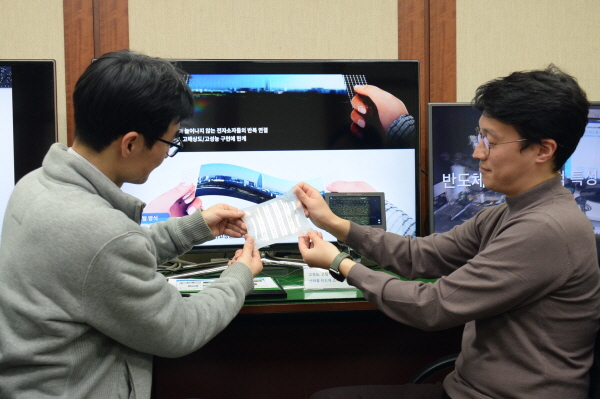
ETRI researchers explaining core semiconductor device technology for stretchable displays.
Domestic researchers have developed flexible inorganic semiconductor device technology for realizing stretchable displays that can be stretched like a rubber band, and are expected to lead the field of next-generation display semiconductors in the future.
The Electronics and Telecommunications Research Institute (ETRI) announced on the 6th that it has succeeded in developing high-performance, high-reliability, flexible inorganic thin-film transistor (TFT) technology capable of high-density integration.
This achievement was published online in the world-renowned science journal 'Nature Communications' on August 24.
Stretchable displays are next-generation display panels that can be stretched and contracted tautly like a rubber band.
While flexible semiconductor devices have primarily utilized flexible organic materials, research is expanding into the field of rigid inorganic materials such as silicon and metal oxides.
This is because, although the material's flexibility is lower, its electrical performance, reliability, and durability are superior.
ETRI researchers have developed a semiconductor device structure that directly places inorganic oxide electronic devices onto flexible metal wiring for the first time in the world.
It is a technology that adds flexibility to high-performance inorganic semiconductors while dramatically increasing device integration density.
The semiconductor device developed by ETRI is a conventional flexible acidThe device integration density has improved by about 15 times compared to the cargo semiconductor device, and the current driving performance has also increased by more than 2 times.
It effectively demonstrates the possibility of simultaneously achieving product miniaturization and high-resolution displays.
The research team realized a stretchable device by densely integrating high-performance oxide semiconductor transistors on a winding horseshoe-shaped polyimide flexible substrate wiring.
It is the principle in which a wavy substrate gradually straightens out and stretches like a spring.
The fabricated device maintains its performance without being destroyed even when pulled up to twice its original length.
Previously, there was a disadvantage of low device integration density due to an inefficient spatial structure consisting of repeated connections between stretchable metal wiring and non-stretchable electronic components; however, this development is expected to achieve both the flexibility and high image quality of display panels.
The newly developed flexible electronic device is attracting particular attention because it is not only compatible with standard semiconductor processes but can also be applied to various stretchable products such as displays, smartphones, TVs, automobiles, healthcare, and skintronics.
Oh Him-chan, a senior researcher at ETRI’s Flexible Electronic Devices Laboratory and the first author of this paper, stated, “Due to China’s rapid pace of research and development, the technology gap between Korea and China in semiconductors and displays is narrowing significantly.” "We expect that Korea will be able to secure a leading position in the next-generation semiconductor and display sectors through stretchable electronic device technology," he said.
Moving forward, the research team plans to focus on further simplifying this flexible semiconductor process to reduce costs and prepare for its rapid application in the industry.
This research was conducted as part of the 'Development of Core Material Technology for Ultra-High Resolution/Ultra-Flexible Display Backplanes (Display Backplane New Materials Research Group)' project, funded by the National Core Materials Research Group of the Ministry of Science and ICT, and the 'Development of Core Technology for Sensory Input/Output Panels for Skintronics' project, funded by ETRI.

Comments
Related news
ETRI Establishes Smart Edge Device SW Development Platform
Domestic researchers are developing a software development platform that enables easy and convenient automatic generation and integrated development of various artificial intelligence (AI) services deployed in smart devices, such as visual intelligence, emotional intelligence, object intelligence, and healthcare intelligence. This is expected to become a major driving force in revitalizing the domestic AI semiconductor ecosystem and securing technological dominance in smart devices in the future.
2022.09.14by 배종인 기자
ETRI Localizes World-Class GaN Power Devices
Domestic researchers have successfully developed gallium nitride (GaN) power devices, which are considered key components for next-generation semiconductors, using purely domestic technology, and this is expected to significantly contribute to enhancing the competitiveness of Korea's semiconductor industry and securing technological leadership.
2022.09.22by 배종인 기자
ETRI and KISTEP Present 15 Key Technologies to Address Digital Dysfunction
Domestic researchers are drawing attention by presenting solutions and countermeasures to address the negative effects of future digital technologies.
2022.11.16by 배종인 기자

Intel Unveils Next-Generation 'Core Ultra Series 3' and vPro Platform for Enterprise PCs
Intel has officially unveiled the "Intel Core Ultra Series 3" for next-generation enterprise PCs and the latest vPro platform, addressing a wide range of demands from enterprise notebooks to high-performance workstations.
2026.03.26by 배종인 기자

ROHM Launches ESD Protection Diode Compatible with High-Speed Interfaces of 10Gbps or Higher
Semiconductor specialist ROHM has developed the 'RESDxVx series' of ESD (electrostatic discharge) protection diodes capable of responding to next-generation high-speed data communication environments exceeding 10Gbps, simultaneously enhancing both signal quality maintenance required in high-speed interfaces and IC protection performance.
2026.03.26by 배종인 기자











