



KETI, Domestic Production of Core SW for Metal 3D Printing
 Published2022.12.20 09:38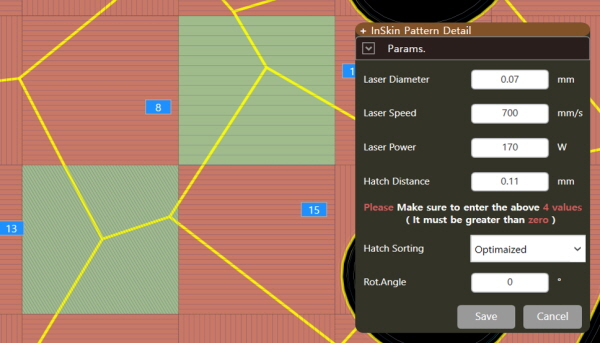
▲Metal 3D printing tool path and output code generation SW
The Korea Electronics Technology Institute (KETI, President Shin Hee-dong) is producing core metal 3D printing software domestically, and this is expected to enhance the competitiveness of domestic metal 3D printers in the future.
KETI announced on the 20th that it has succeeded in developing software (SW) to improve metal 3D printing manufacturing quality.
Metal 3D printing creates the desired product by laying out metal powder flat and selectively shooting a high-temperature laser to melt and solidify it.
This time, the software developed by KETI contributed to improving the stability of metal 3D printing output quality by localizing the tool path and output code generation functions that had previously been dependent on foreign products.
Additionally, the research team reflected many opinions from metal 3D printing process experts in industrial fields and focused on increasing workers' freedom in creating and editing tool paths.
Until now, software responsible for generating metal 3D printing tool paths and output codes has been dependent on overseas sources such as the US and Europe, which has limited the development of processes, such as the software's output code being encrypted and making it impossible to collect process data.
Shin Hwa-seon, KETI Intelligent Convergence SW Research Center, who led the developmentAccording to the researcher, by localizing the tool path generation and output code control functions that were previously closed in foreign software, it has become possible to collect data for process monitoring and modify process parameters (variables) tailored to the characteristics of domestic equipment.
In addition, this software was developed by actively incorporating the opinions of 3D printing process experts working in actual industrial sites, and includes many core functions practically necessary for process stabilization, such as the ability to manually edit tool paths and the ability to generate tool paths with different parameters for each area after dividing the laminated cross-section.
KETI President Shin Hee-dong said, “Through technological development, we have overcome the limitations of metal 3D printing software led by advanced countries overseas, and implemented the ideas of domestic process experts into actual process know-how.” He added, “KETI will continue to secure process autonomy in the metal 3D printing field in the future and contribute to enhancing the competitiveness of the domestic manufacturing industry.”
Meanwhile, this technology was developed through the 'Industrial 3D Printer-mounted Additive Manufacturing Controller SW Technology Development' project supported by the Ministry of Science and ICT since 2020.

Comments
Related news
.jpg)
KETI Successfully Concludes Mobius Developer Conference
KETI successfully held an online and offline awards ceremony for the "6th KETI Mobius International Developer Competition," showcasing various IoT services.
2022.11.29by 배종인 기자
KETI Innovates Industrial Sites with Metaverse
The Korea Electronics Technology Institute (KETI, Director Shin Hee-dong) has applied metaverse real-virtual linkage technology that interconnects virtual environments based on digital twin with actual environments to work sites, and conducted demonstrations and trials.
2022.12.08by 배종인 기자
KETI Launches Industrial Digital Transformation Task Force
Korea Electronics Technology Institute (KETI, Director Shin Hee-dong) has launched the Industrial Digital Transformation Promotion Task Force and will lead a major industrial transformation through cooperation among 11 research centers under KETI.
2022.12.08by 배종인 기자
Schneider Aims for Building Energy Savings and Operational Stability with Next-Generation HVAC Drives
Schneider Electric has unveiled its next-generation HVAC drive product line 'Altivar HVAC'. The new product line's key features center on enhanced energy savings, system operational stability, and building management system integration. The products are divided into 'ATH200' for OEM and small equipment applications, and 'ATH600' for environments requiring continuous operation and advanced control. The company plans to expand the application scope from commercial buildings to facilities where HVAC system stability is critical, such as hospitals, airports, and data centers. The announcement includes over 30% energy savings, operation from -10°C to +60°C, Modbus and BACnet support, and compatibility with low global warming potential refrigerants.
2026.03.26by 명세환 기자
Ecolab Expands AI Data Center Cooling Business Through Acquisition of CoolIT
Ecolab has agreed to acquire CoolIT Systems, a liquid cooling company for AI data centers, for approximately $4.75 billion. The transaction is expected to close by Q3 2026, subject to regulatory approvals. CoolIT has been supplying direct-to-chip cooling-based coolant distribution units, cold plates, and manifolds, serving hyperscale data centers and colocation operators as customers. This acquisition is a measure to address the high-heat and high-density server environments created by AI proliferation. Ecolab plans to combine its water management and digital monitoring capabilities with CoolIT's hardware technology to expand its data center cooling business.
2026.03.26by 명세환 기자











