


Dassault Systèmes Proposes Vision for Future Cities Through Reimagining the Eiffel Tower
 Published2022.12.20 10:00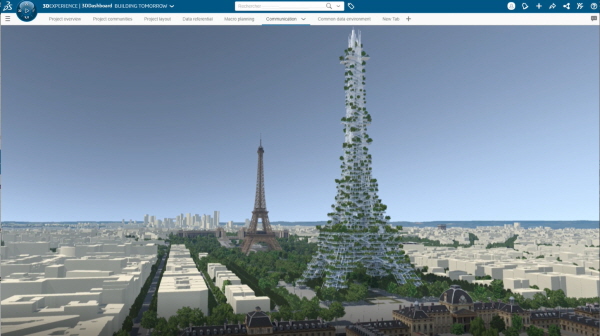
Dassault Systèmes’ 3DEXPERIENCE platform virtual twin technology is being utilized for virtual design for urban regeneration, and is expected to be highly useful in future large-scale infrastructure projects.
Dassault Systèmes announced on the 20th that it has recreated the Eiffel Tower to show how virtual worlds can lead changes in cities and infrastructure for a sustainable future, 130 years after the Eiffel Tower was built.
The 'Building Tomorrow' team assembled a team of Dassault Systèmes experts from various industries to use the 3DEXPERIENCE platform to design and build a low-carbon, circular, and renewable version of the Eiffel Tower to address major sustainability issues such as accelerated urbanization, greenhouse gas emissions, and energy consumption.
This project brings together public institutions, engineers, architects, logistics experts, and construction contractors in a new way to enable more circular practices across the value chain that have a positive impact at all scales and improve the quality of life.
Starting from a design by architect Nicolas Lasine, the team used the 3DEXPERIENCE platform to create a virtual twin Eiffel Tower consisting of a vertical garden decorated with 18,038 trees (equivalent to the number of metal parts in the Eiffel Tower), a 5,500-square-meter greenhouse and garden shed, 451 plant species, and 200 experimental and shared gardens.I heard.
Through the experience of a virtual twin Eiffel Tower equipped with real-time data-driven insights across the value chain, the team demonstrated that large-scale infrastructure projects can be built more sustainably through co-design among all stakeholders, optimized operations and resource management, low-carbon manufacturing of materials, sustainable logistics planning, and productized construction.
The 'Building Tomorrow' team analyzed the impact of shadows, airflow, and heat on neighbors under various construction scenarios at the same height as a virtual Eiffel Tower and modeled the water consumption of vegetation.
In addition, sourcing, transportation, and manufacturing processes for the structure were optimized without affecting the strength and performance of the steel, and the productization principles of the manufacturing industry were applied to the design and construction processes.
Dassault Systèmes’ Life Cycle Assessment solution played a key role in the team’s strategic decision-making by assigning environmental impact scores to each process along the lifecycle, from raw material sourcing to finished product delivery.

Comments
Related news
Dassault Systèmes to Host '3DEXPERIENCE Conference 2022'
Dassault Systèmes presents the direction of digital innovation with sustainability accelerated through Virtual Twin as the theme.
2022.08.22by 배종인 기자
Dassault Systèmes: "3D Experience Works 2023 Leads Business Innovation"
Dassault Systèmes is expected to lead innovation in future business environments through '3D Experience Works 2023', which enables design, manufacturing, service, and marketing to be conducted seamlessly on the web in a single integrated platform.
2022.10.13by 배종인 기자
Dassault Systèmes Accelerates Hydrogen Aircraft Development
Dassault Systèmes announced that Blue Spirit Aero, a France-based aviation company utilizing hydrogen fuel cell technology, is accelerating the development of a hydrogen-electric general aviation aircraft and proceeding with certification for affordable clean aircraft using Dassault Systèmes' cloud-based 3D Experience platform.
2022.12.12by 배종인 기자

Korea Instrument, KOLAS Accredited Calibration Agency First to Simultaneously Acquire ISO/IEC 27,001·27,701
Korea Instrument has become the first among KOLAS accredited calibration agencies to simultaneously acquire ISO/IEC 27,001 and ISO/IEC 27,701 certifications. Through its proprietary platforms CWIZ Enterprise and CWIZ Partners, the company has embedded information security and personal data protection requirements across all business processes including customer information, equipment data, and calibration reports, with plans to continuously advance its management system through regular audits and security inspections.
2026.10.12by 배종인 기자
TeamViewer One, IT Incident Automation Workflow and Resolution Center Enhanced
TeamViewer has added IT incident automation capabilities and an advanced Resolution Center to its integrated digital workplace management platform 'TeamViewer ONE'. Recurrent service disruptions, configuration errors, and capacity shortages are automatically handled according to preset policies, and device status verification through script deployment can be managed in a unified interface, significantly reducing repetitive tasks for IT teams.
2026.10.12by 배종인 기자











