



[Planning] How to shorten BMS development time?
 Published2023.01.03 10:06
Improvement of BMS using French shaft MathWorks MATLABⓡ·Simulinkⓡ
Reduce software development time and improve quality by utilizing modeling and simulation
[Editor's Note] Last August, record-breaking heavy rain in the central region, including Seoul, caused power outages throughout the city. According to an announcement by the Korea Electric Power Corporation, as of August 2022, approximately 12,000 households were affected by the power outage. As domestic power instability due to abnormal weather increases, voices are growing louder to secure emergency power to prevent work interruptions and data loss due to sudden power outages in homes, hospitals, data centers, and industrial plants, and demand for UPS (Uninterruptible Power Supply) devices that continue to supply power for a certain period of time even during a power outage is increasing. As demand for UPS increases, the development of BMS that optimally manages the status of UPS has become important. In the past, BMS development took a long time because it was conducted by directly testing embedded hardware, but recently, development using software simulation is being seen to shorten development time and reduce costs. Here, we looked at ways to shorten the BMS development period and prevent design errors in advance through the case of Saft, a French battery company that used MathWorks MATLAB® and Simulink® for BMS development.
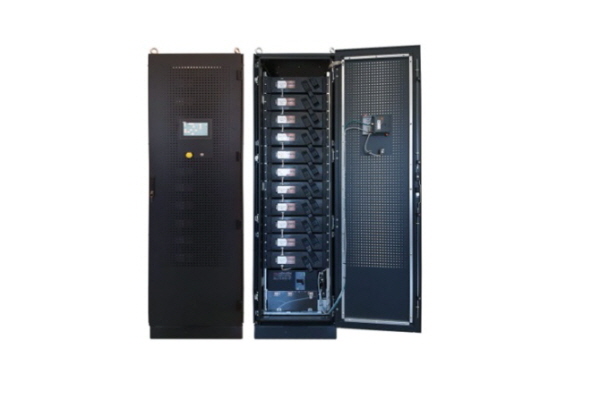
▲Saft Flex'ion Gen2 Battery System for Data Centers and Critical Applications
■ Saft, BMS Improvement with MathWorks MATLAB and Simulink
Saft, a battery manufacturer and subsidiary of France’s largest oil company TotalEnergies, broke away from traditional approaches and adopted model-based design using MATLAB® and Simulink® from MathWorks during the development of the BMS (battery management system) for its Flex’ion Gen2 uninterruptible power supply.
Saft's traditional development approach was to code software directly in C, compile it, and then run tests directly on embedded hardware.
This testing approach had the disadvantage of being difficult to debug because it could not distinguish whether the error was in the software or in previously untested hardware.
Additionally, because it was difficult to conduct testing until the hardware was ready, engineers often found requirements-related issues close to the project deadline.
Errors discovered this late increase project costs and are more difficult to fix, which risks delaying product launches.
Saft adopted MATLAB and Simulink from MathWorks to solve these problems.It has been shown that early verification of design models prior to hardware testing has shortened development and certification times, and models that meet UL (Underwriters Laboratories Inc.) 1998 and other functional safety standards have been implemented.
■ Reduce software development time and improve quality by utilizing modeling and simulation functions
Saft used Simulink to develop a plant model of the hardware, including DC-DC converters, circuit breakers, inverters, and sensors.
They created a model of the battery cell and replicated this model for each of the 224 cells in the battery system, creating several variants.
Afterwards, simulation capabilities were utilized to verify the application software model.
During this simulation process, we identified untested model elements and successfully shortened the simulation time by developing a test suite containing more than 1,500 test cases through simulation automation.
Model-based design has been shown to reduce the time required to develop and certify BMS software by more than 50%.
Saft also used Simulink Coder to generate C code from the plant model and then performed hardware-in-the-loop (HIL) testing.
Hardware-in-the-Loop (HIL) testing is a real-time simulation that allows testing of embedded code without system hardware, allowing prediction of abnormal and fault conditions that could damage hardware if the code being developed does not operate within specifications.
In the traditional development method, there is a limited number of software tests. Whereas we could only run test cases, with MathWorks' Model-Based Design we can now run hundreds of desktop simulations and HIL test cases over and over again.
This allows for earlier detection and identification of problems that would have been difficult to find previously, leading to more sophisticated software models.
■ Battery with improved quality and industry-certified standards, made possible with MATLAB and Simulink
Saft was able to quickly identify errors in its design models because it modeled both its application software and its plants in Simulink, which not only improved product quality but also helped it achieve UL 1998 safety certification.
As various companies, government offices, and industrial plants actively seek to secure emergency power sources, many battery companies are accelerating the development of UPSs (uninterruptible power supplies) equipped with batteries that boast better performance.
Accordingly, demand for computing platforms such as MathWorks' Simulink and MATLAB, which provide modeling and simulation capabilities, is expected to increase.
“The main challenges in developing a BMS (battery management system) are reducing the time required for each development cycle and configuring a product that meets the functional safety certification standards presented by the industry,” said a MathWorks official. “Simulink, MathWorks’ model-based design environment, has the advantage of discovering and resolving issues in the early design stage to secure high system reliability, prevent design errors in advance, and thereby reduce the overall verification time and cost.”

Comments
Related news

MATLAB/Simulink R2021a Announced with Enhanced Communication Verification Features
MathWorks has announced Release 2021a of its MATLAB and Simulink product families. This update adds or improves hundreds of features. In MATLAB, users can now dynamically control live scripts and add plots to live scripts without writing code. In Simulink, C code can be imported into reusable Simulink libraries to accelerate simulation speed.
2021.03.17by 이수민 기자

[Interview] Jong-su Lim, CEO of Sujin, “High reliability of motor control and Simulink-based modeling”
[Editor's Note] Motor control technology is one of the essential technologies used across various industries including △smart factories △electric vehicles △drones △robotics. Although it is being utilized in many aspects of industrial applications and product development, the current situation is that development is being conducted by following previously developed materials and content, which results in considerable time being required to resolve problems when they occur. The industrial motor control technology conference hosted by e4ds has created an opportunity to enhance developers' understanding and technical expertise by presenting core theories for motor control and demonstrations of technologies applied in the field such as MATLAB and Simulink. In this regard, we had an opportunity to meet with Lim Jong-soo, CEO of Su-jin, who was invited as a speaker.
2022.06.23by 명세환 기자

[Interview] Professor Lee Taek-gi of Hankyung University, “Understanding Motor Characteristics is a Priority for Motor Control”
[Editor's Note] Motor control technology is one of the essential technologies used across various industries including smart factories, electric vehicles, drones, and robotics. Despite being utilized in diverse industrial fields and product development, development is often based on existing materials and content, resulting in significant time consumption when problems arise. The Industrial Motor Control Technology Conference hosted by e4ds has established a venue to enhance developers' understanding and technical expertise by presenting core theories for motor control and demonstrating technologies and demos applied in the field, such as MATLAB and Simulink. We met with Professor Lee Taek-ki from Hankyong National University (Chairman of the Power Electronics Society), who was invited as a speaker, to discuss the matter.
2022.06.23by 명세환 기자
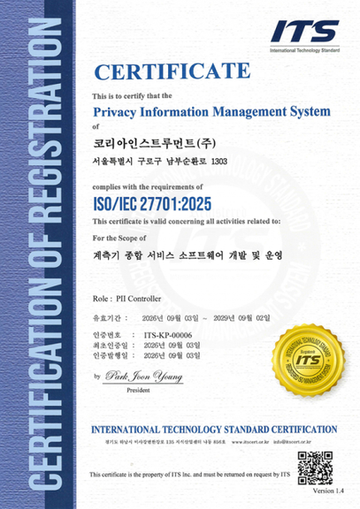
Korea Instrument, KOLAS Accredited Calibration Agency First to Simultaneously Acquire ISO/IEC 27,001·27,701
Korea Instrument has become the first among KOLAS accredited calibration agencies to simultaneously acquire ISO/IEC 27,001 and ISO/IEC 27,701 certifications. Through its proprietary platforms CWIZ Enterprise and CWIZ Partners, the company has embedded information security and personal data protection requirements across all business processes including customer information, equipment data, and calibration reports, with plans to continuously advance its management system through regular audits and security inspections.
2026.10.12by 배종인 기자

TeamViewer One, IT Incident Automation Workflow and Resolution Center Enhanced
TeamViewer has added IT incident automation capabilities and an advanced Resolution Center to its integrated digital workplace management platform 'TeamViewer ONE'. Recurrent service disruptions, configuration errors, and capacity shortages are automatically handled according to preset policies, and device status verification through script deployment can be managed in a unified interface, significantly reducing repetitive tasks for IT teams.
2026.10.12by 배종인 기자











