


A method to restore distorted images without expensive equipment has been developed
 Published2023.01.04 09:07
.jpg)
▲Professor Park Jeong-hoon's team that led this research
A method for restoring distorted images without expensive equipment has been developed, and is expected to be applied to high-quality images for autonomous driving and observation of the inside of living animals.
UNIST (President Yong-Hoon Lee) announced on the 4th that a research team led by Professor Jeong-Hoon Park of the Department of Biomedical Engineering recently developed a method to restore high-resolution images using information hidden in distorted images, and published it in the international academic journal 'Laser & Photonics Reviews' on the 1st.
'Adaptive optics technology' that corrects image distortion is already being used in the field of astronomy and space science. It corrects starlight distorted by the atmosphere to observe the universe clearly.
On the other hand, this technology requires expensive specialized equipment such as a wavefront meter or wavefront controller, making it difficult to use in everyday life to overcome image distortion.
Meanwhile, the method developed by Professor Park Jeong-hoon's team can restore distorted images without expensive specialized equipment.
First, we divided the distorted image into the ‘resolution-lowering component’ and the ‘component that only changes position.’ Then, we removed the effect of the position change using a computer. All positional components are moved and placed in place based on one image. In this state, only the components that reduce the resolution can be collected and the average value can be obtained. This is a concept of finding the average of random resolution-degrading cause factors and removing them, and only the information of the actual object is extracted to restore the high-resolution image.
Phenomena obscured by fog, smoke, or haze are captured using videos shot over time. “Videos are created by combining multiple images over time,” said the first author, Dr. Byungjae Hwang of UNIST’s Department of Biomedical Engineering. “Even though there are different distortions in each scene, the necessary information is hidden, so we can extract it to obtain a clear image.”
The developed method can also be applied to objects with much higher light scattering, such as biological tissues. In this case, the degree of distortion can be used to arbitrarily divide the 'space' of an image to obtain necessary information. It is to collect image information that is fragmented into each space, calculate the average value, and process it as a function.
Professor Park Jeong-hoon said, “Image distortion caused by the atmosphere or biological tissue changes randomly over time and space, and this phenomenon is closely related to our daily lives.” He added, “The technology developed this time can be applied to stable autonomous driving even in bad weather, as well as remote surveillance and astronomy.”
He continued, “Furthermore, we have presented a method to observe the interior of living animals in high resolution and detail,” adding, “It will help enable non-invasive observation of life phenomena.”
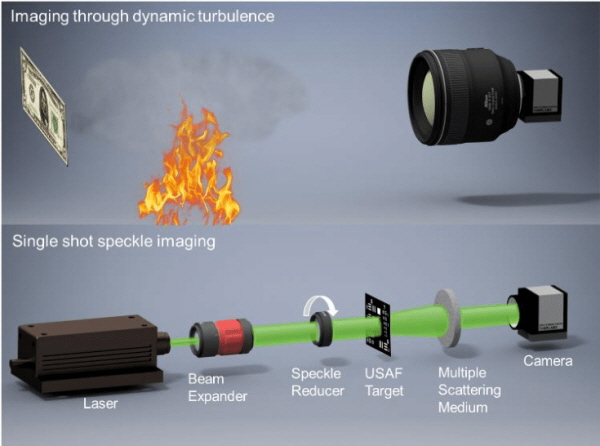
▲The figure shows the principle of generating the distorted image used in the experiment: The image distorted by smoke (top) uses hidden information in the image taken with a gap in ‘time’, and the image scattered by the object (USAF Target) obscured by an obstacle (Multiple Scattering Medium) (bottom) is restored using hidden information distorted in ‘space’.

Comments
Related news
ESP32 Development Environment Selection and GPS Application Implementation
The ESP32 is a microcontroller that integrates Wi-Fi, Bluetooth, 12-bit ADC, capacitive touch, PWM, DAC, and UART in a single SoC. However, the abundance of features does not by itself solve the designer's problems. The real challenges lie in selecting the appropriate development environment, determining which pins can be used and which must be avoided, and converting raw data from modules into usable information. This document addresses ESP32 peripheral constraints (ADC2 and Wi-Fi coexistence limitation, UART1 occupancy, ADC non-linear regions), the trade-offs between Arduino IDE and ESP-IDF, and the process from connecting NEO-6M/NEO-M8N GPS modules to UART2, parsing NMEA sentences, and visualizing routes in Google Earth, all organized based on documented references.
2026.10.12by 편집부

[e4ds Tech Day 2026 ⑨] Sim Sang-gyu, Autocrypt CTO: "In the Physical AI Era, Automotive Security Must Extend Beyond the Vehicle"
At e4ds Tech Day 2026, Sim Sang-gyu, CTO of Autocrypt, explained automotive cybersecurity strategies in the era of Physical AI and SDV (Software-Defined Vehicle). Automobiles are evolving as part of an ecosystem connected to AI, cloud, chargers, IoT, and robots, and he emphasized that the scope of security must expand beyond the vehicle interior to the entire connected environment. In particular, AI model tampering, adversarial attacks, OTA updates, and EV charger hacking were identified as major threats. He explained that response measures require zero trust, AI model integrity protection, intrusion detection, Security by Design and Default, and full lifecycle security management, and that proactive security system establishment beyond regulatory compliance is critical for securing future mobility competitiveness.
2026.10.12by 배종인 기자

Practical HIL Construction Strategy for Automotive and Off-Highway Controller Validation
As vehicle E/E architecture transitions to zonal structures and shifts to software-defined vehicles (SDV), the number of controllers (ECUs) requiring validation and software complexity are surging dramatically. Meanwhile, real vehicle testing cannot provide repeated verification under identical conditions and entails lead time and safety concerns. This white paper explains the principles of HIL (Hardware-in-the-Loop) validation and the structure of the NI platform composed of PXI, SLSC, and VeriStand, and through two actual implementation cases—Camera Record & Replay HIL for In-Cabin Monitoring Controller (ICMU) and Forklift Controller (VCU) HILS—describes how controller-level regression testing becomes possible. Additionally, it explicitly states application boundaries and limitations, such as lack of A2B support.
2026.10.12by 편집부
MIPI CSI-2, DSI-2, C-PHY, D-PHY Test Solution Technical White Paper
The MIPI interface adopts a burst mode that transitions between low-power (LP) and high-speed (HS) states for low-power consumption, and in return, strict timing rules are imposed on state transitions. Additionally, the high-speed section operates as a packet-based protocol with headers, ECC, and CRC, so verification engineers must handle waveforms and protocols simultaneously. Traditional configurations combining general-purpose oscilloscopes and AWGs reveal limitations in setup complexity, measurement uncertainty, and lack of reproducibility when faced with these requirements. This white paper, based on webinar materials, organizes the structure of this problem and describes how the SV5C-DPTXCPTX generator for receiver testing and SV5C-DPRXCPRX analyzer for transmitter testing integrate state transition testing, stressed eye testing, and protocol analysis into a single bench, along with their application boundaries.
2026.10.12by 편집부

NVIDIA to Invest $1 Billion in U.S. Science Over Next Five Years
NVIDIA has announced plans to invest $1 billion over the next five years to strengthen U.S. scientific and technological competitiveness. The company will enhance cutting-edge artificial intelligence research and development capabilities in key areas including quantum computing, healthcare, and energy security, while expanding support for higher education research institutions and cloud service providers. NVIDIA is participating as a major industry partner in the White House Office of Science and Technology Policy's Genesis Mission, and is promoting supercomputer construction in collaboration with national laboratories including Argonne and Los Alamos.
2026.10.12by 배종인 기자











