



SKT and Nokia Successfully Demonstrate 5G OpenRAN Virtualized Base Station
 Published2023.01.10 14:50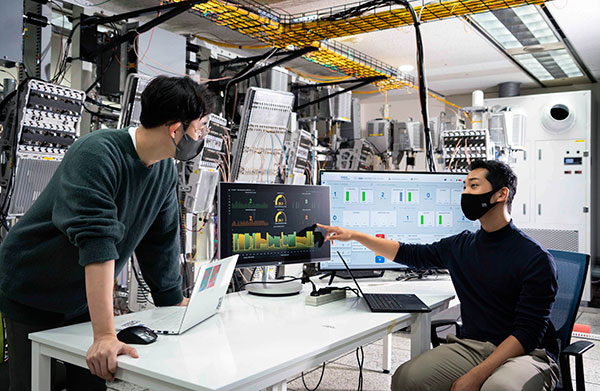
▲SKT researchers testing a solution for use in traffic congestion situations.
Leveraging intelligent open LAN technology to control traffic distribution.
Intelligent Base Station Control Unit: Efficiently Managing Large-Scale Traffic
SK Telecom and Nokia have successfully installed an OpenRAN virtualized base station in a commercial network, accelerating the advancement of 5G and the development of 6G.
SK Telecom announced on the 10th that it has installed a cloud-based Open RAN virtualized base station with Nokia on its commercial network and confirmed stable 5G service speed and coverage performance through field tests.
Open Radio Access Network (OpenRAN) is a technology that separates the hardware and software of mobile communication equipment such as base stations and standardizes the interface between the equipment to enable equipment from different manufacturers to work together.
SKT and Nokia have been jointly conducting research on OpenRAN base stations, including developing a cloud-based virtualized base station linked with 5G 64 TRx equipment early last year. This was the first time this was installed on a commercial network in Korea, demonstrating 5G performance. The two companies added that they plan to continue research to improve 5G performance with open LAN base stations in the future.
Additionally, the two companies have successfully developed and verified a Radio Access Network Intelligent Controller (RIC) capable of automatic traffic optimization.
The company announced that it has confirmed an improvement in the quality of 5G services by developing a technology to distribute traffic between base stations and a technology to optimize packet delay time depending on the type of service and applying it to an intelligent base station control device.
Intelligent base station control systems collect real-time data on the number of concurrent users and traffic volume for each base station, distributing traffic from heavily loaded base stations to neighboring base stations. For example, they can efficiently manage traffic in spaces with high traffic volumes, such as large stadiums and concert halls, providing stable service and improving the quality of experience.
In an open LAN environment, various software can be utilized on base stations implemented with general-purpose hardware. By optimizing and modularizing the software installed in the base station, various functions can be selectively applied or executed, enabling efficient equipment operation.
Additionally, OpenLAN technology allows networks to be built without being tied to a specific manufacturer, and allows for customized software selection or application of cloud-based AI services to the network to meet customer needs.
Meanwhile, SKT is continuing research and activities to lead the ecosystem of Open RAN, which will be a core technology for the evolution of 5G services and the foundation of networks in the 6G era.
In addition to this demonstration, the company participated as a host company in last year's PlugFest event hosted by the O-RAN Alliance, where it presented various demonstration results on base station equipment compliant with O-RAN standards. The company is also expanding its role as co-chair of the "6G Requirements and Services" section of the O-RAN Alliance's Next Generation Research Group (nGRG). The company is also collaborating with Japan's Docomo, signing an MoU with the group last November.
SKT plans to establish a foundation for small and medium-sized enterprises with technological capabilities to participate in the network equipment market by ensuring smooth interoperability between equipment from major manufacturers through open LAN in the future.
Ryu Tak-gi, head of SKT’s infrastructure technology division, said, “Open LAN is important for evolving into an intelligent network in the AI era, and it is also a core technology necessary for the 5G advancement process and 6G services.” He added, “We plan to continue our efforts to lead open ecosystem-related technologies with global partners and create opportunities for capable domestic small and medium-sized equipment companies to grow.”
Comments
Related news
SK Telecom, SK Square, and Hana Financial Group Promote ICT-Finance Cooperation
SKT and Hana Financial Group exchanged a large-scale stake worth approximately 400 billion won in July and concluded a strategic partnership, after which SK Square also participated to establish a synergy council. The three companies will advance cooperation in three key areas: △future joint response through ultra-collaboration △creation of new customer value through business cooperation △expansion of positive influence through cooperation in creating social value.
2022.11.21by 김예지 기자
SKT's 'UAM Linkage Technology' Approved as Global Standard Project
SK Telecom has had its proposed 'UAM Service Interworking Structure and Method for Stable UAM Service Environment' approved as a standard project in ITU-T's Study Group 11 (SG11).
2022.12.08by 김예지 기자
SKT Enters U.S. Terrestrial Broadcasting with '5G MEC'
SK Telecom successfully conducted terrestrial broadcast transmission on the 28th (local time) utilizing MEC and virtualization technologies in collaboration with US-based Sinclair and CastDotEra, a media tech company under SK Square.
2022.12.29by 김예지 기자
[Feature] UAM Industry Trends, 2023 Outlook
With the government's target for commercialization in 2025, the global competition to secure a foothold in the urban air mobility (UAM) market is expected to intensify in the new year. <br><br>Urban air mobility (UAM) is an aerial mobility service based on electric-powered aircraft. It is drawing attention as an eco-friendly transportation mode capable of vertical takeoff and landing without runways in urban areas and capable of connecting with various ground transportation means. It will become a concentrated embodiment of cutting-edge technologies from diverse industry sectors including aviation, automotive, and energy. <br><br>#UAM #AAM #K-UAM #SKT #KT #Hyundai Motor #Supernal
2023.01.06by 김예지 기자
European Patent Applications Surpass 200,000 for the First Time… South Korea Maintains 5th Place, Led by Batteries and Telecommunications
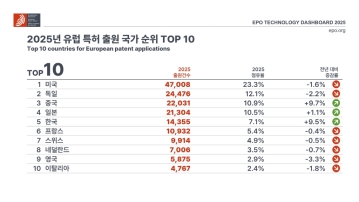
According to the European Patent Office (EPO)'s 'Technology Dashboard 2025', European patent applications last year reached 201,974, surpassing 200,000 for the first time. Korean companies and inventors filed 14,355 applications, representing a 9.5% increase from the previous year and maintaining 5th place by country. Battery, digital communication, and semiconductor technologies led the growth, with Samsung ranking as the top EPO applicant for the second consecutive year and LG reaching 3rd place. The presence of major domestic cities such as Seoul, Suwon, and Yongin was also confirmed. It was also revealed that Korea's European patent strategy is expanding beyond individual technologies to span the entire industry.
2026.03.24by 명세환 기자











