



Akamai: Online shopping security during the holiday season is a must.
 Published2023.01.16 15:16
Cloud company Akamai is expected to help prevent cybercrime by analyzing consumer cases where security issues may arise during online holiday shopping and suggesting solutions.
Cloud company Akamai (Akamai Korea CEO Lee Kyung-jun) presented five types of cyber hacking and prevention methods for online shoppers during the Lunar New Year holiday on the 16th.
The first type is the planned shopper. Because planned shoppers plan their purchases months in advance, they often store credit card information, login information, and other personal information on shopping websites.
The most important attack method to watch out for is credential stuffing, where attackers use lists of compromised user credentials and infiltrate systems via malicious bots. To prevent this, be cautious when storing payment information on shopping websites and set a different password for each site to ensure secure password management.
The second type are last-minute shoppers. They are successful at finding bargains, but always at the very last minute.
Phishing is a type of attack that you should be wary of. Verify the validity of a website before clicking on it or providing personal information, and be wary of potential hacking if the email is unsolicited.
The third type is the bargain hunter, who searches various sites to find the lowest price.
The most common attack method to watch out for is social engineering, which can involve clicking on spoofed emails or downloading malicious extensions that act as price comparison tools. As a preventative measure, always check that the offer is valid and that the sender is legitimate, and use a proper spam filter in your email as a first step to avoid suspicious files and links.
The fourth is impulse buyers. Driven by emotion, impulse buyers often order products they hadn't originally planned to buy.
The most important attack method to be wary of is brand spoofing. To avoid this, carefully check the links provided in emails and be wary if they are not secure or lead directly to third-party sites unrelated to your brand.
Finally, research shoppers extensively compare products and discounts before making a purchase. They often install various browser extensions to facilitate quick comparisons.
The most dangerous attack method is extension malware, where cybercriminals hide viruses behind advertisements to trick users into installing them, collect their browsing history, and disguise themselves as known apps and extensions to obtain login credentials.
As a preventative measure, only install extensions from the official web store, and do not install any extensions if you are suspicious of the required permissions.
"It's not surprising that attackers are looking to exploit the surge in online retail activity during the long shopping season," said Dean Houari, Akamai's Director of Security Technology and Strategy for Asia Pacific. "Asia, in particular, accounts for approximately 60% of global e-commerce sales, making it a lucrative market for attackers." “It is important for shoppers and businesses to work together to learn how to be aware of scams and protect themselves,” he stressed.
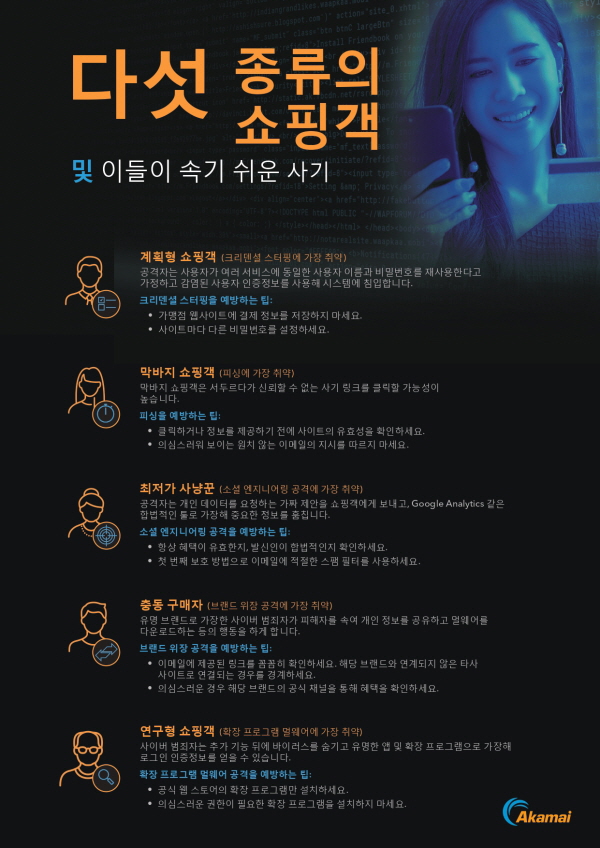
▲Five types of shoppers and the scams they are prone to

Comments
Related news
.png)
Databricks Unveils Open AI Security Monitoring 'Lakewatch'
Databricks entered the security market on March 24 by unveiling LakeWatch, an open-source agentic SIEM. The core functionality of this product is to integrate and analyze security, IT, and business data in a single environment to support AI-based threat detection and investigation. The company explained that it reduces the limitations of existing security operations centers, which have had to forgo some data due to high cost structures, and enables large-scale data analysis and automation based on open formats and ecosystems. LakeWatch is currently offered as a private preview, with Adobe and Dropbox mentioned as early customers. Databricks also announced an expanded partnership with Anthropic as well as the acquisition of Antimatter and SiftD.ai.
2026.03.26by 배종인 기자
Kaspersky Unveils Revamped 'NEXT' Combining SOC Integrated Management and AI Analytics
As enterprises increase demand for integrated management and automation in the construction and operation of Security Operations Centers (SOC), Kaspersky has disclosed updates to its B2B security product suite 'Kaspersky Next'. This update expands EPP, EDR, XDR, and SIEM integration through a single console based on OSMP, incorporates AI capabilities such as DLL hijacking detection and suspicious account takeover behavior identification, and includes integration with generative AI assistant tool KIRA. The company stated that in large-scale deployment environments, EDR Expert can reduce resource requirements by up to 30%, and XDR Expert by up to 60%.
2026.03.25by 배종인 기자
Samsung Electronics Smart Monitor Acquires First International Certification… Expanding Application Scope Following TVs
Samsung Electronics has received Common Criteria (CC) certification for 'Samsung Knox,' a security solution applied to its 2026 smart TVs and smart monitors. The smart TV has achieved certification for 12 consecutive years, while the smart monitor obtained industry-first certification this time. The evaluation was conducted focusing on core functions including kernel integrity monitoring, phishing site blocking, and unauthorized execution prevention. The company plans to expand the scope of security certification beyond TVs to monitors, responding to growing personal information protection requirements as connected devices proliferate.
2026.03.25by 배종인 기자
Teori Selected as AI Voucher Supplier… Supplying LLM Security Solutions
Cybersecurity company Theori has been selected as a supplier for the 2026 AI Voucher Support Program. The company plans to address information leakage and regulatory compliance issues that arise during generative AI adoption through its LLM security solution 'AlphaPrism'. The solution is designed to analyze the context of prompts and source code to identify sensitive information such as personal data and authentication keys, and to continue AI utilization through masking methods rather than simple blocking. The government's AI Voucher Program supports demand enterprises with up to 200 million won per project for solution purchase costs. Based on recent application cases at POSCO DX, Theori plans to respond to expanding demand for enterprise AI security.
2026.03.24by 명세환 기자
Cisco Unveils Agentic AI Security Framework at RSAC 2026
Cisco announced security capabilities targeting the entire process of enterprise AI agent adoption at RSAC 2026 held in San Francisco, USA. The core approach involves applying identity management and the principle of least privilege to AI agents similar to humans, testing for attack vulnerabilities before deployment, and automating threat detection and response through Splunk-based security monitoring during operations. Cisco also unveiled the "AI Defense: Explorer Edition" security validation tool for developers, the open-source framework "DefenseClose," and agent-type SOC functionality. As pilot deployments are increasing but actual operational transitions remain limited, this announcement is interpreted as focusing on how enterprises can implement security frameworks during the commercialization process of AI agents.
2026.03.24by 명세환 기자











