


ETRI Unveils Cancer Diagnosis Technology Earlier Than CT and MRI
 Published2023.01.19 11:37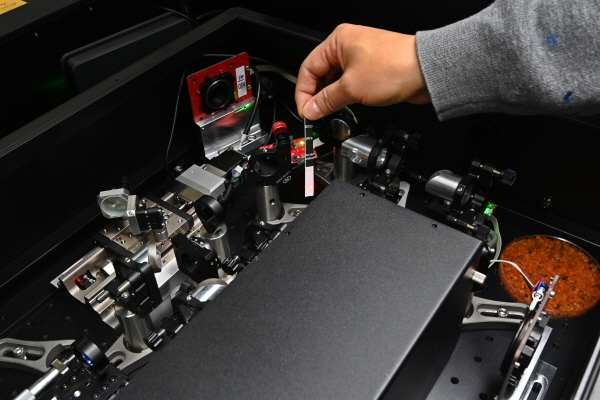
▲ Femtosecond laser CARS Raman microscope developed by ETRI by combining diodes
Price 1/10 of foreign products, rapid commercialization expected
Domestic researchers have developed the world's first real-time Raman molecular vibration imaging technology (CARS) based on a femtosecond laser combined with a semiconductor light-emitting diode. It is possible to provide specific images in real-time based on the type of chemical binding to intracellular targets, which is expected to be useful for future cancer diagnosis or new drug development.
The Electronics and Telecommunications Research Institute (ETRI) announced on the 19th that it has developed 'nonlinear Raman molecular vibration imaging technology' by fabricating a femtosecond laser using a diode coupling method for the first time in the world.
It is expected that rapid commercialization will be possible by completely localizing foreign technology and simultaneously lowering the price to one-tenth of the current level.
A femtosecond laser-based Raman molecular vibration optical microscope is a device that observes the movement of molecules in femtosecond units, which is one quadrillionth of a second.
In particular, a major advantage is that it does not use fluorescent materials, so there are no limitations on observation time and no side effects associated with changes in characteristics.
CT and MRI have been widely used to diagnose various diseases, including cancer.
On the other hand, CT and MRI are used after abnormal lesion tissue has developed.
For a pathological diagnosis, an optical cytology examination, which requires additional staining, was also necessary.
The CARS microscope developed by the research team is intended for early diagnosis before lesions develop.
In addition, it is possible to visualize the state of specific smaller molecules, such as cancer markers (CH2), within cell tissues without staining, making it usable before the onset of disease.
In other words, by observing a sample with a microscope equipped with this technology, it is easy to determine whether it is normal tissue or cancerous tissue.
It was stated that the molecular state of cells can be understood in detail through components such as cancer markers by comparing reflected and transmitted 2D/3D images with Raman spectroscopic signals.
The nonlinear molecular vibration imaging technology developed by ETRI incorporates diode-based femtosecond laser technology, high-precision optical system technology, and microscope automation technology.
thatWhile foreign-made CARS microscopes have excellent performance, they have the disadvantage of being expensive (around 1 billion won) and about twice the size of a desk, as they consist of two lasers.
The research team significantly lowered the commercialization price to within 10% by developing laser technology worth millions of won, and reduced the size to less than half of the existing size by using a single laser.
They explained that upon commercialization, the size could be reduced to about twice the size of a laptop.
In addition, this imaging technology is being prepared for future transition to endoscopy.
The research team also increased the laser output fivefold from the existing laboratory level (200mW) to 1W, maintaining performance at a world-class level and raising the possibility of commercialization within six months.
This imaging technology exhibited a scan speed of 7.5 frames per second at a resolution of 1,024 x 1,024 pixels.
It has four times higher resolution than foreign technology and up to four times faster image analysis.
It is possible to transmit 7.5 frames of video per second, allowing for immediate viewing of real-time samples and seamless video analysis.
In addition, by using a resonant-galvano-scan mirror that is faster than the galvano-galvano-scan mirror applied in foreign equipment, the world's fastest Raman molecular vibration imaging acquisition time was achieved.
Dr. Song Dong-hoon of the Diagnostic and Therapeutic Devices Laboratory at ETRI said, “By implementing nonlinear Raman molecular vibration imaging with a single low-cost femtosecond laser, we have overcome the limitations of conventional Raman imaging acquisition time, bringing us closer to commercialization through real-time implementation and reduced manufacturing costs.”

Comments
Related news
ETRI Localizes World-Class GaN Power Devices
Domestic researchers have successfully developed gallium nitride (GaN) power devices, which are considered key components for next-generation semiconductors, using purely domestic technology, and this is expected to significantly contribute to enhancing the competitiveness of Korea's semiconductor industry and securing technological leadership.
2022.09.22by 배종인 기자
ETRI to Release Expanding Displays
Domestic researchers have developed elastic inorganic semiconductor device technology for implementing stretchable displays that can be stretched like rubber bands, and it is expected to lead the next-generation display semiconductor field in the future.
2022.12.08by 배종인 기자
ETRI Develops Ultra-High-Speed Optical Input/Output Semiconductor Using Light
The Electronics and Telecommunications Research Institute (ETRI) has developed a silicon photonics optical semiconductor chip and related modules capable of transmitting data at 100 gigabits per second (100Gbps) in next-generation data centers and high-performance computing networks.
2022.12.22by 배종인 기자
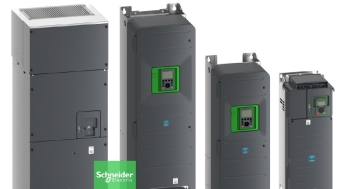
Schneider Aims for Building Energy Savings and Operational Stability with Next-Generation HVAC Drives
Schneider Electric has unveiled its next-generation HVAC drive product line 'Altivar HVAC'. The new product line's key features center on enhanced energy savings, system operational stability, and building management system integration. The products are divided into 'ATH200' for OEM and small equipment applications, and 'ATH600' for environments requiring continuous operation and advanced control. The company plans to expand the application scope from commercial buildings to facilities where HVAC system stability is critical, such as hospitals, airports, and data centers. The announcement includes over 30% energy savings, operation from -10°C to +60°C, Modbus and BACnet support, and compatibility with low global warming potential refrigerants.
2026.03.26by 명세환 기자
Ecolab Expands AI Data Center Cooling Business Through Acquisition of CoolIT
Ecolab has agreed to acquire CoolIT Systems, a liquid cooling company for AI data centers, for approximately $4.75 billion. The transaction is expected to close by Q3 2026, subject to regulatory approvals. CoolIT has been supplying direct-to-chip cooling-based coolant distribution units, cold plates, and manifolds, serving hyperscale data centers and colocation operators as customers. This acquisition is a measure to address the high-heat and high-density server environments created by AI proliferation. Ecolab plans to combine its water management and digital monitoring capabilities with CoolIT's hardware technology to expand its data center cooling business.
2026.03.26by 명세환 기자











