



Rapid Cancer Diagnosis 'Sensor' via Urine Developed
 Published2023.01.25 14:54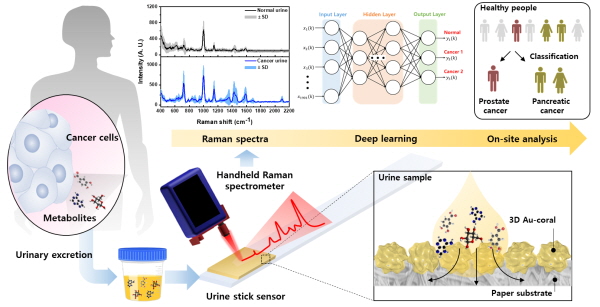
▲ Schematic diagram of the 'Development of a Strip-Type Urine Sensor for Optical Signal Amplification of Metabolites in Urine and Point-of-care Cancer Diagnosis Technology' developed by Dr. Ho-Sang Jeong's research team at the Korea Institute of Materials Science.
A sensor capable of diagnosing cancer on the spot using urine has been developed, raising expectations that it will significantly reduce the mortality rate of cancer patients through the early diagnosis of intractable diseases.
The Korea Institute of Materials Science (KIMS, President Lee Jeong-hwan), a government-funded research institute under the Ministry of Science and ICT, announced on the 25th that a research team led by Dr. Jeong Ho-sang of the Nano Surface Materials Research Division, Professor No Jun-seok of POSTECH, and Professor Choi Sam-jin of Kyung Hee University College of Medicine have successfully developed a strip-type urine sensor capable of amplifying optical signals of metabolites in urine and diagnosed cancer on-site through joint research.
This technology enables the detection of prostate and pancreatic cancer without a separate analysis process, simply by collecting a small volume (10 uL) of urine at the time of need and irradiating it with light. The testing device is designed in a strip form to allow for rapid, high-sensitivity cancer diagnosis on-site.
The research team focused on the differences in the composition of metabolites present in the urine of cancer patients and healthy individuals. When cancer cells proliferate in the body, abnormal metabolism leads to the secretion of metabolites in the urine that differ from those of healthy people.
Distinguishing this as existing technology required expensive, large equipment, making field application difficult. The research team developed a surface-enhanced Raman scattering sensor that amplifies the optical signal of metabolite components in urine by more than 1 billion times by forming coral-shaped plasmonic nanomaterials on porous paper.
When urine is loaded onto the sensor and irradiated with light, cancer metabolite signals are amplified on the sensor surface, making it possible to diagnose cancer. The research team applied an AI-based analysis method to the acquired spectroscopic signals and succeeded in distinguishing between healthy individuals and patients with prostate and pancreatic cancer with up to 99% accuracy.
Many cancer diagnostic technologies currently in use detect the presence of cancer through blood tests or imaging methods and diagnose it via biopsy. Although many people strive to track the occurrence of cancer through annual health checkups, there are also many cases where cancer is discovered late, leading to delayed treatment or even death.
In particular, people in medical blind spots find it difficult to receive regular checkups, so cancer is often discovered only after it has already progressed significantly.
This study utilized urine, a biological sample that is easily obtainable by anyone. It can be applied to new cancer diagnostic methods using urine, point-of-care rapid cancer patient screening, and technologies for monitoring recurrence after cancer treatment.
In addition, since the production cost of strip-type sensors is less than 100 won per unit, they are expected to be utilized for mass inspection as well.
Senior Researcher Ho-Sang Jeong, the principal investigator, stated, “For cancers like pancreatic cancer, where diagnostic methods are not well known, detection is difficult, resulting in a low survival rate after initial diagnosis.” “It is known that 14 pancreatic cancer patients die in Korea every day, and the economic cost per person is around 63 million won per year,” he said. “Since early diagnosis is crucial for intractable diseases like cancer, we expect this technology to provide a new diagnostic method.”
This research achievement was carried out with support from the Korea Institute of Materials Science's major projects and the National Research Foundation of Korea's Nano and Materials Technology Development Project. In addition, the research results were published on January 9 in 'Biosensors and Bioelectronics' (IF: 12.5, JCR top < 3%), a world-renowned journal in the field of biosensors. The research team has filed related patents in Korea and the United States.
The research team is currently gradually expanding the types of cancer that can be diagnosed by analyzing the urine of patients with colorectal and lung cancer, starting with prostate and pancreatic cancer.

Comments
Related news
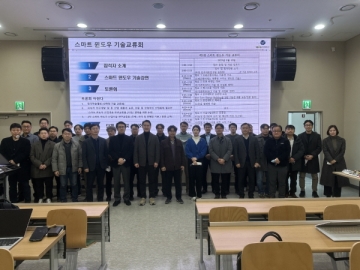
The smart window industry is gaining momentum.
The Korea Institute of Materials Science (KIMS, Director Lee Jung-hwan), a government-funded research institute under the Ministry of Science and ICT, held the "1st Smart Window Industry Technology Exchange Meeting" on the 10th at Konkuk University's Seoul campus.
2023.01.11by 배종인 기자
.jpg)
Twinwiz, a materials company, secured KRW 2.2 billion in investment, recognizing its future value.
TwinWiz, a research institute company under the Korea Institute of Materials Science (KIMS), a government-funded research institute under the Ministry of Science and ICT (Director Lee Jung-hwan), has attracted 2 billion won in pre-Series A investment in less than one year since its founding, despite the harsh investment climate.
2023.01.11by 배종인 기자
.jpg)
Strengthening Communication to Make Powder Industry a Hub
Yoo Ji-hoon, head of the Powder Materials Research Division at the Korea Institute of Materials Science (KIMS, Director Lee Jung-hwan), has assumed office as the 25th president of the Korean Society for Powder Materials.
2023.01.12by 배종인 기자
Schneider Aims for Building Energy Savings and Operational Stability with Next-Generation HVAC Drives
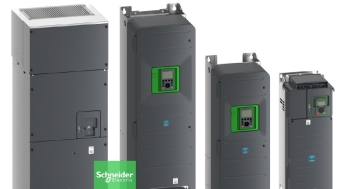
Schneider Electric has unveiled its next-generation HVAC drive product line 'Altivar HVAC'. The new product line's key features center on enhanced energy savings, system operational stability, and building management system integration. The products are divided into 'ATH200' for OEM and small equipment applications, and 'ATH600' for environments requiring continuous operation and advanced control. The company plans to expand the application scope from commercial buildings to facilities where HVAC system stability is critical, such as hospitals, airports, and data centers. The announcement includes over 30% energy savings, operation from -10°C to +60°C, Modbus and BACnet support, and compatibility with low global warming potential refrigerants.
2026.03.26by 명세환 기자
Ecolab Expands AI Data Center Cooling Business Through Acquisition of CoolIT
Ecolab has agreed to acquire CoolIT Systems, a liquid cooling company for AI data centers, for approximately $4.75 billion. The transaction is expected to close by Q3 2026, subject to regulatory approvals. CoolIT has been supplying direct-to-chip cooling-based coolant distribution units, cold plates, and manifolds, serving hyperscale data centers and colocation operators as customers. This acquisition is a measure to address the high-heat and high-density server environments created by AI proliferation. Ecolab plans to combine its water management and digital monitoring capabilities with CoolIT's hardware technology to expand its data center cooling business.
2026.03.26by 명세환 기자











