


Ministry of SMEs and Startups to Support Metaverse Factories
 Published2023.02.03 08:55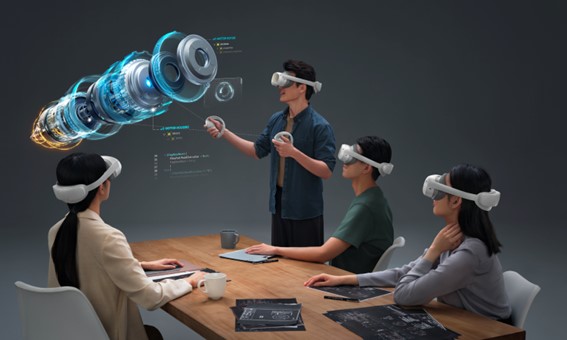
▲The future of XR solutions applied to manufacturing sites (Photo: PICO)
Process optimization and cleanroom remote control in a virtual factory
Overseas companies and some large corporations are strengthening their digital capabilities by building manufacturing infrastructure utilizing the metaverse. On the other hand, domestic small and medium-sized enterprises were unable to make any headway due to insufficient funds and technological capabilities, and a solution was proposed to address this.
The Ministry of SMEs and Startups announced on the 3rd that it will be promoting the 'Metaverse Factory Construction Support Project' to enable manufacturing SMEs to utilize the metaverse to optimize processes and transfer know-how from highly skilled workers.
The Ministry of SMEs and Startups (MSS) has planned a new project this year to help manufacturing SMEs leverage metaverse technology to enhance their competitiveness, taking into account the trend of overseas and large corporations adopting metaverse as a digital capability, as well as the reality that SMEs lack the necessary technology and financial resources.
This project supports the costs of hardware, software, etc. required to build a metaverse factory for a consortium between a company with a manufacturing plant (an adopter) and a company that can build a smart factory using technologies such as CPS and XR (a supplier).
A 'metaverse factory' is a manufacturing site that meets four minimum requirements at a level higher than simulation, which is at least level 3 in the digital twin classification: △ Building a virtual environment of the real manufacturing environment through CPS and digital twin △ Analyzing the acquired manufacturing data through artificial intelligence △ Applying the analyzed data to the overall process or manufacturing-related activities (logistics, design, industrial accident prevention, etc.) △ Satisfying the conditions for AR/VR virtual solution convergence through HMD, etc.
Through this, it is expected that small and medium-sized enterprises will be able to utilize the technology in areas such as △improving and optimizing manufacturing processes, △predictive maintenance of equipment, △transferring know-how from highly skilled workers, △enhancing safety in hazardous processes, and △remote control of clean rooms.
In order to maximize the use of private sector expertise in business promotion, the Ministry of SMEs and Startups has established a 'private sector-led, government-led' model in which the private sector autonomously carries out detailed business planning, etc. by presenting only the minimum requirements.It is promoted in the 'method'.
Additionally, to ensure that Metaverse Factory serves as a leading example of digital transformation for small and medium-sized enterprises (SMEs) and serves as a benchmark for other companies, we plan to give preference to consortiums that have secured a large number of adopters and those that present effective methods for scaling up to other companies after implementation.
Kim Woo-soon, Director General of Technology Innovation Policy at the Ministry of SMEs and Startups, said, “Utilizing the metaverse can implement the most advanced form of digital transformation in the manufacturing industry, but considering the reality that it is not easy for small and medium-sized enterprises to build it independently, the Ministry of SMEs and Startups has started providing support.” He added, “We hope that many consortiums with various ideas will participate to build a metaverse factory optimized for small and medium-sized enterprises, and that this will not only lead to manufacturing innovation but also become an excellent model for domestic manufacturing small and medium-sized enterprises.”

Comments
Related news
KETI Innovates Industrial Sites with Metaverse
The Korea Electronics Technology Institute (KETI, Director Shin Hee-dong) has applied metaverse real-virtual linkage technology that interconnects virtual environments based on digital twin with actual environments to work sites, and conducted demonstrations and trials.
2022.12.08by 배종인 기자
NVIDIA envisions Mercedes-Benz metaverse factory
At CES 2023, the world's largest consumer electronics and IT exhibition, Mercedes-Benz announced that it will elevate the level of digitalization in vehicle production processes by designing and planning manufacturing and assembly facilities using the NVIDIA Omniverse platform.
2023.01.06by 김예지 기자
The Metaverse Act is moving quickly, with the goal of "metaverse is not a game."
Active efforts are underway to foster the domestic metaverse ecosystem. Last year, a metaverse industry promotion bill was proposed, and subsequently, industry stakeholders gathered to hold spirited discussions on expediting the bill's passage and revitalizing the metaverse ecosystem.
2023.01.20by 명세환 기자
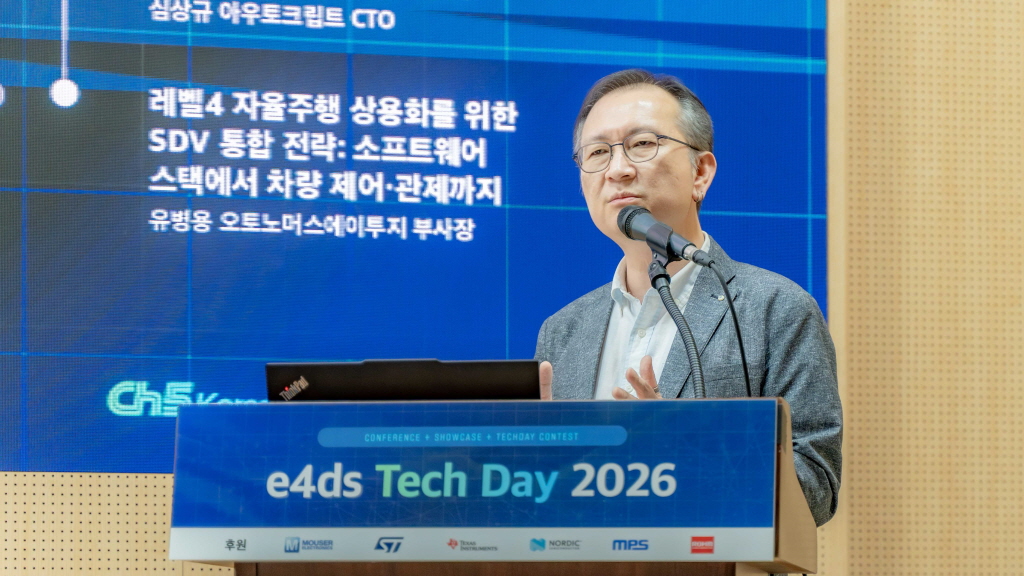
[e4ds Tech Day 2026 ⑨] Sim Sang-gyu, Autocrypt CTO: "In the Physical AI Era, Automotive Security Must Extend Beyond the Vehicle"
At e4ds Tech Day 2026, Sim Sang-gyu, CTO of Autocrypt, explained automotive cybersecurity strategies in the era of Physical AI and SDV (Software-Defined Vehicle). Automobiles are evolving as part of an ecosystem connected to AI, cloud, chargers, IoT, and robots, and he emphasized that the scope of security must expand beyond the vehicle interior to the entire connected environment. In particular, AI model tampering, adversarial attacks, OTA updates, and EV charger hacking were identified as major threats. He explained that response measures require zero trust, AI model integrity protection, intrusion detection, Security by Design and Default, and full lifecycle security management, and that proactive security system establishment beyond regulatory compliance is critical for securing future mobility competitiveness.
2026.10.12by 배종인 기자
NVIDIA to Invest $1 Billion in U.S. Science Over Next Five Years
NVIDIA has announced plans to invest $1 billion over the next five years to strengthen U.S. scientific and technological competitiveness. The company will enhance cutting-edge artificial intelligence research and development capabilities in key areas including quantum computing, healthcare, and energy security, while expanding support for higher education research institutions and cloud service providers. NVIDIA is participating as a major industry partner in the White House Office of Science and Technology Policy's Genesis Mission, and is promoting supercomputer construction in collaboration with national laboratories including Argonne and Los Alamos.
2026.10.12by 배종인 기자











