



Commercialization of Smart Contact Lenses Opened by 3D Printers
 Published2023.02.07 15:44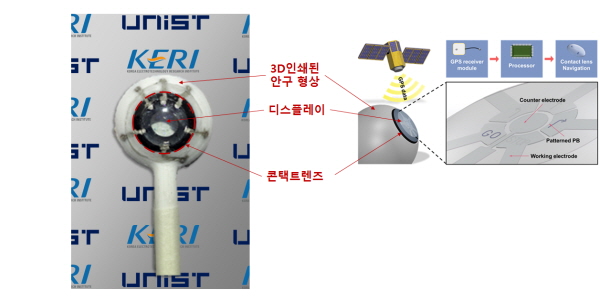
▲ Components of smart contact lenses for AR
A core technology has been developed that enables the production of smart contact lenses with navigation capabilities using 3D printer technology, raising expectations for the future commercialization of smart contact lenses.
Dr. Seung-Kwon Seol's team from the Smart 3D Printing Research Team at the Korea Electrotechnology Research Institute (KERI) and Professor Im-Doo Jeong's team at Ulsan National University of Science and Technology (UNIST) announced on the 6th that they have developed core technology for smart contact lenses capable of implementing augmented reality (AR)-based navigation using a 3D printer.
Smart contact lenses are products that are fitted into the human eye like regular lenses to provide various types of information, and research is primarily being conducted on their use in diagnosing and treating health issues.
Recently, companies like Google have been developing smart contact lenses for use as AR displays, but due to the high technical difficulty, there are many hurdles to overcome before commercialization.
To implement AR with smart contact lenses, electrochromic displays capable of operating on low power are suitable, and among the materials, 'pure Prussian blue' is attracting attention due to its high cost competitiveness and rapid contrast and transition between colors.
On the other hand, since conventional methods used electroplating to coat colors onto substrates in the form of films, there were limitations in producing advanced displays capable of expressing various types of information (text, numbers, images).
KERI-UNIST's achievement is a technology that enables AR by printing micro-patterns on a lens display using a 3D printer without the application of voltage.
The key is the meniscus. A meniscus is a phenomenon in which a curved surface forms on the outer wall of a water droplet due to capillary action, without the droplet bursting, when the droplet is gently pressed or pulled with a certain pressure.
Prussian blue crystallizes through the evaporation of the solvent within the meniscus formed between the micro-nozzle and the substrate.
Unlike conventional electroplating, where the substrate had to be a conductor when voltage was applied, a major advantage of utilizing the meniscus phenomenon is that there are no restrictions on the substrate that can be used because crystallization occurs through the natural evaporation of the solvent.
Through the movement of this nozzle, micro-patterns can be formed as crystallization of Prussian blue occurs continuously.
Pattern formation is possible not only on flat surfaces but also on curved surfaces. The research team's micro-pattern technology is extremely fine (7.2 micrometers), suitable for application in smart contact lens displays for AR, and features continuous and uniform colors.
The primary expected application is navigation. Simply by wearing the lenses, navigation unfolds right before the eyes via AR. Even hugely popular games like 'Pokémon GO' can be enjoyed with smart contact lenses instead of smartphones.
Dr. Seol Seung-kwon of KERI stated, “Our achievement is a 3D printing technology that can commercialize smart contact lenses that are much more comfortable and affordable than existing smart goggles or glasses used to implement AR,” adding, “It will contribute significantly to the miniaturization and versatility of AR devices.”
The related research results were recognized for their excellence and were recently published as a cover article in 'Advanced Science' (IF 17.521/JCR 4.71%), a world-renowned academic journal in the field of materials science.
The research team anticipates that this achievement will attract significant interest not only from the AR sector but also from battery and biosensor companies requiring Prussian blue micro-patterning, and plans to identify potential customers to pursue technology transfer.
Meanwhile, KERI is a government-funded research institute under the National Science and Technology Research Council of the Ministry of Science and ICT. Dr. Seol Seung-kwon also serves as a professor at the KERI campus of the University of Science and Technology (UST).
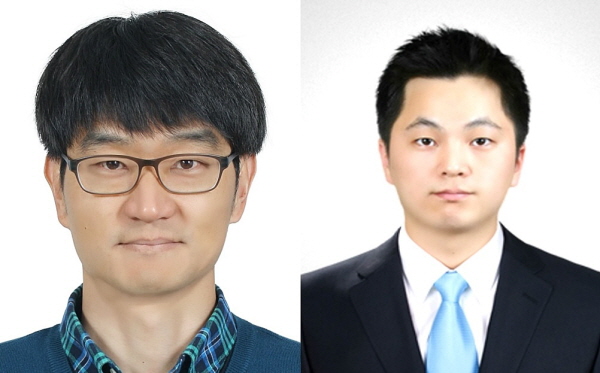
▲ (Left) Dr. Seol Seung-kwon of the Korea Electrotechnology Research Institute and Professor Jeong Im-doo of Ulsan National Institute of Science and Technology, who led this research.

Comments
Related news
.jpg)
Electric Power Research Institute, Graphene Technology National Research and Development Excellence Award
The graphene technology developed by the Korea Electrotechnology Research Institute (KERI, Acting Director Kim Nam-gyun) has been selected as the best national research and development technology, and is expected to see significant applications in mobility batteries and electrical components in the future.
2022.11.09by 배종인 기자
UNIST Develops Virtual AI Manufacturing Technology for Metal Surfaces
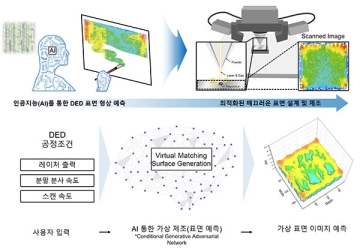
A research team led by Professor Jung Im-doo from the Department of Mechanical Engineering at UNIST has successfully developed a technology that virtually manufactures 'predicted 3D surface morphology of metals according to metal processing conditions' based on actual data, as announced on the 15th.
2022.11.21by 김예지 기자
Electric Yeon, Development of Zinc-Manganese Redox Battery to Replace Expensive Vanadium
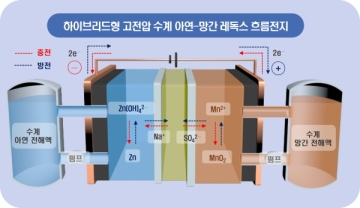
The Korea Electrotechnology Research Institute (KERI, Acting President Kim Nam-gyun) has enhanced battery performance and secured price competitiveness by replacing expensive vanadium with zinc and manganese at optimal ratios, and it is expected that environment-friendly batteries without fire and explosion risks will become widespread in the future.
2023.01.10by 배종인 기자

Intel Unveils Next-Generation 'Core Ultra Series 3' and vPro Platform for Enterprise PCs
Intel has officially unveiled the "Intel Core Ultra Series 3" for next-generation enterprise PCs and the latest vPro platform, addressing a wide range of demands from enterprise notebooks to high-performance workstations.
2026.03.26by 배종인 기자

ROHM Launches ESD Protection Diode Compatible with High-Speed Interfaces of 10Gbps or Higher
Semiconductor specialist ROHM has developed the 'RESDxVx series' of ESD (electrostatic discharge) protection diodes capable of responding to next-generation high-speed data communication environments exceeding 10Gbps, simultaneously enhancing both signal quality maintenance required in high-speed interfaces and IC protection performance.
2026.03.26by 배종인 기자











