



2023 EV Subsidy, Ioniq 6 6.8 million won
 Published2023.02.08 11:13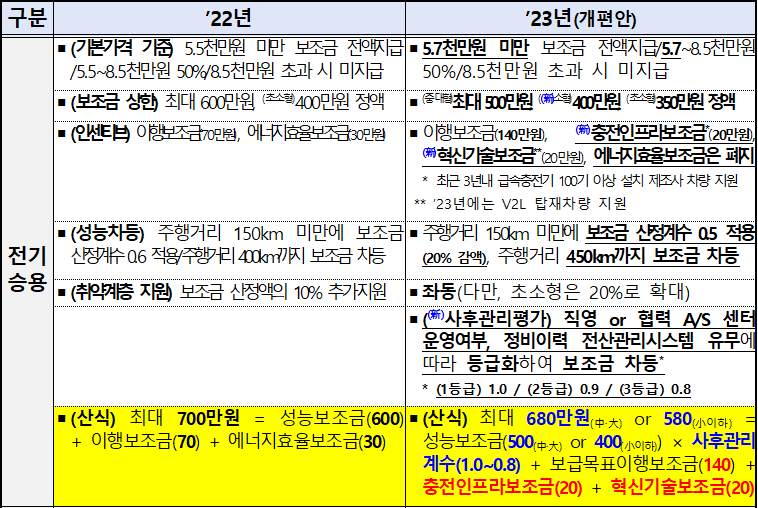
▲ 2023 Electric Vehicle Subsidy Reform Plan (Image Source: Ministry of Environment Press Release)
Reflecting battery raw material price hikes… Full payment price up by 2 million won
Considering equity by vehicle class, etc… Rationalization of subsidy unit prices and increase in support volume
On the 2nd, the Ministry of Environment, in conjunction with related ministries, unveiled the '2023 Electric Vehicle Purchase Subsidy Reform Plan (hereinafter the Subsidy Reform Plan).'
To prepare this subsidy reform plan, the Ministry of Environment has been conducting related research and has formed a consultative body with relevant ministries, including the Ministry of Economy and Finance and the Ministry of Trade, Industry and Energy, to hold discussions.
In addition, meetings were held with manufacturers and importers for each vehicle model, and the submitted opinions were reviewed and reflected in the subsidy reform plan.
The parts marked in bold are the parts that were changed or added in 2023.
■ Subsidy conditions by base price: 55 million KRW → 57 million KRW (Reflecting increase in battery raw material prices)
In 2022, the full subsidy was provided for vehicles under 55 million won, 50% for those between 55 million and 85 million won, and no subsidy was provided for those exceeding 85 million won.
Full subsidy for vehicles under 57 million won (change) in 202357 million to 85 million 50%, over 85 million unpaid
In order to promote the adoption of mass-market electric passenger vehicles, the full subsidy was provided only to vehicles priced under 55 million won by adjusting the vehicle payment ratio.
As battery prices have risen due to the recent surge in raw material prices and the resulting pressure to increase vehicle prices, the base price threshold for full subsidy payment has been raised from the original 55 million won to 57 million won.
■ Unit Price Adjustment… Considering Life Cycle Cost Analysis, Equity by Vehicle Class, etc.
2022 subsidy cap up to 6 million won, fixed amount of 4 million won for ultra-compact vehicles
2023: Mid-to-large up to 5 million won, small 4 million won (additional), micro 3.5 million won
We will accelerate the adoption of electric passenger vehicles by rationalizing subsidy unit prices through life cycle cost analysis and equity across vehicle classes, while significantly increasing the volume of support.
Instead of reducing the unit price of performance subsidies for medium and large electric passenger cars by 1 million won (6 million → 5 million won), the volume of subsidized electric passenger cars was increased by approximately 31% (160,000 → 215,000 units) compared to the previous year.
In addition, considering the price difference based on vehicle class, a performance subsidy cap of 4 million won was newly established for small and light electric passenger vehicles, and the cap for ultra-small electric passenger vehicles was reduced from 4 million won to 3.5 million won.
■ Incentives… Purpose: To promote the supply of low-emission vehicles by manufacturers, the expansion of charging infrastructure, and the development and adoption of innovative technologies.
2022 Incentives: Implementation Subsidy 700,000 KRW, Energy Efficiency Subsidy 300,000 KRW
2023 Incentives: Implementation Subsidy 1.4 million KRW (Change), Charging Infrastructure Subsidy 200,000 KRW (Addition), Innovative Technology Subsidy 200,000 KRW (Addition), Energy Efficiency Subsidy Abolishedtrong>
We are introducing various support measures (incentives) to promote the distribution of low-emission vehicles by manufacturers, the expansion of charging infrastructure, and the development and adoption of innovative technologies.
Given the persistent calls for subsidies to encourage the adoption of safe electric vehicles and improve user convenience through the expansion of charging and after-sales service infrastructure, in light of concerns regarding electric vehicle safety such as battery fires, the Ministry of Environment has reflected these views.
The 'Subsidy for Achieving Supply Targets' was increased (from 700,000 to 1.4 million won) to alleviate the burden on manufacturers resulting from the upward revision of this year's supply targets for low-emission vehicles and to encourage compliance.
The companies subject to the low-emission vehicle supply target system are domestic manufacturers Hyundai, Kia, SsangYong, Renault, and GM Korea, and foreign manufacturers Mercedes-Benz, BMW, Volkswagen, Toyota, and Honda, totaling 10 companies.
To encourage manufacturers to expand electric vehicle chargers, an additional 'charging infrastructure subsidy' (200,000 won) will be provided to electric passenger vehicles produced by manufacturers that have installed 100 or more fast chargers (recognized as 1 fast charger for every 10 slow chargers) within the last three years.
In addition, there are plans to provide an 'Innovation Technology Subsidy' (200,000 won) to vehicles that apply high-value-added innovative technologies to enhance the utilization of electric vehicles. This year, the subsidy will be provided to vehicles equipped with V2L (Vehicle to Load, a technology that allows power from the battery mounted on the electric vehicle to be drawn and used externally), which converts the electric vehicle into a mobile energy storage system (ESS).
■ Strengthening performance evaluation… Strengthening differentiated subsidies based on performance factors such as driving range
2022 Performance-based Differential: Subsidy calculation factor of 0.6 applied for driving distance under 150km / Driving distance 400kmDifferential subsidies up to
2023 Performance-based Differential Subsidy: Application of a subsidy calculation factor of 0.5 for driving distances under 150km, 20% reduction (change), differential subsidy up to 450km (change)
Subsidies for electric passenger cars with a driving range of less than 150 km on a single charge have been reduced by about 20%, and the differential range for driving range on a single charge has been expanded from the original 400 km to 450 km so that high-performance vehicles can receive more subsidies.
■ Evaluation of Manufacturer's After-Sales Service Capabilities… Operation of Directly Managed Service Centers and Computerized Management of Maintenance History, etc.
Post-management evaluation was newly added to the 2023 subsidy reform plan.
This is graded based on whether a directly managed or partner service center is operated and whether a maintenance history computerized management system is in place, with subsidies provided differentially as Grade 1 (1.0), Grade 2 (0.9), and Grade 3 (0.8).
We plan to evaluate the manufacturer's after-sales service capabilities, such as the operation of directly managed maintenance centers and computerized management of maintenance history, and provide performance subsidies of up to 20% differentially based on this.
The evaluation of after-sales service capabilities was newly introduced during this subsidy reform in response to persistent complaints regarding the inconvenience caused by the lack of after-sales infrastructure for electric vehicles and inconsistencies in expertise, service quality, and pricing among maintenance centers.
While the operation of manufacturer-operated service centers will be evaluated most highly, we plan to provide subsidies even if a post-maintenance system is outsourced to partner centers, as long as the manufacturer fulfills certain responsibilities, such as directly conducting professional training for maintenance personnel, by considering it equivalent to operating a direct service center.
For imported electric vehicles that do not have directly operated service centers in the country, subsidies could be reduced by up to 20% compared to last year.
The Ministry of Environment [regarding] vehicle models primarily purchased by vulnerable groups and small business ownersIt also reflected the opinion that more robust support should be provided to ease entry barriers.
■ Support for vulnerable groups
2022 Support for Vulnerable Groups: 10% Additional Support on Calculated Subsidy Amount
2023 Support for Vulnerable Groups: 10% additional support on the calculated subsidy amount, expanded to 20% for micro-sized units (additional)
Low-income households and small business owners will receive an additional 10% of the calculated subsidy amount, while the additional support for ultra-compact electric passenger cars has been increased to 20%.
In addition, for electric taxis, an additional 2 million won in state funds is provided on top of the vehicle subsidy.
The Ministry of Environment plans to finalize the guidelines for handling electric vehicle subsidies by February 9, after collecting supporting documents necessary for calculating subsidies by vehicle type, such as the status of after-sales service (A/S) system establishment, and gathering opinions.
Park Yeon-jae, Director General of Air Environment Policy at the Ministry of Environment, stated, “This subsidy reform plan includes various measures designed to promote the adoption of electric vehicles, enhance performance and safety, and improve user convenience.” He added, “It is expected to contribute significantly not only to environmental improvements, such as the reduction of air pollutants and greenhouse gases resulting from the expansion of EV adoption, but also to strengthening the technological competitiveness of electric vehicles.”
The Ministry of Environment announced that it will post the '2023 Guidelines for Handling Subsidies for Electric Vehicle Supply Projects,' which contain the details of the subsidy reform plan, on the Zero-Emission Vehicle Integrated Website (www.ev.or.kr) starting February 2.
Comments
Related news
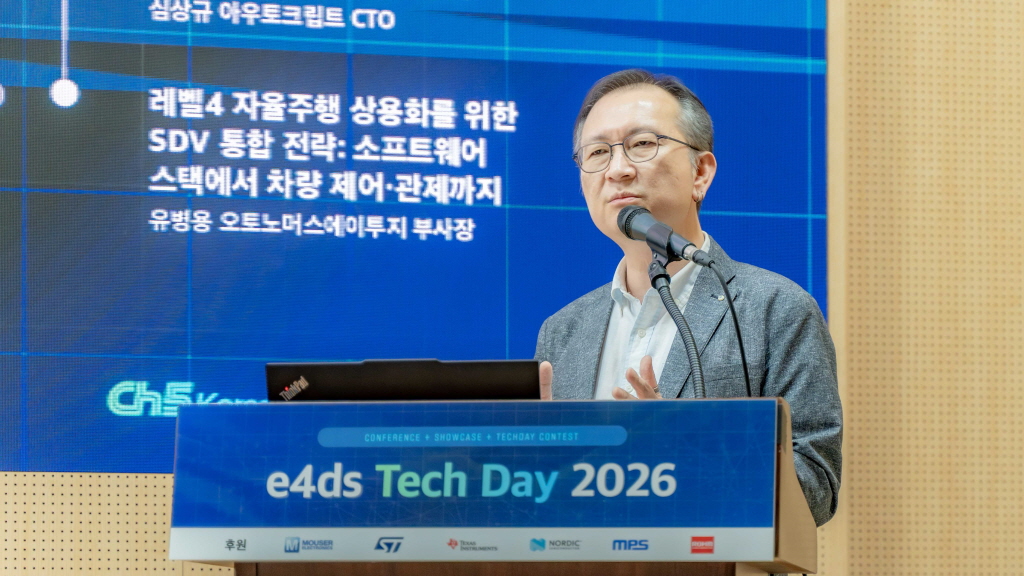
[e4ds Tech Day 2026 ⑨] Sim Sang-gyu, Autocrypt CTO: "In the Physical AI Era, Automotive Security Must Extend Beyond the Vehicle"
At e4ds Tech Day 2026, Sim Sang-gyu, CTO of Autocrypt, explained automotive cybersecurity strategies in the era of Physical AI and SDV (Software-Defined Vehicle). Automobiles are evolving as part of an ecosystem connected to AI, cloud, chargers, IoT, and robots, and he emphasized that the scope of security must expand beyond the vehicle interior to the entire connected environment. In particular, AI model tampering, adversarial attacks, OTA updates, and EV charger hacking were identified as major threats. He explained that response measures require zero trust, AI model integrity protection, intrusion detection, Security by Design and Default, and full lifecycle security management, and that proactive security system establishment beyond regulatory compliance is critical for securing future mobility competitiveness.
2026.10.12by 배종인 기자
Practical HIL Construction Strategy for Automotive and Off-Highway Controller Validation
As vehicle E/E architecture transitions to zonal structures and shifts to software-defined vehicles (SDV), the number of controllers (ECUs) requiring validation and software complexity are surging dramatically. Meanwhile, real vehicle testing cannot provide repeated verification under identical conditions and entails lead time and safety concerns. This white paper explains the principles of HIL (Hardware-in-the-Loop) validation and the structure of the NI platform composed of PXI, SLSC, and VeriStand, and through two actual implementation cases—Camera Record & Replay HIL for In-Cabin Monitoring Controller (ICMU) and Forklift Controller (VCU) HILS—describes how controller-level regression testing becomes possible. Additionally, it explicitly states application boundaries and limitations, such as lack of A2B support.
2026.10.12by 편집부
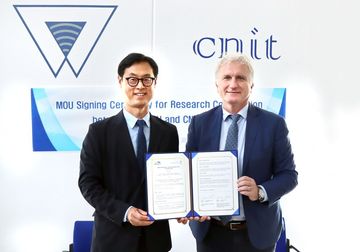
Korea Automotive Research Institute Signs MOU with Italy National Institute for Wireless Communications
The Korea Automotive Research Institute will sign an MOU with Italy's National Institute for Wireless Communications and launch joint research on next-generation mobility technologies based on 6G, V2X, and connected vehicles. The two organizations will conduct research to apply advanced wireless communication technologies to vehicles and discover international joint projects to advance next-generation connected vehicle technology development.
2026.10.12by 배종인 기자
Color Accuracy Issues in Vehicle Interior Ambient Lighting and Intelligent LED Drivers
Vehicle interior ambient lighting is spreading across all price segments, and the level of color accuracy required of lighting designers is rising accordingly. This white paper quantitatively addresses why temperature drift and individual variations of RGB LEDs cannot be corrected by standard constant-current drivers, and explains an intelligent LED driver approach that integrates an MCU, calibration data, and a LIN network interface into the driver. It covers implementation details of the LITIX Interior TLD4020-3ET currently in production, portfolio roadmap, and evaluation/development environments, and clarifies application boundaries including lack of 48V support, lack of RGBi/ISELED support, and absence of direct optical degradation diagnostics.
2026.10.08by 명세환 기자
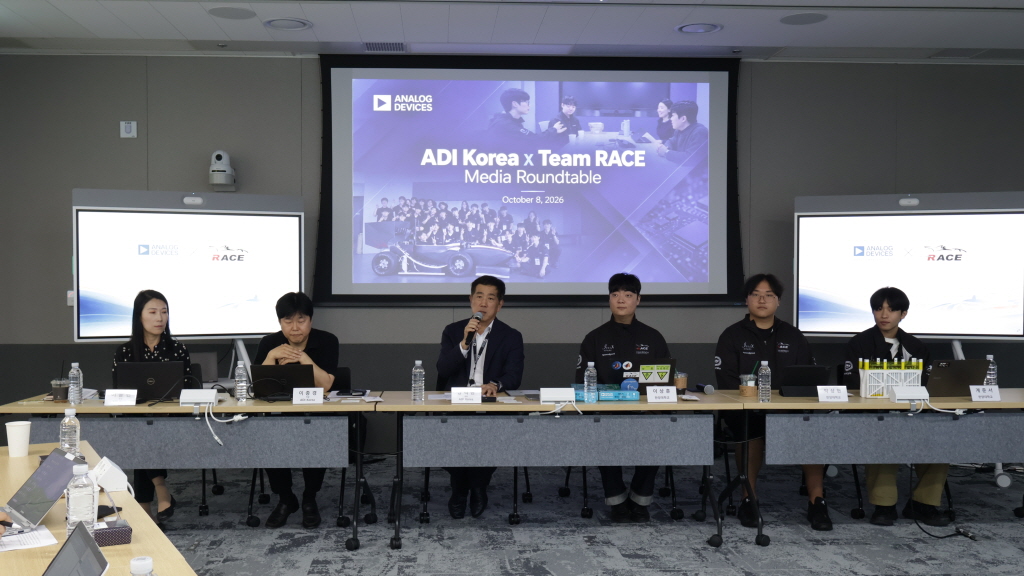
ADI, "Fostering Future Engineers Beyond Component Support"
Global semiconductor company Analog Devices (ADI) is drawing attention for moving beyond simply sponsoring university student car projects to serve as a partner in nurturing future engineers. Over the past three years, ADI has collaborated with Hanyang University's automotive research club Team RACE to support electric formula vehicle development, and recently has been providing technical consultation and semiconductor solutions to enable students to directly develop battery management systems (BMS), creating a model case of industry-academic cooperation.
2026.10.08by 배종인 기자











