


KIMS Localizes 3D Printing Powder Materials for Mobility Parts
 Published2023.02.15 15:31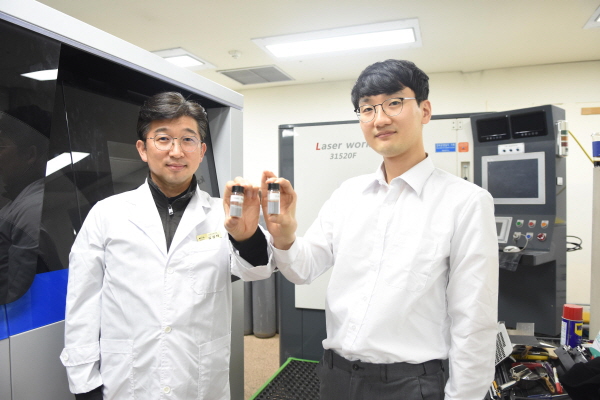
▲ (Left) Principal Investigator Kim Kyung-tae of the Korea Institute of Materials Science and Research (KIMS) and First Author Choi Joong-ho of the paper.
The Korea Institute of Materials Science (KIMS, President Lee Jeong-hwan), a government-funded research institute under the Ministry of Science and ICT, has localized 3D printing powder materials for mobility parts, raising expectations that it will be possible to replace foreign products and export them in the future.
Dr. Kim Kyung-tae's research team at the Powder Materials Research Division of the Korea Institute of Materials Science announced on the 13th that, through joint research with Hyundai Motor Company and Pohang University of Science and Technology (Professor Kim Hyung-sup), they have succeeded in localizing the manufacturing technology for 3D printing-specific powder materials for high-strength aluminum alloys for next-generation mobility parts and presenting, for the first time in the world, a model that predicts solidification crack behavior problems occurring during the process.
Until now, high-strength aluminum powder material technology specifically for metal 3D printing and defect prediction technology such as cracks have been developed separately, making it difficult to provide an integrated solution.
In particular, while conventional solidification crack behavior prediction models can identify crack initiation trends, it is difficult to predict the critical point of solidification cracking; therefore, the critical point had to be determined directly through experiments whenever there were changes in materials or processes.
The technology developed this time localizes the synthesis process for high-strength 7000-series aluminum alloy composite powder considering the characteristics of laser-based 3D printing processes, and at the same time, addresses the issue of cracks occurring during the process The conditions were quantified for the first time in the world.
It is possible to predict the crack generation critical point, thereby providing an optimal solution for manufacturing high-strength aluminum 3D printed parts. As a result, the application of 3D printing processes to 7000 series aluminum alloys, which are key materials in the aerospace and mobility sectors, is possible, and widespread utilization of the developed technology is expected in the future.
Laser-based 3D printing was impossible for existing 7000 series high-strength aluminum alloys due to solidification cracking.
Although an improved powder was developed through joint research by Boeing and GM, the technical barriers to localization remain high due to the internalization of the technology.
This technology enables the production of an aluminum alloy that is crack-free and has a yield strength more than twice that of Al-Si series laminated materials by appropriately combining laser process conditions using the developed composite powder. It is significant as it presents a direction that simultaneously secures economic efficiency and physical properties.
The market size for aluminum alloy powder for 3D printing is growing rapidly from $8.56 million in 2018 to $40.53 million in 2023.
However, high-strength aluminum alloy materials for 3D printing are exclusively supplied at high prices by advanced overseas companies, so it is expected that this technology development will not only have the effect of replacing imports through localization but also enable the export of integrated solutions combining powder and processes.
"This technology will serve as a model to suggest a direction for the localization of high-value-added lightweight aluminum alloy powders in the field of 3D printing metal powder materials, which are currently entirely dependent on imports," said Kim Kyung-tae, a principal researcher at the Korea Institute of Materials Science and Technology and the research leader. "In the future, close collaboration with the domestic metal 3D printing demand and powder manufacturing industries is required to commercialize process technologies linked to materials at low cost."
This research achievement was carried out with the support of the Ministry of Science and ICT through the Korea Institute of Materials Science's major projects, Hyundai Motor Company's commissioned projects, and Pohang University of Science and Technology's Metal Additive Manufacturing Materials and Components Research Center projects.
In addition, the research results were published on January 25 in Additive Manufacturing (IF: 11.31), the world's top journal in the field of 3D printing (First author: Researcher Choi Jung-ho of the Korea Institute of Materials Science).
Currently, the research team is conducting follow-up research to secure source technology for the mass production of dedicated aluminum powder and to enhance the physical properties of 3D-printed aluminum alloys through continuous joint research with Hyundai Motor Company and Pohang University of Science and Technology.

Comments
Related news
Materials Research Institute certified as an excellent safety management laboratory
The Korea Institute of Materials Science has obtained certification as an Excellent Safety Management Laboratory in the 2022 Excellent Safety Management Laboratory Certification Review overseen by the Ministry of Science and ICT.
2022.12.02by 배종인 기자
.jpg)
KIMS, “Producing Hydrogen from Waste Water”
The Korea Institute of Materials Science (KIMS, President Lee Jung-hwan), a government-funded research institute under the Ministry of Science and ICT, has developed a system capable of producing high-purity hydrogen from wastewater, brightening the outlook for future green hydrogen production.
2022.12.05by 배종인 기자
Materials Research, Neuromorphic Semiconductor Implementation
Korea Institute of Materials Science (KIMS, Director Lee Jung-hwan) has implemented the world's first neuromorphic semiconductor device capable of simultaneously performing information processing and storage, enabling image learning and recognition such as handwriting patterns, and is garnering expectations that it can be applied to various artificial intelligence devices in the future.
2023.02.08by 배종인 기자
Schneider Aims for Building Energy Savings and Operational Stability with Next-Generation HVAC Drives
Schneider Electric has unveiled its next-generation HVAC drive product line 'Altivar HVAC'. The new product line's key features center on enhanced energy savings, system operational stability, and building management system integration. The products are divided into 'ATH200' for OEM and small equipment applications, and 'ATH600' for environments requiring continuous operation and advanced control. The company plans to expand the application scope from commercial buildings to facilities where HVAC system stability is critical, such as hospitals, airports, and data centers. The announcement includes over 30% energy savings, operation from -10°C to +60°C, Modbus and BACnet support, and compatibility with low global warming potential refrigerants.
2026.03.26by 명세환 기자
Ecolab Expands AI Data Center Cooling Business Through Acquisition of CoolIT
Ecolab has agreed to acquire CoolIT Systems, a liquid cooling company for AI data centers, for approximately $4.75 billion. The transaction is expected to close by Q3 2026, subject to regulatory approvals. CoolIT has been supplying direct-to-chip cooling-based coolant distribution units, cold plates, and manifolds, serving hyperscale data centers and colocation operators as customers. This acquisition is a measure to address the high-heat and high-density server environments created by AI proliferation. Ecolab plans to combine its water management and digital monitoring capabilities with CoolIT's hardware technology to expand its data center cooling business.
2026.03.26by 명세환 기자











