



Ford and CATL Joint Venture, Survival Strategy Against Tesla Competition
 Published2023.02.21 15:33
.jpg)
▲Screen capture of Samsung Life 2030 Business LIVE ON
EV Operating Profit Margin: Tesla 25% vs. Ford in Losses
Ford to Continue Price Competition with Lithium Iron Phosphate Battery Integration
At the '2030 Business LIVE ON' event hosted by Samsung Life, Professor Kim presented on the theme of 'The Future of the Mobility Industry,' noting that Ford and CATL's factory establishment plans, which directly confront the IRA enacted based on domestic-first policies, represent a strategy to survive competition with Tesla.
Tesla has recently entered into price competition by offering 20% discounts on electric vehicles.
For electric vehicles equipped with lithium-ion batteries, battery costs account for 40% of the total cost, making it important to reduce battery prices, but this is not straightforward.
Tesla was able to reduce EV prices because the supply of battery materials such as lithium, cobalt, nickel, and manganese has stabilized.
One additional point is that Tesla's operating profit margin exceeds 25%.
The operating profit margin for global automakers is typically 5~6% if favorable.
Only Tesla, Mercedes-Benz, and BMW achieve double-digit profit margins in the automotive industry.
Following Tesla's discount, Ford reduced EV prices by 8.8%, while GM and Volkswagen did not.
Ford is offsetting EV sales losses with internal combustion engine vehicle sales, and since GM and Volkswagen's EVs are recording losses, reducing prices is not easy.
Ford is pursuing the joint venture with CATL to continue price competition.
This directly confronts the United States' IRA law, which prioritizes domestic interests and seeks to exclude China.
It is interpreted as a contingency measure to use lithium iron phosphate batteries, which are cheaper than lithium-ion batteries, in response to Tesla's price cuts to maintain competitiveness.
As complete vehicle manufacturers pursue battery internalization, high-performance battery companies seeking new revenue streams will begin manufacturing automobiles, according to Professor Kim's assessment.
A prime example of this is China's BYD.
BYD, which was originally a battery manufacturer, accumulated expertise by manufacturing vehicles, which led to surpassing Tesla's sales last year.
Although Tesla gained popularity with OTA and FSD (autonomous driving), as other manufacturers released similar features, Tesla lost distinct advantages and fell behind in differentiation competition.
Experts note that there are technological difficulties in autonomous driving and consumer perception issues. While autonomous-only roads could enable this technology, differences in machine and human judgment make implementation on regular roads challenging.
Professor Kim predicted that autonomous driving will first be applied to South Korea and Japan, which face aging population issues, in the form of active safety features for elderly drivers who experience reduced device control and delayed decision-making abilities.
Additionally, technologies such as automatic battery charging similar to robot vacuum cleaners could be integrated to provide useful services to people.
Regarding autonomous driving, related legal support is enabling demonstration road operations, and field testing is underway, but more intensive efforts are needed for practical autonomous driving tests comparable to overseas examples.
In reality, judging millions of conditions at congested intersections is not an easy task, and a single fatal accident could make operations impossible.
Furthermore, ethical judgment prioritizing passengers or pedestrians is an increasingly important issue and could become more severe when AI is integrated.
Professor Kim forecasted that "the absence of a government control tower and insufficient opportunities to realize synergies among industry, academia, and research are very lacking, so advancement to developed nation status will depend on future efforts."
Future mobility transcends mere transportation, becoming moving appliances and living spaces.
Mobility, which was merely machinery, is being reinvented as a convergence product with AI algorithms.
Not only big tech companies but also third parties like Naver are joining forces, and success appears to depend on strategic alliances and convergence between different industries.
Hyundai Motor unveiled SDV (Software Defined Vehicle), automobiles based on software, and tech companies' entry into the mobility industry, including Apple Car, is underway.
The emergence of Apple Car signifies a shift to mass production and a transformation into a 'mobility foundry' that produces electric vehicles.
Professor Kim Pil-soo stated, "If the smartphone brought innovation to humanity, the emergence of Apple Car will be recorded as marking the full beginning of the mobility era."
He added that Apple Car's launch will accelerate the market entry of Sony, Samsung, and LG Car (tentative name), and predicted that battery companies will also launch vehicles.
Battery companies are already constructing battery factories in the United States through joint ventures with foreign companies and making efforts to secure core materials.
He suggested that forming consortiums or partnering with companies possessing distinct advantages are viable approaches, emphasizing that entrepreneurs need to consider what elements can be linked together.
As of 2022, the cumulative number of domestic EV registrations reached 400,000 units, and an additional 270,000 units are expected to be supplied in 2023 alone.
Additionally, among 80 million global vehicle sales in 2022, EVs approached 10 million units, showing steep growth.
While rapid changes are evident, Professor Kim did not evaluate the situation purely positively.
The possibility of a hard landing cannot be ruled out, and job losses are occurring.
Professor Kim Pil-soo expressed concern, stating, "While internal combustion engine vehicles have 30,000 components, EVs have only about 13,000, making parts suppliers' concerns inevitable," and added, "Manufacturing employment can decrease by 30% without problems, so workers' sense of crisis is substantial."
Comments
Related news
.jpg)
“Digital Twin, Axis of Electric Vehicle Development”
Digital twin has been established as an important factor across all areas ranging from electric vehicle drivetrain component development to integrated development, as presented by an expert, along with case examples.
2022.11.18by 성유창 기자
“Reorganization of electric vehicle subsidies and expansion of charging infrastructure”
The Ministry of Environment announced that it will restructure subsidies to promote the widespread adoption of electric vehicles and expand charging infrastructure in line with accelerating electric vehicle deployment.
2022.11.25by 성유창 기자
.jpg)
Global Electric Vehicle Subsidy Cuts, China Eliminates, US Freezes
As electric vehicle subsidies show a declining trend, the contrasting directions of China and the United States' subsidy policies in 2023 are drawing attention to future market proliferation and competitive advantages.
2023.02.10by 성유창 기자
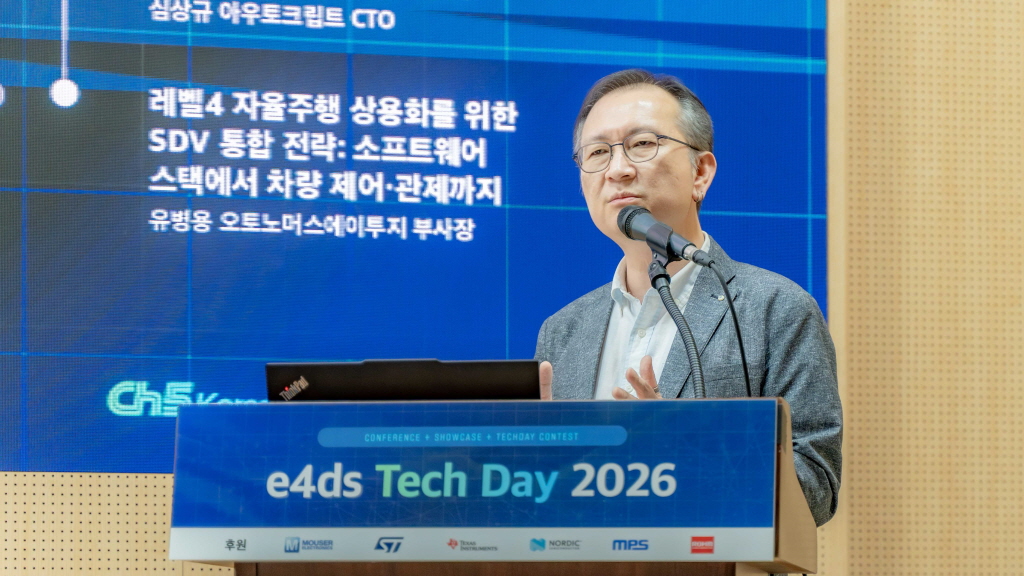
[e4ds Tech Day 2026 ⑨] Sim Sang-gyu, Autocrypt CTO: "In the Physical AI Era, Automotive Security Must Extend Beyond the Vehicle"
At e4ds Tech Day 2026, Sim Sang-gyu, CTO of Autocrypt, explained automotive cybersecurity strategies in the era of Physical AI and SDV (Software-Defined Vehicle). Automobiles are evolving as part of an ecosystem connected to AI, cloud, chargers, IoT, and robots, and he emphasized that the scope of security must expand beyond the vehicle interior to the entire connected environment. In particular, AI model tampering, adversarial attacks, OTA updates, and EV charger hacking were identified as major threats. He explained that response measures require zero trust, AI model integrity protection, intrusion detection, Security by Design and Default, and full lifecycle security management, and that proactive security system establishment beyond regulatory compliance is critical for securing future mobility competitiveness.
2026.10.12by 배종인 기자

Practical HIL Construction Strategy for Automotive and Off-Highway Controller Validation
As vehicle E/E architecture transitions to zonal structures and shifts to software-defined vehicles (SDV), the number of controllers (ECUs) requiring validation and software complexity are surging dramatically. Meanwhile, real vehicle testing cannot provide repeated verification under identical conditions and entails lead time and safety concerns. This white paper explains the principles of HIL (Hardware-in-the-Loop) validation and the structure of the NI platform composed of PXI, SLSC, and VeriStand, and through two actual implementation cases—Camera Record & Replay HIL for In-Cabin Monitoring Controller (ICMU) and Forklift Controller (VCU) HILS—describes how controller-level regression testing becomes possible. Additionally, it explicitly states application boundaries and limitations, such as lack of A2B support.
2026.10.12by 편집부











