



Materials Research Institute and Korean Air Join Forces to Develop Aircraft Materials
 Published2023.02.24 15:17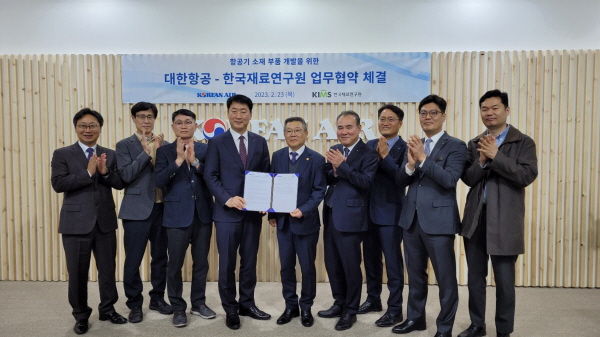
▲(Fifth from the left) Director Lee Jeong-hwan of the Materials Research Institute and other officials pose for a commemorative photo after signing the MOU.
The Korea Institute of Materials Science (KIMS, President Lee Jeong-hwan), a government-funded research institute under the Ministry of Science and ICT, has agreed to accelerate the development of aircraft materials and parts in cooperation with Korean Air, Korea's leading airline.
On the 23rd, at the '2023 Drone Show Korea' held at BEXCO in Busan, Korea Materials Research Institute signed a business agreement (MOU) with Korean Air for the development of aircraft materials and component technology.
With this agreement, the two organizations expressed their ambition to lead the drone industry, which has great future growth potential, and to revitalize the development of related industries by achieving domestic production of materials and component technology.
Unmanned aerial vehicles (UAVs) are multi-purpose aircraft that can be used for various purposes, including logistics transportation using small drones, urban air mobility (UAM), revitalizing the cargo and passenger transportation industries, and strengthening national defense systems.
It is expected to have a significant impact on future changes in batteries, autonomous driving, and transportation services.
Korean Air has been jointly participating in the development of Korea's first low-observable unmanned aerial vehicle (UAV) led by the Agency for Defense Development (ADD) since 2010, successfully completing test flights.I have done it.
Low observable is a type of stealth technology that has a very small radar cross-section (RCS), making it difficult to detect with regular radar.
In addition, Korean Air is developing a high-heat/high-strength ceramic-based stealth composite structure for the Agency for Defense Development (KRIT), and is emerging as a leading tactical-level and mid-level unmanned aerial vehicle system integration company.
The two organizations plan to collaborate on various core technologies in the aircraft materials and parts field that the Korea Aerospace Research Institute possesses, as well as its experience in developing various materials and parts capable of absorbing radio waves through participation in the government's stealth composite core technology project, and Korean Air's radio wave absorbing structure design technology and airframe shape design and manufacturing technology, to achieve advanced low-observability performance with domestically-owned technology in a short period of time.
Lee Jeong-hwan, president of the Korea Institute of Materials Science, said, “In order to respond to the growth and utilization of the future unmanned aerial vehicle industry, it will be necessary to foster related material and component companies, establish a support system infrastructure, and provide corporate support and form a network for technology commercialization.” He added, “Through this business agreement with Korean Air, the Korea Institute of Materials Science will do its best to ensure that it can play a leading role in the development of aircraft materials and component technology as a leading materials research institute in Korea.”

Comments
Related news
KIMS Localizes 3D Printing Powder Materials for Mobility Parts
The Korea Institute of Materials Science (KIMS, Director Lee Jeong-hwan), a government-funded research institute under the Ministry of Science and ICT, has localized 3D printing powder materials for mobility components, and expectations are gathering that future import substitution and exports will also be possible.
2023.02.15by 배종인 기자
[2023 Drone Show Korea] The Future of the Drone Industry at a Glance
Busan Metropolitan City, Ministry of Trade, Industry and Energy, Ministry of Science and ICT, Ministry of Land, Infrastructure and Transport, and Ministry of National Defense present Asia's largest drone exhibition 'Drone Show Korea 2023,' which will be held for three days from February 23 (Thursday) to February 25 (Saturday) at Busan BEXCO.
2023.02.23by 김예지 기자
[e4ds Tech Day 2026 ⑨] Sim Sang-gyu, Autocrypt CTO: "In the Physical AI Era, Automotive Security Must Extend Beyond the Vehicle"
At e4ds Tech Day 2026, Sim Sang-gyu, CTO of Autocrypt, explained automotive cybersecurity strategies in the era of Physical AI and SDV (Software-Defined Vehicle). Automobiles are evolving as part of an ecosystem connected to AI, cloud, chargers, IoT, and robots, and he emphasized that the scope of security must expand beyond the vehicle interior to the entire connected environment. In particular, AI model tampering, adversarial attacks, OTA updates, and EV charger hacking were identified as major threats. He explained that response measures require zero trust, AI model integrity protection, intrusion detection, Security by Design and Default, and full lifecycle security management, and that proactive security system establishment beyond regulatory compliance is critical for securing future mobility competitiveness.
2026.10.12by 배종인 기자

Practical HIL Construction Strategy for Automotive and Off-Highway Controller Validation
As vehicle E/E architecture transitions to zonal structures and shifts to software-defined vehicles (SDV), the number of controllers (ECUs) requiring validation and software complexity are surging dramatically. Meanwhile, real vehicle testing cannot provide repeated verification under identical conditions and entails lead time and safety concerns. This white paper explains the principles of HIL (Hardware-in-the-Loop) validation and the structure of the NI platform composed of PXI, SLSC, and VeriStand, and through two actual implementation cases—Camera Record & Replay HIL for In-Cabin Monitoring Controller (ICMU) and Forklift Controller (VCU) HILS—describes how controller-level regression testing becomes possible. Additionally, it explicitly states application boundaries and limitations, such as lack of A2B support.
2026.10.12by 편집부
Korea Automotive Research Institute Signs MOU with Italy National Institute for Wireless Communications
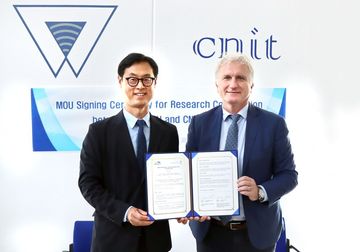
The Korea Automotive Research Institute will sign an MOU with Italy's National Institute for Wireless Communications and launch joint research on next-generation mobility technologies based on 6G, V2X, and connected vehicles. The two organizations will conduct research to apply advanced wireless communication technologies to vehicles and discover international joint projects to advance next-generation connected vehicle technology development.
2026.10.12by 배종인 기자











