



2023 Mechanical Industry 'Contraction'
 Published2023.02.27 16:21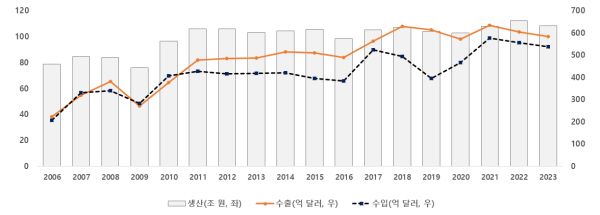
▲Production, import/export trends in Korea's mechanical industry and 2023 outlook (image)
Positive factors such as inflation mitigation present opportunity for rebound
The mechanical industry in 2023 is expected to show a market situation with modest contraction compared to the previous year due to worsening domestic and external conditions including reduced semiconductor investment and economic slowdown.
The Korea Institute of Machinery and Materials (KIMM, President Park Sang-jin) under the Ministry of Science and ICT released 'Mechanical Industry 2022 Performance and 2023 Outlook' through Mechanical Technology Policy No. 111 published in February.
According to this, KIMM predicts that domestic mechanical industry production and export value in 2023 will decrease slightly by 2% compared to the previous year.
This is an outlook that comprehensively considers negative factors such as the declining trend in mechanical orders and PMI index, continued domestic and external economic downturn, and positive factors such as signs of neutral-recovery phase in inventory cycle index and export base effects.
Despite concerns over continued global economic slowdown due to interest rate hikes and high inflation in 2022, as well as prolonged Russia-Ukraine war, the mechanical industry recorded production increase of 3.9% to 112 trillion won, exports slightly decreased by 0.3% to 60.5 billion dollars, and imports decreased by 3.3% to 55.8 billion dollars.
In 2023, Korea's mechanical industry is experiencing visible economic slowdown centered on manufacturing, and concerns have persisted since 2022 including decreased domestic orders for machine tools, stagnation in semiconductor equipment market, and reduced exports to China due to regulations.
However, positive factors also coexist such as possibility of Russia-Ukraine war resolution, mitigation of European energy risks, and increased domestic demand.
In particular, attention is focused on how much government policies promoting equipment investment and fostering new industries to activate the economy this year will contribute to resolving the mechanical industry's stagnation phase.
By sector, semiconductor equipment is expected to continue the previous year's downturn due to realization of reduced investment by semiconductor companies such as TSMC and Samsung Electronics, and decreased downstream industry demand.
Meanwhile, construction machinery export value increased 6.9% compared to the previous year, and with anticipated increased demand for reconstruction from the recent Turkey earthquake and Russia-Ukraine war, growth momentum is expected to continue somewhat.
In the machine tool sector, although cumulative machine tool orders in 2022 decreased 8.3% compared to the previous year, exports to all regions except China increased, recording 9% increase in export value compared to the previous year.
While stagnation factors exist due to decreased domestic mechanical industry orders, expectations for recovery based on downstream industry base effects also coexist, and 2023 is analyzed to maintain stability.
In the display equipment sector, total exports decreased 32.8% including 41.7% decrease in exports to China in 2022, and the equipment market stagnated due to significant reduction in investment by China's LCD panel industry.
However, the recent expansion of next-generation OLED equipment investment is analyzed as a positive factor.
In the plant sector, orders decreased 10.6% compared to the previous year as large-scale projects in the Middle East shrunk, but it is expected to rebound in 2023 due to increased LNG demand from Europe's energy crisis.
The construction machinery sector achieved the highest export value in the past 10 years, and is expected to see increased reconstruction demand in 2023 from the Turkey earthquake and Russia-Ukraine war, and increased exports are also anticipated following increased construction machinery demand.
According to KIMM, major organizations including the National Assembly and Korea Development Institute expect expanded uncertainty in external conditions and anticipated downturn in the semiconductor industry, but predict slight increase in equipment investment due to expanded demand for next-generation technology equipment investment such as batteries.
Researchers suggested that if inflation mitigation through interest rate cuts and improvement in external conditions materialize, economic improvement in the mechanical industry is also possible.
Gil Hyung-bae, senior researcher at KIMM's Mechanical Technology Policy Center, stated "In 2023, the mechanical industry is expected to show modest decline due to negative factors including decreased exports to China, stagnant Chinese economic growth, and oversupply and reduced investment in semiconductors and displays. However, positive factors such as inflation mitigation through interest rate cuts and expectations for improvement in external conditions like equipment investment coexist, and mechanical industry exports are projected to show recovery after 2023's third quarter when global economic slowdown is anticipated."
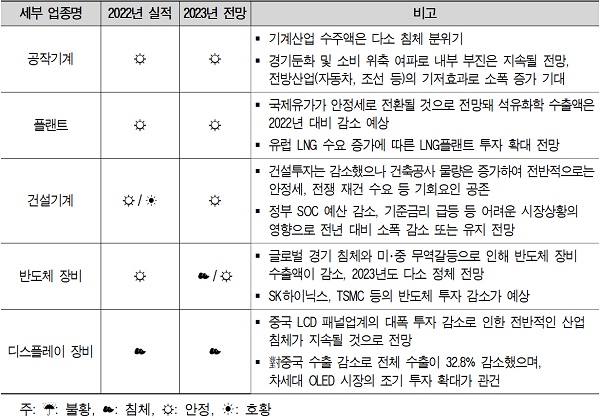
▲2022 Performance and 2023 Outlook weather chart by detailed sector of mechanical industry (table)

Comments
Related news
KIMM Develops Self-Repairing Valve for Damaged Pipes
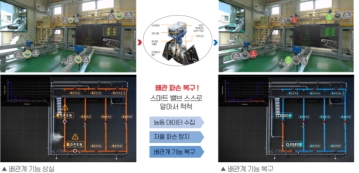
A smart valve that automatically repairs damaged piping in the event of accidents has been developed for the first time in Korea, and it is drawing expectations that it will quickly restore damaged piping within the golden time window during future piping failure incidents, thereby preventing major accidents.
2022.10.28by 배종인 기자
.jpg)
KIMM Develops Underwater Cutting Simulator for Reactor Decommissioning
A remote virtual simulator for worker training in underwater laser and plasma cutting of reactor internal structures (RVI) required for nuclear power plant decommissioning has been developed for the first time in Korea.
2022.11.11by 배종인 기자
KIMM and KIMS Join Hands on 1.2 Billion Won Fund for National Strategic Technological Capabilities
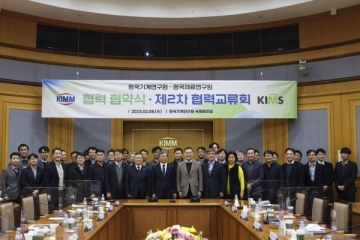
The Korea Institute of Machinery and Materials (Director Park Sang-jin) and the Korea Institute of Materials Science (Director Lee Jung-hwan) have signed a research cooperation agreement to secure differentiated technological competitiveness in the national strategic technology sector and held a cooperation exchange meeting.
2023.02.08by 배종인 기자
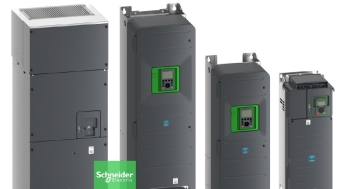
Schneider Aims for Building Energy Savings and Operational Stability with Next-Generation HVAC Drives
Schneider Electric has unveiled its next-generation HVAC drive product line 'Altivar HVAC'. The new product line's key features center on enhanced energy savings, system operational stability, and building management system integration. The products are divided into 'ATH200' for OEM and small equipment applications, and 'ATH600' for environments requiring continuous operation and advanced control. The company plans to expand the application scope from commercial buildings to facilities where HVAC system stability is critical, such as hospitals, airports, and data centers. The announcement includes over 30% energy savings, operation from -10°C to +60°C, Modbus and BACnet support, and compatibility with low global warming potential refrigerants.
2026.03.26by 명세환 기자
Ecolab Expands AI Data Center Cooling Business Through Acquisition of CoolIT
Ecolab has agreed to acquire CoolIT Systems, a liquid cooling company for AI data centers, for approximately $4.75 billion. The transaction is expected to close by Q3 2026, subject to regulatory approvals. CoolIT has been supplying direct-to-chip cooling-based coolant distribution units, cold plates, and manifolds, serving hyperscale data centers and colocation operators as customers. This acquisition is a measure to address the high-heat and high-density server environments created by AI proliferation. Ecolab plans to combine its water management and digital monitoring capabilities with CoolIT's hardware technology to expand its data center cooling business.
2026.03.26by 명세환 기자











