



Universal Robots, “Machine Tending Automation Immediately Addresses ‘Labor Shortage’”
 Published2023.03.07 11:38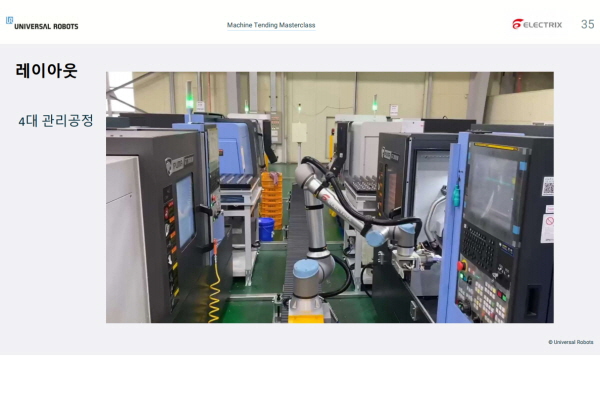
▲ A single collaborative robot managing four machine tools
Achieve rapid ROI, increase productivity, and flexibly handle labor shortages
It was found that by establishing machine tending automation using collaborative robots, it is possible to actively address the rapidly increasing labor shortage in industrial sites and flexibly respond to sudden increases in orders.
Universal Robots held a webinar on the 7th via e4ds eeWebinar on the topic of 'Collaborative Robot Utilization Guide - Machine Tending with Cobots'.
Jae-ik Lim, Manager at Universal Robots, and Jung-min Lee, Partner at Electrotrix, who led the presentations at this webinar, introduced Universal Robots' collaborative robot series, training programs, and examples of machine tending automation.
When operating machine tools such as CNCs, it is essential to load the material for processing into the machine tool and remove the workpiece.
This task has the disadvantage that efficiency varies depending on the worker's condition, and worker fatigue increases as working time increases. In addition, the risk of safety accidents is high for unskilled workers.
In addition, there are cases where additional workers are required for night work due to a sudden increase in order volume.
In such cases, while increased costs are a problem, the inability to find personnel in a timely manner is a major disadvantage.
In such situations, there is an advantage in that the machine tending function of collaborative robots can solve the problem of labor shortages and replace unskilled labor.
Unlike commercial robots, collaborative robots allow for rapid installation, programming by anyone, and flexible redeployment depending on the work situation. They also offer the advantages of utilizing limited space, collaborating with humans, and being cost-effective due to a quick return on investment.
Based on these advantages, the demand for collaborative robots is surging in the implementation of machine tending automation.
Depending on the work environment, a single collaborative robot can handle one, two, or four or more machine tools, and can process various types of products.
Looking at a key case, AF Fasteners implemented machine tending automation with collaborative robots to increase production volume, which resulted in rapid automation adoption, a 40% increase in productivity, and a rapid ROI within eight months.
Benham Engineering required flexibility for various products across diverse production facilities and faced difficulties in finding personnel for continuous night shifts, so they implemented machine tending automation using collaborative robots. Through this, productivity was increased by 40%, and ROI was achieved within 8 months.
UPE Engineering introduced collaborative robots to address the difficulties caused by rising labor costs and the need for efficiency. They maximized efficiency, reduced scrap, and realized machine operations, achieving a 40% increase in production volume and ROI within 12 months.
Based on these examples, collaborative robots are establishing themselves as an excellent solution for increasing production output and uptime in manufacturing sites.
Universal Robots, which supplies such collaborative robots, offers products such as the UR3e, UR5e, UR16e, UR10e, and UR20 depending on the payload.
In addition, it provides software for easy programming and a fast installation process that allows even beginners to install the product within one hour. Furthermore, it offers easy maintenance through the use of grease with a semi-permanent lifespan, magnetic absolute encoders, and motors with integrated joints.
In addition, UR is actively supporting users of collaborative robots through service solutions such as RU Care, UR Insight, and UR Performance, as well as online and offline training through the UR Academy.
The proliferation of collaborative robots is expected to continue surging in the future to address labor shortages, improve productivity, and increase investment efficiency.

Comments
Related news
Universal Robots Leads Automation Solutions
Universal Robots, which commercialized the world's first collaborative robot, asserts that collaborative robots can be applied across all industrial sectors to realize automation and enhance productivity by assisting humans and creating synergistic effects.
2022.11.02by 김예지 기자
Universal Robots "Will Grow Domestic Collaborative Robot Market"
Global collaborative robot specialist Universal Robots held a press briefing for the domestic launch of the UR20 at BotBotBot in Seongsu-dong on the 7th, where it demonstrated the new product UR20 and presented industry prospects and future plans for collaborative robots.
2022.12.07by 김예지 기자
Universal Robots Presents Solution to Labor Shortage and Automation Challenges
Universal Robots will hold a webinar on March 7 through e4ds with the theme of 'Collaborative Robot Utilization Guide - Machine Tending with Cobots'.
2023.03.02by 배종인 기자

Korea Instrument, KOLAS Accredited Calibration Agency First to Simultaneously Acquire ISO/IEC 27,001·27,701
Korea Instrument has become the first among KOLAS accredited calibration agencies to simultaneously acquire ISO/IEC 27,001 and ISO/IEC 27,701 certifications. Through its proprietary platforms CWIZ Enterprise and CWIZ Partners, the company has embedded information security and personal data protection requirements across all business processes including customer information, equipment data, and calibration reports, with plans to continuously advance its management system through regular audits and security inspections.
2026.10.12by 배종인 기자
TeamViewer One, IT Incident Automation Workflow and Resolution Center Enhanced
TeamViewer has added IT incident automation capabilities and an advanced Resolution Center to its integrated digital workplace management platform 'TeamViewer ONE'. Recurrent service disruptions, configuration errors, and capacity shortages are automatically handled according to preset policies, and device status verification through script deployment can be managed in a unified interface, significantly reducing repetitive tasks for IT teams.
2026.10.12by 배종인 기자











