



KIMM, Robot Harvests Crops Without Human Assistance
 Published2023.03.13 16:43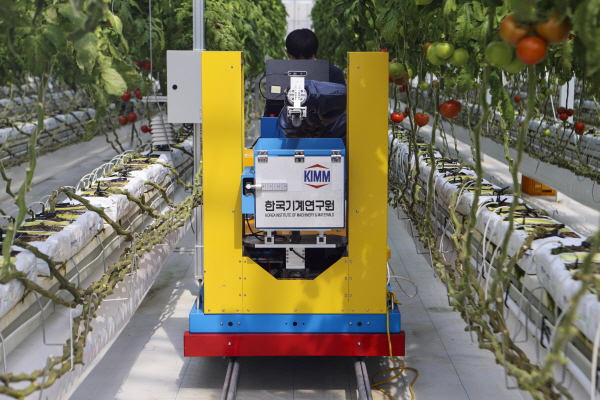
▲ Greenhouse horticulture crop harvesting robot
A robotic system has been developed that harvests and transports crops autonomously without human assistance in facility horticulture, such as smart farms.
The Korea Institute of Machinery and Materials (KIMM), under the Ministry of Science and ICT (President Park Sang-jin), announced on the 9th that a research team led by Principal Researcher Choi Tae-yong of the Robot Mechatronics Laboratory at the AI Robot Research Division has developed a multi-robot system for harvesting horticultural crops that can assist humans in agricultural fields facing severe labor shortages by automatically harvesting crops and transporting the harvested crops to a loading dock via autonomous driving.
A multi-robot system for harvesting horticultural crops, consisting of harvesting robots and transport robots, is expected to help resolve the difficulties faced by agricultural sites where crops are plowed under because they cannot be harvested due to severe labor shortages.
By fully automating the harvesting and transportation processes of the entire horticultural facility, it demonstrated the potential to automate not only harvesting but also various labor-intensive tasks in the agricultural field.
The agricultural environment is complex and highly variable, making it difficult to apply robots and requiring a very high level of technical expertise. This is why research on robots for harvesting in greenhouse horticulture has remained at an early stage.
Existing robotic technology for horticultural crop harvesting was limited to the implementation of single-crop harvesting functions. The Dutch SWEEPER robot was developed exclusively for harvesting bell peppers, while in Korea, robots dedicated to harvesting strawberries, cucumbers, and Korean melons are being developed.
On the other hand, the multi-robot system for horticultural crop harvesting developed by the KIMM this time goes beyond mere harvesting; by establishing a multi-robot-based harvest-transport linkage technology, it enables the automation of crop harvesting operations for the entire horticultural facility.
It consists of a crop harvesting robot that actually harvests crops and a transport robot that carries the harvested crops to the rear. There is no limit to the number of units, so multiple harvesting robots can harvest crops simultaneously, and multiple transport robots can carry them to the rear.
In particular, the harvesting robot applies KIMM's advanced mechanical and artificial intelligence technologies to recognize crop information with high speed and precision in greenhouse environments, and utilizes a robotic arm and a directly developed high-power robotic hand to harvest even tough crops without difficulty. Additionally, the transport robot is capable of precise autonomous driving in greenhouse environments.
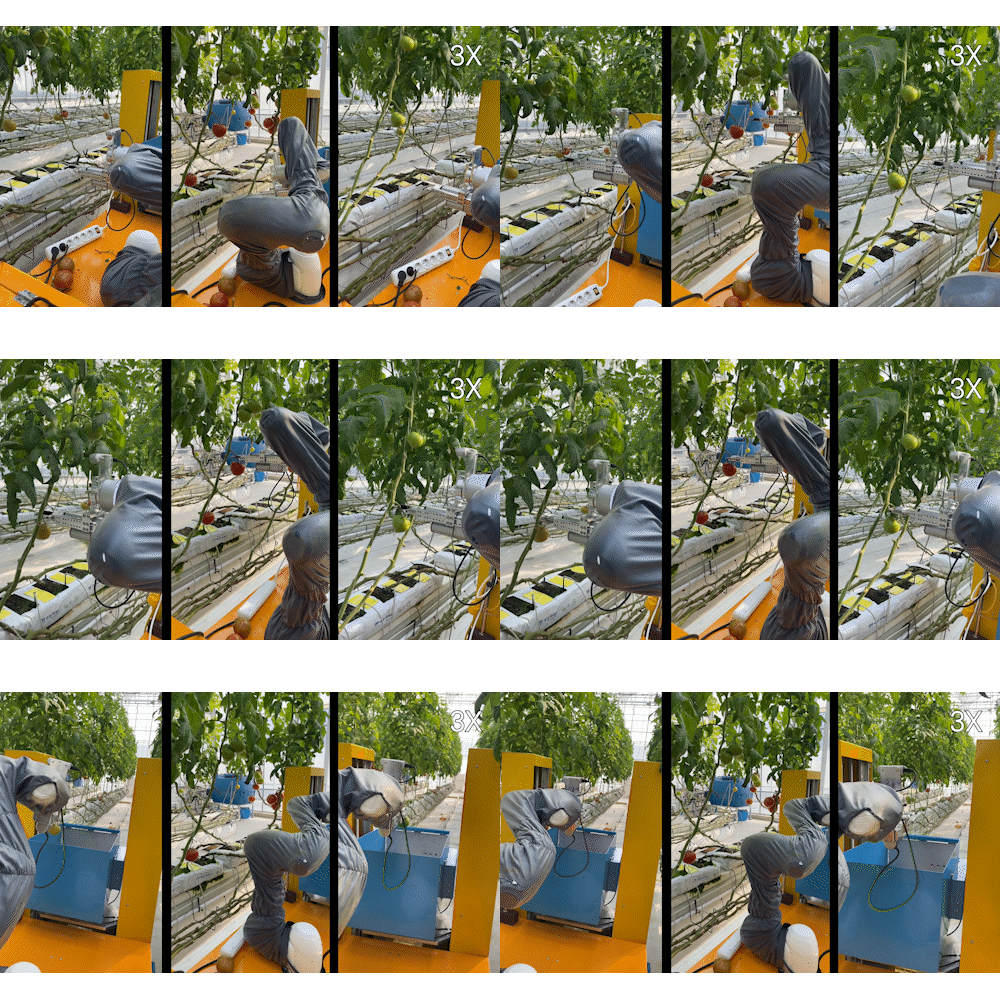
The harvesting robot applies AI technology to recognize the location and orientation of crops to accurately identify their positions, and harvests the recognized crops using a specially designed robotic harvesting hand. The harvested crops are temporarily stored in a harvesting robot, and when the box is filled to a certain level, a transport robot is called to deliver the crops.
The research team succeeded in developing a system capable of harvesting crops with 80% efficiency compared to humans, assuming a crop recognition rate of over 90% and 24-hour operation.
Choi Tae-yong, a principal researcher at the Korea Institute of Machinery and Materials, stated, “The multi-robot system for harvesting horticultural crops developed this time marks the beginning of research aimed at solving the labor shortage problem in disappearing rural areas,” adding, “We will continue research to enhance performance and functionality so that it can be used not only in indoor facility horticulture but also in various manual tasks in outdoor environments such as orchards.”
Meanwhile, this research was conducted as part of the 'Advanced Agricultural Machinery Industrialization Technology Development Project' managed by the Korea Institute of Planning and Evaluation for Agricultural and Food Technology (IPET) under the Ministry of Agriculture, Food and Rural Affairs, with the participation of Hada Co., Ltd., the National Institute of Agricultural Sciences, Chungbuk National University, and Chungnam National University.

Comments
Related news
A robotic hand with an elephant trunk that can even grasp micro-needles.
An elephant trunk-inspired gripper robot has been developed that can grasp everything from very thin objects like acupuncture needles to large objects like boxes, and is expected to be applicable to various fields including effective material handling.
2022.10.21by 배종인 기자
KIMM Develops Self-Repairing Valve for Damaged Pipes
A smart valve that automatically repairs damaged piping in the event of accidents has been developed for the first time in Korea, and it is drawing expectations that it will quickly restore damaged piping within the golden time window during future piping failure incidents, thereby preventing major accidents.
2022.10.28by 배종인 기자
.jpg)
KIMM Develops Underwater Cutting Simulator for Reactor Decommissioning
A remote virtual simulator for worker training in underwater laser and plasma cutting of reactor internal structures (RVI) required for nuclear power plant decommissioning has been developed for the first time in Korea.
2022.11.11by 배종인 기자

Korea Instrument, KOLAS Accredited Calibration Agency First to Simultaneously Acquire ISO/IEC 27,001·27,701
Korea Instrument has become the first among KOLAS accredited calibration agencies to simultaneously acquire ISO/IEC 27,001 and ISO/IEC 27,701 certifications. Through its proprietary platforms CWIZ Enterprise and CWIZ Partners, the company has embedded information security and personal data protection requirements across all business processes including customer information, equipment data, and calibration reports, with plans to continuously advance its management system through regular audits and security inspections.
2026.10.12by 배종인 기자

TeamViewer One, IT Incident Automation Workflow and Resolution Center Enhanced
TeamViewer has added IT incident automation capabilities and an advanced Resolution Center to its integrated digital workplace management platform 'TeamViewer ONE'. Recurrent service disruptions, configuration errors, and capacity shortages are automatically handled according to preset policies, and device status verification through script deployment can be managed in a unified interface, significantly reducing repetitive tasks for IT teams.
2026.10.12by 배종인 기자











