



[Technical Contribution] ADI's Frederik Dostal: Designing More Compact Power Supplies with Just One Inductor
 Published2023.03.14 15:47
LTM4668, 인덕터 내장·4개 채널·높은 전력밀도 달성
MAX77655, 단일 인덕터 사용 모든 채널 에너지공급
 오늘날 거의 모든 전자 회로는 여러 개의 전원 전압을 필요로 한다. 따라서 요구되는 서로 다른 전압 레일에 적합한 전원 관리 아키텍처를 설계해야 한다.
통상적으로 이를 위해서 스위칭 레귤레이터 방식의 멀티채널 컨버터를 사용한다. 이러한 설계 방식에서는 스위칭 레귤레이터에 각각의 인덕터가 필요하다.
최종 제품의 경우, PCB 공간을 되도록 덜 차지하고 관련 비용을 낮추는 것이 중요하다. 이러한 목표를 달성하기 위해 주로 많이 사용하는 방법이 집적화이다.
반도체에 회로를 집적하는 것은 저전력 스위칭 레귤레이터와 선형 레귤레이터에 특히 적합하다. 시중에는 집적 수준이 매우 높은 스위칭 레귤레이터 IC 제품들이 다양하게 출시되어 있다.
이러한 제품을 전원 관리 IC(power management integrated circuit, PMIC)라고도 한다. 그림 1은 이처럼 고도의 집적 수준을 나타내는 DC-DC 컨버터 제품인 ADP5014를 보여준다.
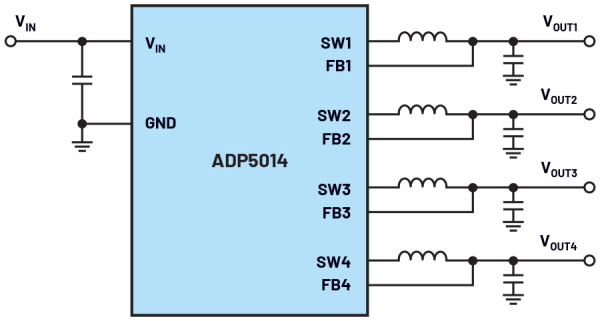
▲그림 1 : DC-DC 컨버터의 사례로서, ADP5014는 하나의 입력 전압을 사용해서 최대 4개의 출력 전압을 제공한다.(개략도)

그림 1의 회로를 더 작게 만들기 위해 인덕터들을 패키지 안에 통합할 수도 있다. 그림 2의 LTM4668이 바로 그러한 솔루션이다. LTM4668은 4개 채널을 제공하며, 패키지 내부에 꽤 큰 인덕터들을 내장하고 있어 필요한 외부 부품 수가 적다.
LTM 모듈 제품군은 높은 전력 밀도를 달성하고, EMC 동작이 우수하며, 견고성이 뛰어나다. 다만 외부 부품들을 사용하는 솔루션에 비해 가격이 좀 더 비쌀 수 있다.
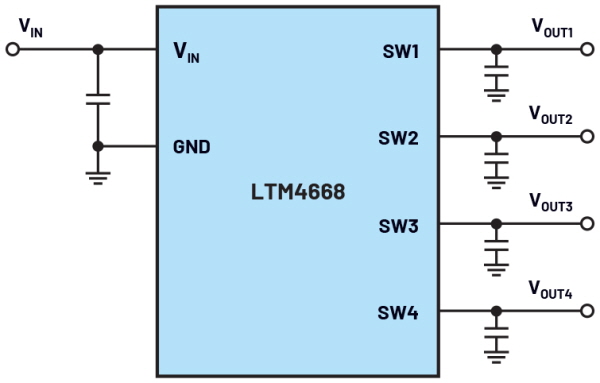
▲그림 2 : 인덕터를 패키지 내부에 통합한 LTM4668을 사용한 컴팩트한 솔루션(개략도)
세 번째 솔루션은 개념적으로는 그림 1과 비슷하지만, 단일 인덕터 다중 출력(single-inductor multiple output, SIMO) 컨버터를 사용한 것이다.
이 솔루션은 하나의 인덕터를 에너지 저장 장치, 특히 전류 저장 장치로 사용하고 모든 채널들이 이 인덕터를 공유한다. 이 솔루션은 다양한 형태로 구현할 수 있다.
어떤 제품은 어느 한 시점에 인덕터를 충전하고 이 에너지를 서로 다른 채널로 부분적으로 방전할 수 있다.
또한 어떤 제품은 한 채널로 인덕터를 충전하고 완전히 방전하고, 이 빈 에너지 저장 장치를 다음 채널로 넘겨서 이 채널에서 다시 충전 및 방전한 다음, 또 다음 채널로 넘어가는 식으로 모든 채널들에 에너지를 공급한다.
전원장치는 주어진 구현 방식에 따라서 특성이 다를 수 있다. 일반적으로 이러한 컨셉트는 비교적 저전력과 잘 맞는다. 내부 MOSFET의 크기와 단일의 외부 인덕터를 사용한다는 점에서 저전력에 잘 맞는다.
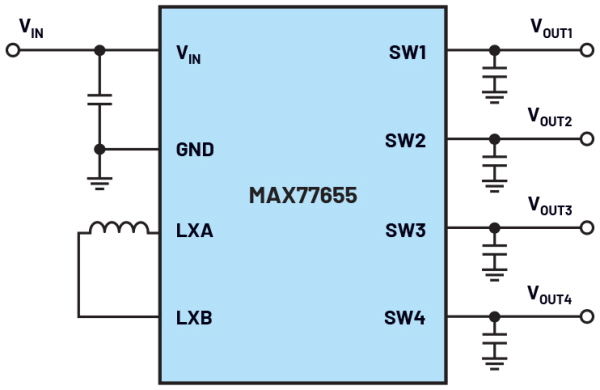
▲그림 3 : MAX77655 SIMO 컨버터는 하나의 IC와 하나의 인덕터만을 사용해서 4개의 전압을 제공한다.(개략도)
MAX77655의 내부 집적 스위치는 단일 인덕터를 사용해서 모든 채널에 에너지 공급이 가능하게 할 뿐만 아니라, 가용 전압을 더 높거나 더 낮은 전압으로 변환할 수 있게 해준다. 내부 MOSFET을 적절히 구동함으로써 특정한 동작 모드가 가능해진다.
그림 3의 SIMO 컨버터는 단 1개의 에너지 저장 인덕터만을 사용해서 여러 전압을 효율적으로 발생할 수 있다. 이는 보다 컴팩트한 전원 관리 아키텍처를 달성할 수 있으며 비용도 더 낮출 수 있게 해준다.
###
※ 저자 소개
글 : 프레데릭 도스탈(Frederik Dostal) 수석 엔지니어 / 아나로그디바이스(Analog Devices, Inc.)
프레데릭 도스탈(Frederik Dostal)은 전원 관리 전문가로서 이 분야에서 20년 넘게 종사해 왔다. 독일의 에를랑겐 대학에서 마이크로일렉트로닉스를 전공하고, 2001년에 내셔널 세미컨덕터(National Semiconductor)에 입사해 FAE로서 고객 프로젝트로 전원 관리 솔루션 구현에 있어서 풍부한 경험을 쌓았으며, 애리조나주 피닉스에서 4년 간 근무하면서 애플리케이션 엔지니어로서 스위치 모드 전원장치를 담당했다. 2009년에 아나로그디바이스에 입사했으며, 이후로 제품 라인 및 유럽 고객 기술 지원과 관련한 다양한 직책을 거쳤다. 현재는 풍부한 설계 및 애플리케이션 지식을 바탕으로 전원 관리 전문가로서 ADI 뮌헨 지사에서 근무하고 있다. 문의: frederik.dostal@analog.com

Comments
Related news

[Technical contribution] ADI Frederik Dostal - “Burst mode and pulse skipping must be checked when designing power supply”
Analog Devices, Inc. FAE Frederik Dostal presents a solution to explain why pulses appear to be omitted in switch mode power supplies.
2022.02.15by 명세환 기자

[Technical Contribution] ADI Frederic Dostal - How to Miniaturize Power Supplies
Analog Devices' Frederik Dostal discusses the miniaturization of power supply units.
2022.07.12by 명세환 기자

[Technical Contribution] ADI Frederic Dostal – Dynamic Control Method for Optimal Output Voltage
Let's hear from Frederik Dostal, FAE at Analog Devices, Inc., about the dynamic adjustment method for appropriate output voltage.
2022.12.06by 명세환 기자

Intel Unveils Next-Generation 'Core Ultra Series 3' and vPro Platform for Enterprise PCs
Intel has officially unveiled the "Intel Core Ultra Series 3" for next-generation enterprise PCs and the latest vPro platform, addressing a wide range of demands from enterprise notebooks to high-performance workstations.
2026.03.26by 배종인 기자
ROHM Launches ESD Protection Diode Compatible with High-Speed Interfaces of 10Gbps or Higher
Semiconductor specialist ROHM has developed the 'RESDxVx series' of ESD (electrostatic discharge) protection diodes capable of responding to next-generation high-speed data communication environments exceeding 10Gbps, simultaneously enhancing both signal quality maintenance required in high-speed interfaces and IC protection performance.
2026.03.26by 배종인 기자











