


[2023 IIoT Innovation DAY] Chairman Park Han-koo, “Responding to Carbon Regulations by Building Cloud-Based Smart Factories”
 Published2023.04.04 16:42
.jpg)
e4ds news '2023 IIoT Innovation DAY' held at COEX in Samseong-dong last March
Industry 5.0 Aims for Collaboration Between Humans, Robots, and AI
Smart Factory: Reducing Carbon Emissions, Enhancing Safety and Security
Digitalization of the manufacturing industry supply chain… Adoption of a single cloud
Experts have argued that the private sector can actively respond to carbon regulations by establishing cloud computing-based smart factories.
Park Han-koo, Honorary Chairman of the Korea Industry 4.0 Association and former Director of the Smart Manufacturing Innovation Promotion Team, discussed rapidly changing global trends, this year's outlook, and response measures at the '2023 IIoT Innovation DAY' seminar hosted by e4ds news last March.
At the event, Chairman Park Han-koo argued, “Large corporations and SMEs in the value chain must collaborate to build smart factories and collect and share data through a single cloud to respond to carbon regulations.”
First, Chairman Park reviewed the latest industrial trends. Industry 4.0, which originated in Germany in 2011, is evolving into a human-centered circular economy based on adding services to smart manufacturing. Starting in 2022, the EU has shifted its focus to Industry 5.0, emphasizing the collaboration between robots and artificial intelligence. Chairman Park said, “Industry 4.0 is ongoing, and the direction we intend to pursue in the future is the revival of the people-centered manufacturing industry of Industry 5.0.”
The world is shifting to the era of data capitalism. This means that data generates greater added value than products. Countries such as the United States, Japan, and Germany are sparing no effort in providing policy support to create new value based on data.
The EU established an organization called Gaia-X to facilitate seamless interfaces between different platforms, making it easier to secure data sovereignty. For instance, it defined standardized protocols that enable the easy exchange of data between different countries and companies, such as from AWS to Auzure.
Meanwhile, the entire world is engaging in a war of various export regulations to secure a leading position in global markets. The EU has introduced a 'Digital Product Passport' that tracks carbon emissions and origins, mandating electronic information that allows consumers to assess sustainability within the product supply chain. At the time of final product production, origin tracking and carbon footprints are aggregated, and a passport must be attached to every single product.
For example, starting from 2024, in order to maximize battery safety and ensure recycling through battery passports, products such as industrial and automotive batteries must be designed according to recycling standards in accordance with eco-design regulations to be exportable to Europe or the United States.
In addition, the Carbon Border Adjustment Mechanism (CBAM) is a trade tariff introduced by the EU to address carbon leakage issues in countries with strict carbon emission reduction regulations. If this is fully implemented, the burden on domestic industries is estimated at 8.2456 trillion won by 2030, making a response urgently needed.
■ Inter-company collaboration and data sharing are essential across the value chain
Chairman Park states that the answer can be found in smart factories. He explains that once a smart factory is established, there is no need to build a separate system, as one can simply create a "passport" using reliable, internationally recognized data calculating carbon emissions measured within the factory. He also emphasized the ancillary benefits of introducing collaborative robots in smart factories, such as ensuring safety by eliminating 3D tasks on the production floor for humans.
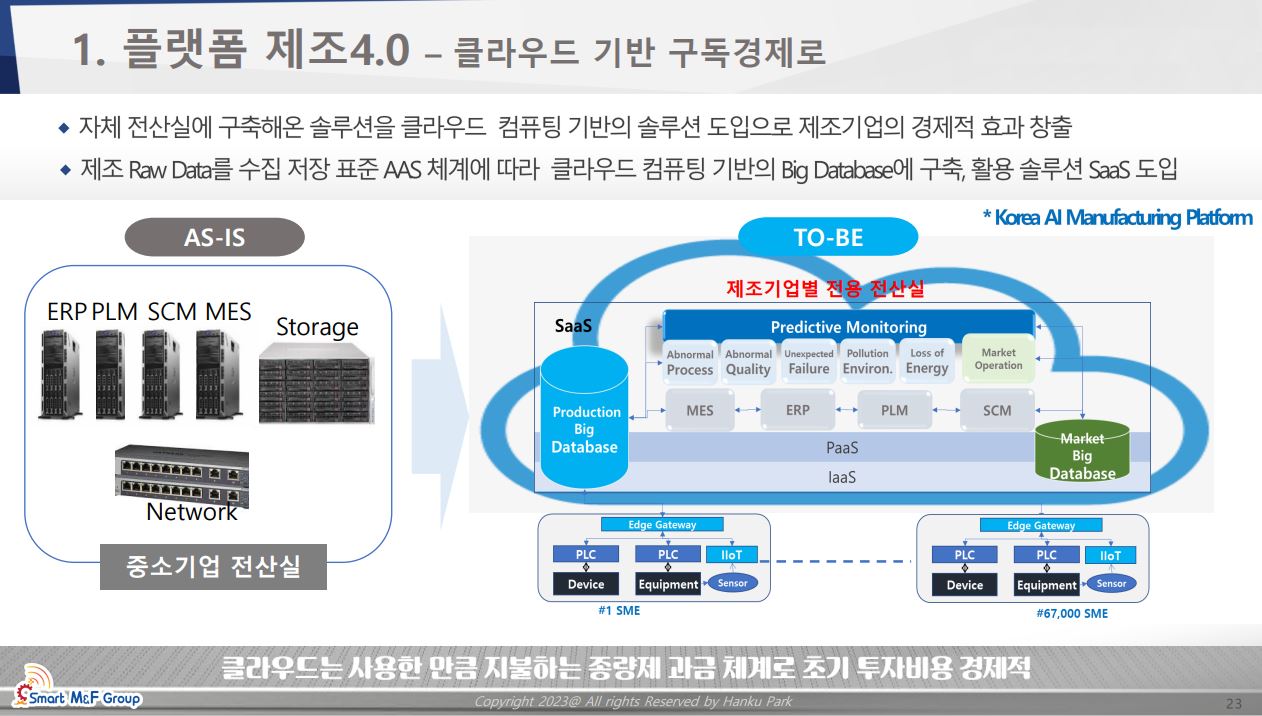
The digitalization of the manufacturing industry's supply chain, including the establishment of smart factories, was presented. In other words, services must be added to smart manufacturing. Chairman Park argued, "It must be developed as SaaS based on a single cloud platform."
Adopting cloud computing can generate economic benefits by replacing in-house data center solutions with computing-based solutions. Furthermore, companies within the manufacturing value chain can be networked to optimize processes and secure a competitive edge. It is economical as companies are not subject to carbon emission quotas per ton of product, and it promotes a circular economy in response to carbon regulations. In addition, not only is security enhanced, but cloud computing also offers the advantage of eliminating the need to install separate security systems.
Although Korea is establishing a presence on cloud service platforms such as Google, Microsoft, and Amazon, it is still at an insufficient level. Chairman Park urged large corporations and SMEs to work together to implement a single cloud subscription economy.
In particular, Chairman Park encouraged small and medium-sized enterprises (SMEs) to expand their investments on their own initiative. This year, the government's investment budget was cut to 100 billion won, compared to 300 billion won last year. The government is focusing on improving the quality of data-based smart factories. The government must establish a consultative body to help SMEs currently dependent on large corporations acquire new customers, produce more products, achieve economies of scale, and grow into mid-sized enterprises.
Chairman Park stated, “This year marks the starting point for companies in the value chain to work together to build smart factories, share collected data, and create a ‘passport’ to respond to carbon regulations,” adding that “we must promote collaboration to develop new business models.”
Comments
Related news
[Interview] Park Han-gu, Head of the Smart Manufacturing Innovation Promotion Team: "Smart manufacturing innovation requires building a digital economy system centered on mid-sized companies." (Part 1)
We arranged an interview session to hear from Park Han-gu, Director of the Smart Manufacturing Innovation Promotion Team, who oversees the domestic smart factory dissemination and expansion project, regarding future smart factory support project policies.
2022.03.29by 김예지 기자
[Interview] Park Han-gu, Head of Smart Manufacturing Innovation Promotion Team - “Smart manufacturing innovation, medium-term-centered digital economic system must be established” (2)
We arranged a meeting to hear from Park Han-gu, Director of the Smart Manufacturing Innovation Promotion Group, who oversees the domestic smart factory promotion and diffusion project, and to discuss future smart factory support business policies.
2022.03.29by 김예지 기자
[Interview] Park Dong-joo, Chair of the 5G Forum Ecosystem Strategy Committee: "5G-specific networks represent a new opportunity, and awareness must be improved."
A 5G private network is a network that allows operators to obtain mobile telecommunications business licenses to operate dedicated 5G networks for specific purposes in specific regions, offering the advantage of being able to configure optimized solutions tailored to requirements. This publication met with Park Dong-joo, chairman of the 5G Forum, to examine the characteristics of 5G for smart factory construction and the importance of 5G private networks.
2023.02.07by 김예지 기자
[Interview] Shin Jae-seung, Principal Researcher at ETRI – “5G Enables Remote Control as Fast as Wired”
5G is expanding its application scope in the smart manufacturing market to simultaneously handle real-time control and high-capacity data transmission in manufacturing facilities. We spoke with ETRI researcher Shin Jae-seung about the research on 5G Industrial Internet of Things for smart factory construction and the current status of verification of remote control and monitoring services domestically and internationally.
2023.02.13by 김예지 기자
[Interview] Jihoon Kang, Ericsson LG Team Leader - “Ericsson EP5G, 5G Specialized Network Construction in 1 Hour”
With the introduction of 5G private networks driving transformation in manufacturing and logistics sectors, Ericsson LG is moving forward to capture the 5G private network equipment market. We met with Kang Ji-hoon, team leader at Ericsson LG, to hear about the company's solutions for 5G application and service development.
2023.02.28by 김예지 기자











