



Investing 160 trillion won over five years in semiconductors, displays, and next-generation batteries.
 Published2023.04.06 09:19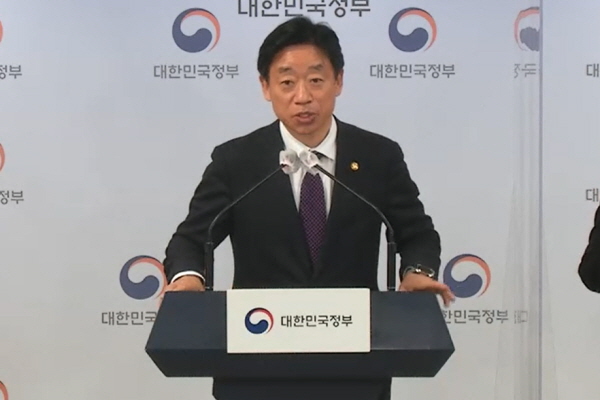
▲Oh Tae-seok, First Vice Minister of Science and ICT, is announcing the ‘Three Major Technology Future R&D Strategy.’
Securing a total of 100 key future technologies
The government will invest 160 trillion won over five years in three key technologies: semiconductors, displays, and next-generation batteries, and enter a race to secure world-leading, ultra-gap technologies.
The Ministry of Science and ICT (Minister Lee Jong-ho) announced a joint R&D strategy for the three major key technologies, semiconductors, displays, and next-generation batteries, with related ministries at the Emergency Economic Ministers' Meeting on the 6th to secure future core technologies in Korea's three major key technologies: semiconductors, displays, and next-generation batteries.
According to this, first, a 'public-private research consultative body' at the inter-ministerial level will be established and operated for each field.
Building on our private sector's outstanding competitive edge, proactive R&D investment based on public-private collaboration is urgently needed to secure a leading position in the future markets of the three major technology sectors. Until now, the three key technology sectors have tended to be supported in a fragmented manner, with the basic/original, application/development, and commercialization stages being the most common.
The government is working with the Ministry of Science and ICT and the Ministry of Trade, Industry and Energy to overcome these problems and provide continuous research support centered on private sector demand technologies.A "public-private research council" comprised of ministries supporting R&D projects in three key technology fields, including the Ministry of Science and ICT, and experts and organizations from industry, academia, and research will be established within this year to seamlessly link all stages of R&D, from R&D project planning to sharing and utilizing research results.
In addition, the government plans to invest a total of 160 trillion won in public-private R&D funds over five years until 2027 to secure ultra-gap technologies and create new markets in the three key technology fields of semiconductors, displays, and next-generation batteries, in cooperation with the private sector.
The government selected a total of 100 future core technologies during the strategy formulation process.
For semiconductors, a total of 45 technologies were selected in three fields: devices, design, and processes; for displays, a total of 28 technologies were selected to secure ultra-realistic, next-generation free-form, and convergence/composite technologies; and for next-generation batteries, a total of 27 technologies were selected in the fields of secondary batteries, hydrogen fuel cells, and isotope batteries. Future core technologies are revised and supplemented every year to provide focused support.
Furthermore, government R&D in the three key technology fields will be supported in a balanced manner by strengthening basic and fundamental stages and next-generation technologies, as well as application and development stages and current-generation technologies.
In addition, we plan to actively promote R&D, human resources, and tax support by utilizing the strategic technology-related laws and systems of each ministry to ensure that R&D investments can be made quickly in necessary technology fields in the private sector. To this end, inter-ministerial communication and cooperation will be strengthened to ensure that key technologies from private companies are immediately reflected in the support targets when selecting detailed technologies for national strategic technologies under the Special Taxation Act.
Thirdly, we will support the development of high-level human resources with master's and doctoral degrees, as well as specialized human resources, so that they can advance into the private sector at the right time.
The government will establish and expand projects to build university research centers to cultivate advanced human resources with master's and doctoral degrees in each of the three key technology fields. It will also actively support the development of professional human resources who can be immediately deployed in the field through measures such as the establishment of a contract quota system, contract departments, and specialized tracks.
Finally, to promote R&D to secure future super-gap technologies, we will establish a researcher-centered infrastructure and activate international cooperation.
We are promoting the establishment of a specialized open fab centered on researchers capable of producing new semiconductor-related materials and structure-based prototypes, and we are also creating a customized research infrastructure for displays and next-generation batteries. In addition, the division of roles between existing fabs, such as the Nano Convergence Technology Institute (Si CMOS process) and the Korea Nanotechnology Institute (compound process), will be clarified and cooperation will be strengthened.
In addition, we will strengthen international cooperation by holding a "Researcher Forum" and establishing joint R&D projects with technologically advanced countries to jointly solve key challenges in each technology through international collaborative research with countries such as the US and EU.
Minister of Science and ICT Lee Jong-ho said, “Semiconductors, displays, and next-generation batteries are key technologies that have supported our economy based on outstanding private sector capabilities,” and added, “We will continue to strengthen R&D investment through public-private collaboration to secure world-class, ultra-gap technologies in these three key technology fields, which are currently dominated by a winner-take-all structure.”
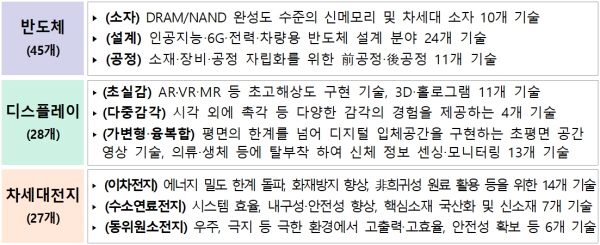
▲100 key future technologies

Comments
Related news
Investing 170 trillion won in science and technology R&D over 5 years
The government will invest 170 trillion won over five years in the development of 12 state-strategic technologies including space and quantum, as well as key areas such as carbon neutrality, through a mid-to-long-term investment strategy legislated for the first time.
2023.03.14by 배종인 기자
Will the semiconductor investment tax cut really work? The industry is watching closely for passage.
National capacity is being concentrated on fostering the semiconductor industry. With the government's vision being disclosed alongside private investment in system semiconductor development plans, the industry is closely monitoring the passage of amendments to semiconductor facility investment tax credits, referred to as the "K-Chips Act."
2023.03.17by 명세환 기자
Semiconductor VC investment at 90 billion won level in Q1
Despite concerns that VC investments in fabless startups may decline due to economic slowdown, promising startups have achieved significant fundraising results in the first quarter of this year.
2023.04.03by 명세환 기자
Nvidia invests $5 billion in Intel
NVIDIA and Intel, leaders in global AI computing technology, are now forging ahead in providing cutting-edge solutions through NVLink-based architecture integration. NVIDIA and Intel have officially announced a strategic partnership and stated that they will jointly develop customized data center and personal computing products to accelerate diverse applications and workloads ranging from hyperscale to enterprise and consumer markets, thereby laying the foundation for the next generation computing era.
2025.09.22by 배종인 기자
.jpg)
Applied Materials Launches Environmental Protection Campaign to Mark World Cleanup Day
Applied Materials Korea (CEO Park Kwang-seon) is carrying out environmental cleanup activities with employees and their families around the Dongtan Sinricheon area on the occasion of World Cleanup Day, evolving into a company that engages with the local community beyond technological innovation.
2025.09.22by 명세환 기자











