



[Creaform Contest 2023 Grand Prize Winner] Park Si-mon, CEO of Zion 3D
 Published2023.04.07 12:00
Accurate precision without micro thermal deformation during long-term use
Benefits of using 3D scanning: High degree of completion, time savings, and cost savings.
[Editor's Note]
Recently, Creaform held the "2023 Creaform Contest," a reverse-engineering competition utilizing 3D technology, including 3D scanners and 3D printers. Unlike previous events, this one involved experts acquiring scan data using 3D scanners, then using that data to reverse engineer, 3D print, and inspect the designs before judging the results. Notably, the contest went beyond simply evaluating the reverse-engineering skills of 3D scanner users to include the manufacturing of actual products, elevating their expertise. At this event, Zion 3D won the grand prize for their reverse-engineering of a laptop and cooling fan. Their concept was to attach a cooling fan to the inside of a laptop to solve overheating issues. They scanned a gaming laptop motherboard bottom case and a laptop cooling dock station. We interviewed Zion 3D CEO Park Si-mon to hear his thoughts on the award.
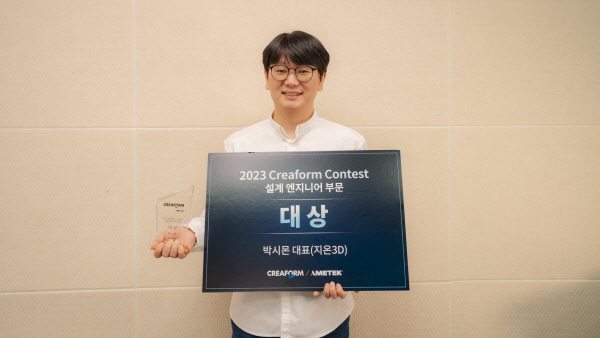
■ Please introduce yourself and explain why you are participating.
hello. This is Park Si-mon, the CEO of Zion3D, a company specializing in 3D scan reverse engineering.
I was close with the director and manager of Soltive Co., Ltd., and I happened to receive information about the contest. I thought it would be beneficial in many ways if I participated.
I currently use an optical 3D scanner, but this contest not only allowed me to compare and experience the performance of a laser 3D scanner, but also supported me in making a 'direct laptop cooling' device that I had been thinking about, so it was an easy decision to participate.
■ You won the grand prize at the 'Creaform Contest 2023'. Please share your thoughts on the award.
First of all, I thank God. And I would like to thank Creaform, the organizer of this event, and the Soltive staff who took the time to help me with my contest entries.
Before participating in this contest, I had never had the opportunity to experience a laser 3D scanner, but it was beneficial to be able to fully experience the performance of a laser 3D scanner over the three months from planning to completion.
I was also grateful that I was able to successfully create the 'notebook direct cooler' device that I personally wanted to create through this competition.
On the one hand, I was concerned that this entry might not be of much general interest, but I think it won because the engineering aspects were well-received.
Although we still have many shortcomings, we will do our best to utilize the laser 3D scanner in various ways in the future to reward you with interesting and useful content.
■ Please provide the topic and description of the final submission.
The title of this entry is 'Direct Notebook Cooler'.
I usually enjoy playing MMORPG games on my gaming laptop, but I was worried that the laptop would shut down due to internal heat generation.
So, I've been thinking about how to lower the temperature of the CPU and GPU, which are the sources of internal heat generation, and I thought it would be good to install a cooling fan on top of the CPU and GPU like in a desktop PC.
The cooling system of a conventional laptop transfers the heat from the CPU and GPU to heat pipes and exhausts the heat through small blower fans installed at both ends.
Additionally, because the laptop uses a long heat pipe due to its structure, the heat transfer section is longer than that of a desktop PC.
Therefore, the cooling performance is improved by transferring and dissipating heat to the blower fan as quickly as possible.
On the other hand, since increasing the rpm of the blower fans mounted on both ends of the laptop is already at its limit, the direction was set to lower the heat in the heat pipe section passing over the CPU and GPU.
Because the heat pipe has an insulating structure, the temperature cannot be lowered simply by external airflow.
So, we installed an aluminum heat sink on top of the heat pipe to create a structure that draws in as much heat as possible and cools it down with air.
Additionally, since heat transfer efficiency decreases when there is a micro gap between the heat pipe and the heat sink, thermal compound was applied and installed.
For the blower device, a powerful 120mm blower fan was used because the circular fan would be too bulky and have low cooling efficiency. The blower fan is USB type, so it can be conveniently powered and the wind speed can be adjusted.
To install the heatsink, a square hole the size of the heatsink was made on the bottom cover of the laptop so that the bottom cover could be assembled without interference, and a bracket for mounting the blower fan was designed so that the existing laptop bolting locations could be used in common.
To design this bracket, we needed to know several dimensions, including the location of the laptop's heat pipes, the location of the holes on the bottom cover, the gap between the motherboard and the bottom cover, and the size of the blower fan outlet. With the help of the Creaform laser 3D scanner, we were able to accurately measure these dimensions.
We aligned the mesh models of the motherboard, lower cover, and blower fan, which were created by 3D scanning using the VXmodel program provided by Creaform, to match their positions to the actual installation, and proceeded with the bracket design based on these dimensions.
The completed bracket model was 3D printed, and the dimensions of the output matched the design values almost exactly, making it very easy to assemble and operate.
I compared the temperatures before and after installing it while playing my usual MMORPG game. Before installing it, the CPU temperature went over 90℃, but after installing it, it stayed at around 65-70℃.
Of course, it seems that the CPU is Intel 6th generation i7-6700HQ, which has lower power consumption compared to the CPUs released now, so it seems that a large cooling effect was seen.
While building this device, we found that the cooling effect improved as the heat pipes and heat sink were tightly sealed, and we also felt that it would have been better to use a copper-based material with better thermal conductivity or a heat sink with a larger fin surface area.
If I ever get the chance to create content related to heat transfer, I'd like to use this experience to create a better device.
■ While working in the fieldIt must not have been easy to hold the meeting, but were there any difficulties during the contest process?
Due to the nature of my work, I often find myself hectic and lack the time to focus on the design of my submissions. Therefore, I worked as early as possible while I had the time. Anticipating the potential for future complications due to overlapping work, I also requested 3D printing ahead of the announced schedule.
On the other hand, the 3D printing schedule for the contest was set in advance, so I couldn't receive the samples during the time I wanted.
Unfortunately, the sample arrived while I was busy with work, which was a bit disappointing as it resulted in inefficient time management.
I think that if there were more time in the contest schedule to request and receive 3D printing results, we would be able to create more complete entries and production videos.
■ I know you're a design expert. I'm curious about how using a 3D scanner in design helps improve the final results. Also, from the perspective of a real user, what are the pros and cons of the Creaform 3D scanner?
First, from the perspective of product restoration or data management, only by using a 3D scanner can the dimensional information of all sections of the restoration target be accurately obtained, so restoration is possible exactly as the original, and data can be managed without missing sections.
From a design perspective, 3D scanning can be used to quickly create CAD models of existing, proven products to determine their dimensions, structure, and operating principles.
And rather than creating something from nothing, design work usually involves applying the design to a product by slightly modifying its key structure or operating principles to suit the situation.
Even if you refer to existing products, if you try to create a prototype design model from scratch, you will experience a lot of trial and error due to dimensional issues, and it will take a long time and be difficult.
On the other hand, using 3D scanning, you can easily and quickly create various prototype models and perform simulations based on CAD dimensional data.
Therefore, using 3D scanning for design allows you to quickly achieve a high-quality prototype model, reducing design time and costs.
I believe that the advantages of the Creaform 3D scanner lie above all in its dimensional accuracy and precision.
If heat management is not done during long-term use, precision may change due to slight thermal deformation, but in this respect, Creaform products seem very stable.
On the other hand, no matter how good the 3D scanner performance is, if the operating program is not good, it cannot perform at 100%. However, the Creaform 3D scanner driver VXmodel seems to have many functions and good data processing algorithms.
A drawback is that while the measurement resolution is precise, at 0.025mm, 0.05mm, and 0.1mm, the resulting mesh resolution is four times that, at 0.1mm and 0.2mm. If technically feasible, it would be nice to have a higher maximum mesh resolution.
■ I plan to be a promotional ambassador for the Creaform 3D scanner in the future. If you have any plans on how to proceed, please introduce them.
I am honored and grateful to be working as a Creaform ambassador.
During my time as an ambassador, I plan to utilize the 3D scanner in two directions.
First, since I do 3D scanning and reverse engineering for work, I plan to introduce a case where 3D scanners are highly utilized among the many requests I will receive in the future.
The other is to use 3D scanners to create more interesting and useful content from an engineering perspective. I enjoy fixing and modifying things.
So, expanding this interest a bit further, we plan to use 3D scanners to provide solutions for products that are inconvenient in daily life and products that have not been improved for a long time.
Of course, it won't be a perfect solution, but rather than simply relaying consumer complaints, I hope that by showing production cases that can help solve problems, developers will be inspired to create better products.
Also, since planning content alone can lead to a narrow field of vision, I will do my best to create useful content while communicating with Creaform managers and effectively promoting the 3D scanner.
thank you

Comments
Related news
[Creaform Contest 2023 Grand Prize Winner] Kwon Oh-hyun, CEO of Obed
We conducted an interview with Kwon Oh-hyun, Representative Director of Obed, who won the grand prize at the Creaphorm Contest 2023.
2023.04.07by 배종인 기자
[Creaform Contest 2023] Kim Geon-ah, Creaform Business Division Manager
We met with Kim Gun-a, head of the Creaform Business Division, who hosted and organized the Creaform Contest 2023, to hear about the overall details of the competition.
2023.04.07by 배종인 기자
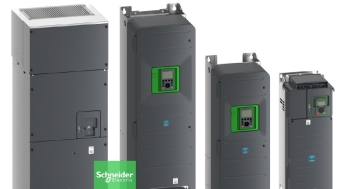
Schneider Aims for Building Energy Savings and Operational Stability with Next-Generation HVAC Drives
Schneider Electric has unveiled its next-generation HVAC drive product line 'Altivar HVAC'. The new product line's key features center on enhanced energy savings, system operational stability, and building management system integration. The products are divided into 'ATH200' for OEM and small equipment applications, and 'ATH600' for environments requiring continuous operation and advanced control. The company plans to expand the application scope from commercial buildings to facilities where HVAC system stability is critical, such as hospitals, airports, and data centers. The announcement includes over 30% energy savings, operation from -10°C to +60°C, Modbus and BACnet support, and compatibility with low global warming potential refrigerants.
2026.03.26by 명세환 기자
Ecolab Expands AI Data Center Cooling Business Through Acquisition of CoolIT
Ecolab has agreed to acquire CoolIT Systems, a liquid cooling company for AI data centers, for approximately $4.75 billion. The transaction is expected to close by Q3 2026, subject to regulatory approvals. CoolIT has been supplying direct-to-chip cooling-based coolant distribution units, cold plates, and manifolds, serving hyperscale data centers and colocation operators as customers. This acquisition is a measure to address the high-heat and high-density server environments created by AI proliferation. Ecolab plans to combine its water management and digital monitoring capabilities with CoolIT's hardware technology to expand its data center cooling business.
2026.03.26by 명세환 기자

AI Semiconductor Era, Key is 'Materials Technology'… KIEC Holds Seminar on High-Performance Semiconductor Materials
With rapid growth in the global semiconductor market driven by expanded AI data center investments and increased demand for high-bandwidth memory (HBM), a specialized seminar examining next-generation semiconductor materials and packaging technologies will be held. The Korea Chemical Industry Institute will host a "High-Performance Semiconductor Materials Technology Seminar" on April 24 at the FKI Tower of the Korea Economic Association in Yeouido, Seoul. Applications to participate in the seminar are being accepted on a first-come, first-served basis through the Korea Chemical Industry Institute's official website, with early bird discounts available until March 27 and advance registration open until April 22.
2026.03.25by 배종인 기자











