



The Ministry of Trade, Industry and Energy will invest 70% of its new R&D budget in 40 key sectors, including semiconductors.
 Published2023.04.10 14:47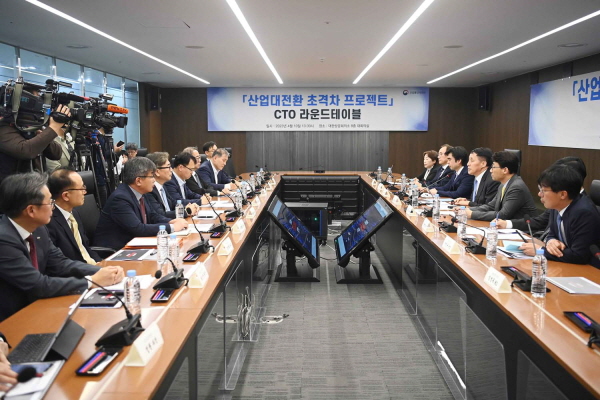
Formation of an institution-led consortium, linked development and verification
The Ministry of Trade, Industry and Energy is comprehensively reorganizing its core research and development projects into 34 missions and 40 projects, and is embarking on a concentrated investment strategy of investing 70% of the ministry's new R&D budget each year.
On the 10th, the Ministry of Trade, Industry and Energy held a CTO roundtable at the Korea Chamber of Commerce and Industry, chaired by First Vice Minister Jang Young-jin, with the attendance of CTOs from nine companies, including LX Semicon, Samsung Display, Hyundai Motor Company, POSCO, Eugene Robot, LG Innotek, L&F, Hanwha Aerospace, and CJ CheilJedang, and heads of four specialized organizations, including the Strategic Planning Division, Korea Institute for Advancement of Technology, Korea Evaluation Institute of Industrial Technology, and Korea Institute of Energy Technology Evaluation and Planning.
At this meeting, it was announced that the plan to promote the 'Industrial Transformation Super Gap Project' will be discussed and confirmed, which includes: △ focusing investment in projects for industrial transformation within the research and development (R&D) system; △ comprehensively reorganizing the investment, planning, and implementation system to ensure that the private sector with expertise and innovation capabilities has actual authority.
The Industrial Transformation Super Gap Project is being promoted in three major directions.
First, the public and private sectors will work together to establish clear goals and investment directions for each sector, select strategic projects, and focus investments on them.
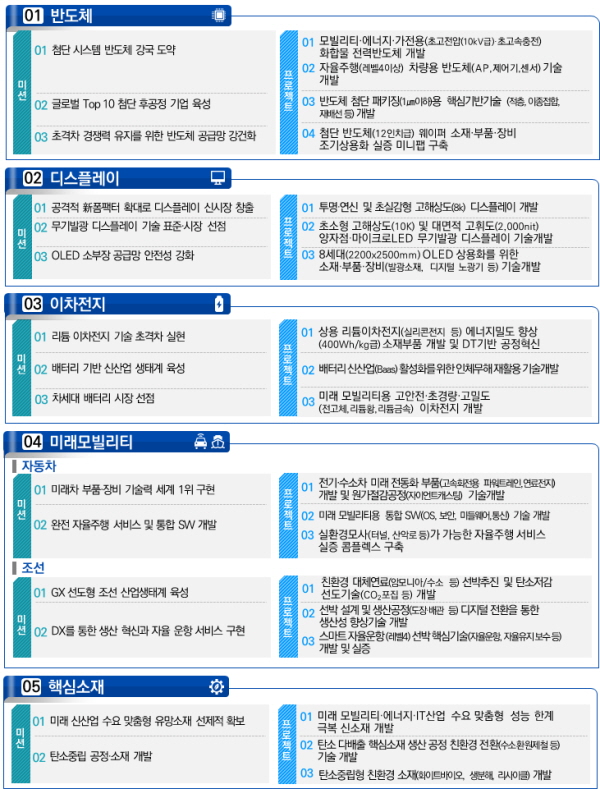
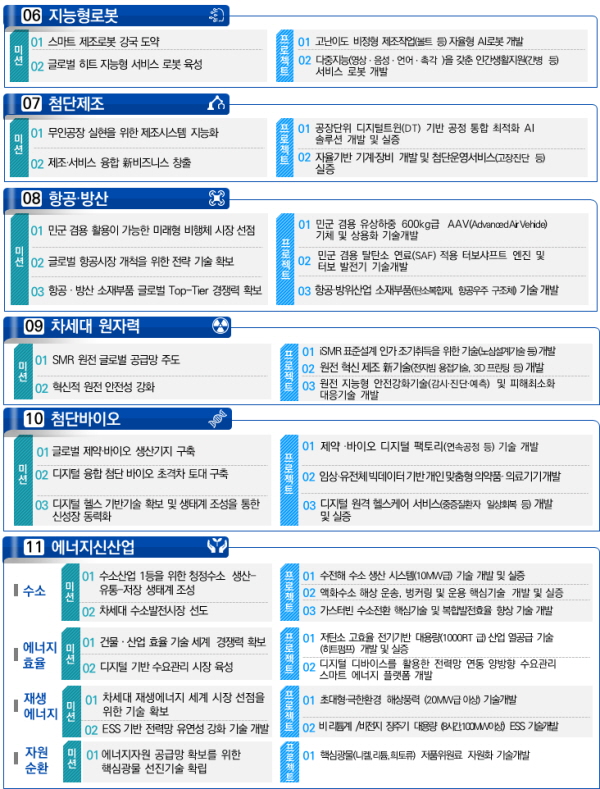
To this end, 34 missions across 11 key investment areas and 40 projects to achieve them have been identified.
In the semiconductor field, there are three missions and four projects.was selected.
To achieve the first mission of "Leaping Forward to a Powerhouse in Advanced System Semiconductors," two projects will be pursued: △Development of compound power semiconductors for mobility, energy, and home appliances, and △Development of semiconductor technology for autonomous vehicles (Level 4 or higher).
For the second mission, 'Fostering a Global Top 10 Post-processing Company,' a project to develop core basic technologies for advanced semiconductor packaging was confirmed.
To achieve the third mission, "Strengthening the semiconductor supply chain to maintain ultra-gap competitiveness," a mini-fab will be built to demonstrate the early commercialization of 12-inch advanced semiconductor wafer materials, components, and equipment.
The plan is to allocate 70% of the annual R&D budget to selected projects. Going forward, through preliminary feasibility studies, new business development, and ongoing utilization of new business projects, the plan is to invest KRW 6.2 trillion between 2023 and 2027, and KRW 13.5 trillion by 2030.
The second direction is to give top market and industry experts actual operational authority over the project.
Previously, projects and tasks were planned under the leadership of a single program director (PD) for each industry. After planning, the role of the program director ended, and as a specialized agency took over the support process, there was no entity to manage the entire cycle from planning to performance.
In the Super Gap Project, a group of project managers, including market and industry experts in addition to the program director, lead the entire process, from setting project goals to planning technology development, commercialization, human resource development, and infrastructure construction projects to achieve those goals, to performance review.
Through this, we plan to enhance performance by supplementing the expertise of program directors, actively reflecting market demand, and managing everything from planning to performance creation.
First, we plan to form a project management group and establish detailed implementation plans for each of the 40 projects by the end of this year, including goals, business structure, and milestones for each project.
Finally, we support research and development in the form of large-scale, mission-oriented projects, allowing organizations with strong innovation capabilities to participate and take responsibility for achieving project goals.
The goal is to have organizations with outstanding innovation capabilities take the lead in forming the optimal consortium and develop and verify multiple elemental technologies to create tangible results.
Jang Young-jin, First Vice Minister of Trade, Industry and Energy, said, “Closed business operations by a small number of experts and support for fragmented, small-scale projects will not produce results in research and development, and we will never be able to get ahead of our competitors in the technological competition.” He added, “Through the ‘Super Gap Project,’ we will create a research and development system where the country’s best experts will set the direction and institutions with the most outstanding innovation capabilities will form a dream team to produce impactful results.”
Meanwhile, the nine companies and four specialized organizations that participated in the event signed a memorandum of understanding (MOU) to implement the ultra-gap project.
The company has a group of project managersThe strategic planning team decided to participate in the play and support the operation of the technology innovation alliance.
The Korea Institute of Industrial Technology Evaluation and Planning (KIIT) and the Korea Energy Technology Evaluation and Planning (KETEP) support the activities of project managers, and the Korea Institute for Advancement of Technology (KIAT) provides support for human resource development and infrastructure projects.

Comments
Related news
Investing 170 trillion won in science and technology R&D over 5 years
The government will invest 170 trillion won over five years in the development of 12 state-strategic technologies including space and quantum, as well as key areas such as carbon neutrality, through a mid-to-long-term investment strategy legislated for the first time.
2023.03.14by 배종인 기자
Semiconductor VC investment at 90 billion won level in Q1
Despite concerns that VC investments in fabless startups may decline due to economic slowdown, promising startups have achieved significant fundraising results in the first quarter of this year.
2023.04.03by 명세환 기자
Investing 160 trillion won over five years in semiconductors, displays, and next-generation batteries.
The government is investing 160 trillion won over five years in three core technologies—semiconductors, displays, and next-generation batteries—and is launching a push to secure world-leading technologies with a significant competitive edge.
2023.04.06by 배종인 기자
Nvidia invests $5 billion in Intel
NVIDIA and Intel, leaders in global AI computing technology, are now forging ahead in providing cutting-edge solutions through NVLink-based architecture integration. NVIDIA and Intel have officially announced a strategic partnership and stated that they will jointly develop customized data center and personal computing products to accelerate diverse applications and workloads ranging from hyperscale to enterprise and consumer markets, thereby laying the foundation for the next generation computing era.
2025.09.22by 배종인 기자
.jpg)
Applied Materials Launches Environmental Protection Campaign to Mark World Cleanup Day
Applied Materials Korea (CEO Park Kwang-seon) is carrying out environmental cleanup activities with employees and their families around the Dongtan Sinricheon area on the occasion of World Cleanup Day, evolving into a company that engages with the local community beyond technological innovation.
2025.09.22by 명세환 기자











