


Microchip's LoRa solution makes it easy to build long-range wireless communication environments.
 Published2023.04.10 15:49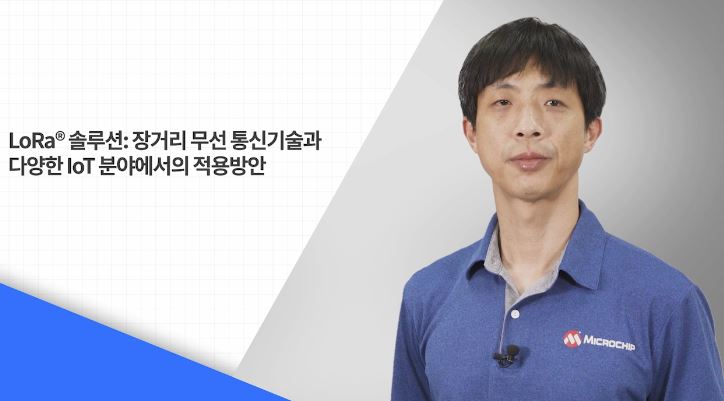
▲Kim Ki-beom, Senior Manager of Microchip's Wireless Communication Solutions Division
Communication range up to 15km...Distance↑·Data transfer rate↓
MiWi supports 2.4GHz and sub-6GHz…low power consumption
Expanding application areas to include security, logistics, and monitoring.
Experts have suggested that Microchip's LoRa solution can easily create a stable, long-range wireless communication environment.
At the e4ds news webinar held in March, Microchip's Senior Director of Wireless Communication Solutions, Ki-Beom Kim, presented on 'LoRa Solutions: Long-Range Wireless Communication Technology and Applications in Various IoT Fields.'
The lecture on this day introduced the concepts of LoRa and LoRaWAN, examples of LoRa being applied in various IoT fields, and the wireless communication performance of Microchip's LoRa solution in the field was revealed.
LoRa stands for "Long Range," referring to both the technology itself and the LoRaWAN network protocol. It enables long-range communication up to 5km in urban areas and up to 15km in rural areas.
LoRa is a wireless communication method that sacrifices data transmission rate to gain communication range. It spreads the transmitted data and despreads it at the receiving end, increasing reception sensitivity and extending the communication range. Spreading data reduces the data rate.
LoRa's applications are expanding, encompassing security, logistics, parking management, facilities, building management, environmental monitoring, leak management, and home care. For example, it's used in door locks in smart homes and for various monitoring tasks in smart farms. However, interference and collisions can be problematic when LoRa is deployed in blind spots, requiring appropriate channel allocation and power control.
There are three factors that determine the distance and data transmission speed in LoRa settings: SF (Spreading Factor), Bandwidth (BW), and Forward Error Correction (FEC) Code Rate (CR).
SF (Spreading Factor) adjusts data spread information. The more data is spread, the greater the spreading gain, which increases reception sensitivity and communication distance.
Bandwidth (BW) controls the width of a communication channel. A narrower channel width increases reception sensitivity but also increases transmission time. It can be set to 125 kHz, 250 kHz, or 500 kHz, with 125 kHz being the standard in Korea.
Lastly, Forward Error Correction (FEC) Code Rate (CR) increases the communication distance by enabling error detection and seeding when overlapping data transmission. Code Rate sets the degree of overlap, usually 4/5 is used.
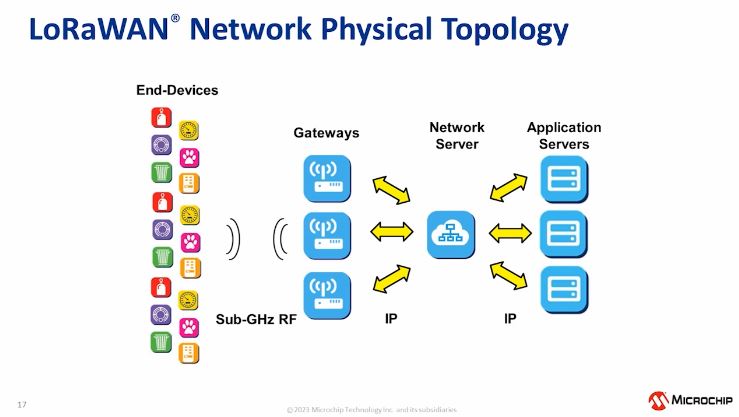
'LoRaWAN' is a network protocol defined by the LoRa Alliance. It consists of four layers: end devices, network servers, and application servers.
LoRa messages sent to end devices are received by the gateway and forwarded to the network server. LoRa wireless communication occurs between the end devices and the network, and the subsequent sections, including the gateway, network server, and application server, are standard IP communication sections.
Messages transmitted from end devices to servers are called uplink messages, while the opposite is called downlink. These messages are categorized into Class A, B, and C, with Class A having a significant delay but offering the most power-efficient option. Class B provides a limited amount of time, while Class C allows continuous transmission. LoRa's long communication range allows multiple gateways to simultaneously receive data transmitted by end devices.
Microchip Offers Full-Stack LoRa Solutions
MiWi (Microchip Wireless) is Microchip's wireless network protocol stack. It supports both 2.4 GHz and 6 sub-bands. It features low power consumption and light weight, and has the advantage of being freely usable without a separate license.
Among MiWi's main functions, △'Active Scan' is a function that collects information about other MiWi networks existing on each channel. It helps select a channel with smooth communication by selecting it based on PAN, signal strength, etc. △'Energy Scan' is used when measuring the channel's noise level to measure the channel status before data transmission or when creating a network. △'Frequency Agility' is a function that moves the entire network to a different channel if the currently used channel is congested. △'Network Freezer' is a function that quickly recovers the network. It stores the existing network information and immediately restores the communication status in the event of a power outage, etc.
Senior Kim introduced Microchip's LoRa solutions, including ICs and modules. He asserted, "Microchip's LoRa ICs enable flexible design and are affordable, while the modules have obtained major national wireless certifications, including those from the FCC, and are effective in shortening development times."
The SAM R34 is a SiP solution that integrates a 48MHz Cortex M0+ MCU and a transceiver. It comes with a certified design package and LoRaWAN stack, along with Microchip's Studio features. It also includes various peripherals, including an ADC.
The LoRa transceiver supports frequencies from 137MHz to 1020MHz, with a maximum wireless output of 20dBm and a receiver sensitivity of -148dBm. Its ultra-low backup mode current consumption is 790nA, an industry-leading 790nA. The WLR089 is a certified module, reducing verification time. Precisely matched antennas ensure safe wireless performance.
The LoRa evaluation board can be used for performance testing as well as product design with the accompanying circuit diagram, and the included onboard debugger eliminates the need for a separate debug tool.
Microchip's LoRa software was also introduced. LoRa P2P & MiWi and LoRaWAN implement apps via APIs. The LoRaWAN stack allows for more flexible implementation of protocols like MiWi and allows for application adaptation to a wider range of applications.
Microchip presented field tests of its LoRa solution in urban and suburban areas. In the suburban area of Bibongsan Mountain, communication distances of up to 15 km were achieved without issue, while in the urban area of Gasan-dong, Seoul, distances were measured to be approximately 6 km, despite various obstacles. The LoRa IoT system demo consists of a LoRa network, gateway, cloud service, and visualization.
Comments
Related news
.jpg)
Microchip Launches FPGA-Based Satellite System Development Kit
Microchip Technology (Asia General Manager and Korea Representative Han Byung-don) combines RT PolarFire® FPGA with aerospace-grade certification and development kits and interfaces that enable design concepts to be evaluated based on actual in-flight electrical and mechanical characteristics.
2023.03.09by 배종인 기자
Microchip Launches New Family of Embedded Security Authentication ICs
As the importance of embedded security continues to be emphasized, the need for validated security solutions that comply with industry standards and are easy for developers to use at optimized costs is also increasing.
2023.03.15by 명세환 기자
Microchip awards scholarships to 34 outstanding electrical and electronics engineering students
Microchip Technology, a global leader in microcontrollers, mixed-signal, analog semiconductors, and flash-IP solutions (Asia General Manager and Korea Representative: Han Byeong-don), awarded scholarships to outstanding domestic electrical and electronics engineering students to foster next-generation engineers and contributed to future business development.
2023.03.22by 배종인 기자

Microchip Unveils Latest Embedded Insights for AI, Security, and Edge
Microchip will host 'Tech Insights Korea' online from April 25th to 27th, featuring topics on artificial intelligence/machine learning, safety and security, and connectivity and embedded solutions.
2023.04.05by 배종인 기자

Intel Unveils Next-Generation 'Core Ultra Series 3' and vPro Platform for Enterprise PCs
Intel has officially unveiled the "Intel Core Ultra Series 3" for next-generation enterprise PCs and the latest vPro platform, addressing a wide range of demands from enterprise notebooks to high-performance workstations.
2026.03.26by 배종인 기자











