



Qualcomm Fine of 1.0311 Trillion Won for Abuse of Dominant Market Position Confirmed
 Published2023.04.14 09:14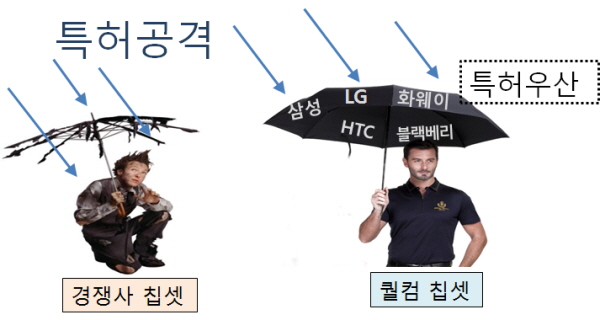
▲ The exclusionary effect of free cross-grants (patent umbrellas) on competitors
Expectations of a substantive guarantee of FRAND license negotiation opportunities
As the Supreme Court has confirmed that Qualcomm’s actions of restricting competition in the product market through licensing policies that violated its FRAND commitments and exclusively enjoying the benefits of standard adoption in the SEP licensing market constituted an abuse of its dominant market position, fair competition in technological innovation regarding the R&D achievements of mobile phone companies and chipset companies is expected in the future.
On the 13th, the Supreme Court dismissed the appeals of both parties in the appeal case (2020du31897) filed by the Fair Trade Commission (Chairman Han Ki-jung) and Qualcomm Incorporated and two affiliates (hereinafter collectively referred to as Qualcomm), confirming the ruling in part in favor of the Fair Trade Commission that the fine imposed by the Commission was lawful.
On January 20, 2017, the Fair Trade Commission issued a corrective order and imposed a fine of approximately 1.0311 trillion won on Qualcomm for abusing its dominant market position to interfere with the business activities of competing modem chipset manufacturers and mobile phone manufacturers.
Qualcomm appealed this and filed a lawsuit with the Seoul High Court on February 21, 2017, seeking the annulment of the aforementioned disposition by the Fair Trade Commission, but the Seoul High Court dismissed most of Qualcomm's claims on December 4, 2019, ruling that the imposition of the fine was lawful.
Subsequently, Qualcomm and the Fair Trade Commission Both parties filed appeals with the Supreme Court on December 19 and 23, 2019, regarding the parts they lost, and the Fair Trade Commission continued the legal battle by submitting 21 documents, including the grounds for appeal, the answer, and the supplementary grounds for appeal, for about 3 years and 4 months. The Supreme Court dismissed the appeals from both sides, and the final judgment was that the Fair Trade Commission's fine disposition was lawful.
Qualcomm’s abuse of its dominant market position in three ways: first, it refused or restricted the provision of licenses for Standard Essential Patents (SEPs) essential for the manufacture and sale of chipsets despite requests from competing modem chipset manufacturers; and second, by linking chipset supply with patent license agreements, it forced mobile phone manufacturers to enter into and perform unfair license agreements by circumventing FRAND commitments (meaning a promise by an SEP holder to provide licenses to patent users under fair, reasonable, and non-discriminatory conditions) by holding chipset supply hostage.
In addition, while providing only comprehensive licenses to mobile phone manufacturers and forcing unilaterally determined license conditions without going through a fair compensation calculation process, it also demanded that mobile phone manufacturers cross-license their patents to itself free of charge.
Although the illegality of the content of the license agreement itself was not recognized, this ruling is significant in that it clarified that it is illegal for a dominant market player to establish an anti-competitive business structure to maintain and expand its monopolistic position in the standard essential patent market and the modem chipset market while being aware of FRAND obligations, and for such a business structure to cause anti-competitive effects in the relevant markets and monopolize the market structure.
An official from the Fair Trade Commission stated, “Going forward, the KFTC will thoroughly monitor the implementation of corrective orders in accordance with the intent of the ruling, while [addressing] unfair competition such as the abuse of standard essential patents"We plan to respond strictly to acts that restrict disputes as well," they stated.
Meanwhile, Qualcomm has maintained a contradictory stance of obtaining licenses from other patent holders, such as mobile phone companies, while not granting any licenses to competitors.
As a result, Qualcomm chipsets have become products safe from patent attacks, while competitor chipsets have become defective products without patent licenses, creating a competitive landscape in the chipset market that is absolutely advantageous to Qualcomm.
The 'free cross-grants' received by Qualcomm from mobile phone companies and others provided a 'patent umbrella' that protected only its own chipset customers from patent infringement attacks, allowing it to easily secure a competitive advantage. When mobile phone companies purchased Qualcomm chipsets, they enjoyed the effect of a patent umbrella that exempted them from royalties payable to approximately 200 other patent holders, whereas when they purchased competitor chipsets, they had to pay royalties separately for other mobile phone companies' patents, making efficient competition impossible for competing chipset companies.
The refusal to license to competing chipset companies restricted the competitors' sales channels and created a structure that allowed Qualcomm to intervene in transactions between competitors and customers.
If a competing chipset company sells chipsets to mobile phone companies that do not have a licensing agreement with Qualcomm or have a dispute with them, it could face patent attacks at any time. Therefore, competing chipset companies could only sell to mobile phone companies that had license agreements with Qualcomm, making it difficult to actively expand the market.
Furthermore, by exploiting the fact that mobile phone companies have no choice but to enter into and fulfill patent license agreements with them, they became able to unfairly intervene in transactions between competitors and mobile phone companies.
Qualcomm was able to hinder the sale of competitor chipsets by methods such as conducting strict loyalty audits when mobile phone companies attempted to purchase competitor chipsets, and to attract competitor customers by methods such as providing conditional rebates to mobile phone companies that purchased Qualcomm chipsets.
A FRAND commitment is designed to prevent the abuse of monopoly power by standard essential patent holders by requiring SEP holders to promise to license to anyone on fair, reasonable, and non-discriminatory terms.
Therefore, if a SEP holder does not comply with FRAND commitments, standard technology becomes the exclusive property of a few operators or patent holders, undermining the standardization process and distorting competition among technologies.
As Qualcomm uses the supply of modem chipsets as leverage to force the signing and implementation of patent licensing agreements, FRAND commitments designed to curb the abuse of dominance in the SEP licensing market have been effectively neutralized.
Consequently, from the perspective of mobile phone companies, even if they secure a number of mobile communication SEPs through active R&D investment, they cannot receive fair compensation for it because they license them to Qualcomm for free; and they were forced into a structure where Qualcomm would take a significant portion of the profits if they created new demand and increased added value through R&D.
With the confirmation of this Supreme Court ruling, mobile phone companies are expected to be substantially guaranteed the opportunity to negotiate FRAND license terms with Qualcomm on an equal footing without worrying about the supply of Qualcomm chipsets.

Comments
Related news
European Patent Applications Surpass 200,000 for the First Time… South Korea Maintains 5th Place, Led by Batteries and Telecommunications
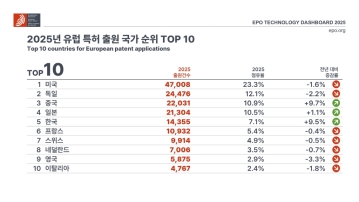
According to the European Patent Office (EPO)'s 'Technology Dashboard 2025', European patent applications last year reached 201,974, surpassing 200,000 for the first time. Korean companies and inventors filed 14,355 applications, representing a 9.5% increase from the previous year and maintaining 5th place by country. Battery, digital communication, and semiconductor technologies led the growth, with Samsung ranking as the top EPO applicant for the second consecutive year and LG reaching 3rd place. The presence of major domestic cities such as Seoul, Suwon, and Yongin was also confirmed. It was also revealed that Korea's European patent strategy is expanding beyond individual technologies to span the entire industry.
2026.03.24by 명세환 기자

SK Telecom First Applies AI-Based Network Operations at Gwanghwamun K-Pop Concert
SK Telecom announced that it applied an AI-based network operation system for the first time at a large-scale K-pop concert held in the Gwanghwamun area of Seoul on March 21st, managing communication quality throughout the event. Mobile data usage during the three hours before and after the concert reached 12.15TB, approximately doubling compared to the same time slot the previous weekend. SK Telecom monitored traffic using the AI system 'A-One' in five-minute and 50-meter units to respond to potential overload situations, while also operating temporary communication facilities and on-site personnel in parallel. This case is interpreted as confirmation of the practical applicability of AI-based autonomous network operation in an environment where demand from dense events and foreign users increases simultaneously.
2026.03.23by 명세환 기자
ETRI Develops 200Gbps Photodetector… Initiates Localization of Optical Receivers for AI Data Centers
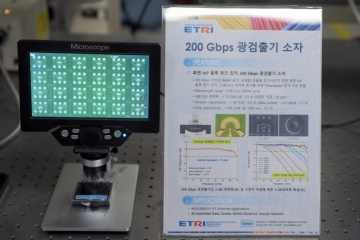
The Electronics and Telecommunications Research Institute (ETRI) has developed a photodetector device that processes optical signals of approximately 200Gbps per channel for the first time in Korea. This device is a component that converts optical signals into electrical signals and determines the reception performance of AI data centers and 5G/6G communication networks. ETRI achieved bandwidth of 70GHz or higher and optical responsivity of 0.75A/W or higher, and integrated an indium phosphide lens on the rear of the chip to enhance optical reception efficiency and alignment convenience. The technology was presented at OECC 2025 and was recently published in the international academic journal 'Optics Express'.
2026.03.19by 명세환 기자
SKT and Ericsson Expand Joint Research on AI Networks… Preparing for 6G Beyond 5G Advancement
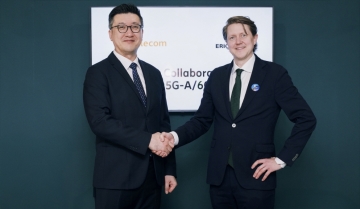
SK Telecom and Ericsson are expanding AI-based mobile network collaboration. On the 19th, the two companies signed a memorandum of understanding covering 5G advancement through 6G standardization, and agreed to undertake joint research and verification in the areas of AI-RAN, open and autonomous networks, security, and future communication technologies. This collaboration is interpreted as a move to enhance current 5G operational efficiency while preparing for a 6G environment where AI becomes embedded throughout the network. The scope also includes network operations automation, multi-vendor environment response, energy efficiency improvements, and review of communication-sensing fusion technology.
2026.03.19by 배종인 기자
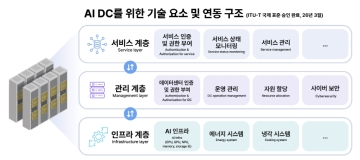
SKT Receives International Standard for AI Data Center Interconnection Structure… Establishes Operating System Standards
SK Telecom's proposed AI data center interworking architecture has received final approval as an international standard at the International Telecommunication Union Telecommunication Standardization Sector (ITU-T) conference. The core of this standard is the classification of AI data centers into three layers—service, management, and infrastructure—and the organization of signaling requirements between layers. As AI service proliferation increases the importance of interworking among various systems within data centers such as computation, power, cooling, storage, and security, this standard is significant in that it presents a common architecture for operations and service delivery. SK Telecom stated that it initiated the relevant standardization project in 2024 and achieved this approval following approximately two years of discussion.
2026.03.18by 명세환 기자











