



[Technical Contribution] ADI Michael Hate – How to Add Authentication Security to Vehicle Endpoints Using a Single PIN
 Published2023.04.17 11:38
DS28E40 adopts ECDSA public key security algorithm
Easily implement ECU host processor security layer
As the proportion of electronic devices used in vehicles increases, so do the vulnerable areas susceptible to hacker attacks.
Digital authentication can reduce the risk of theft and counterfeiting of high-quality genuine parts.
In critical automotive applications such as ADAS or electric vehicle (EV) batteries, counterfeit products can pose safety risks due to their inferior quality compared to genuine products.
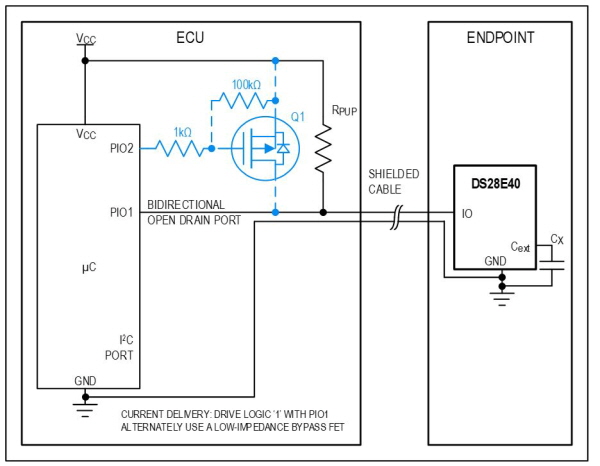
Stolen parts may not function properly when used in other vehicles. In this case, adding a single authentication IC allows the component to be authenticated with only one signal between the ECU and the endpoint device (Figure 1).
The conventional approach to component security and authentication is to use secure microcontrollers or, furthermore, automotive Hardware Security Modules (HSMs).
Although it is a robust solution, this method is expensive, requires numerous electrical signals from the host controller, occupies a significant amount of PCB board space, and necessitates extensive software development and verification work to prevent bugs.
However, now, by simply adding a single compact fixed-function IC, the endpoint can be safely protected by transmitting only one signal along with a ground reference through a shielded cable between the ECU and the endpoint.
Analog Devices' DS28E40 implements a 1-wire protocol, which uses half-duplex communication and parasiticly generates power for device operation through the communication line, thereby reducing the need for a dedicated power line in the cable.
The energy generated in this way is stored in an external capacitor. Most automotive ECUs include high-performance microcontrollers and require only one open drain PIO pin along with a pull-up resistor for bidirectional communication.
Up to 16 mA is required for security algorithm computation, which exceeds the sourcing capacity of pull-up resistors.
If PIO1 can switch between an open drain and a push/pull configuration with sufficient current sourcing, it drives logic 1 during operation.
Alternatively, sufficient current can be supplied by adding a low-impedance bypass FET and controlling it using PIO2.
The DS28E40 adopts the ECDSA public key security algorithm and provides libraries and code examples, allowing for the easy implementation of a security layer on the ECU host processor.
Key management is simplified because this asymmetric security algorithm allows the host to read the unique public key directly from the DS28E40.
Next, when the host issues a random question message to the DS28E40, the DS28E40 responds to the question and digitally signs using its internal private key, which is never exposed to the outside world.
If the host verifies that this signature matches the public key, this endpoint gains trust from the ECU.
The DS28E40 has obtained AEC Q100 Grade 1 (-40C to +125C) certification and is available as a 3mm x 3mm side wettable frank (SWF) TDFN package.
※ Author Introduction
Michael Haight, Director of Business Management at Analog Devices, oversees embedded security products with a particular focus on automotive application business development. Michael, originally an IC design engineer, held various roles at Maxim Integrated (now acquired by ADI) for about 25 years, including product definition, application management, and what is now business management. Prior to joining the Maxim team at ADI, he held an IC design position at a defense contractor. Michael earned his BSEE from the University of Florida in 1993.

Comments
Related news

Intel Unveils Next-Generation 'Core Ultra Series 3' and vPro Platform for Enterprise PCs
Intel has officially unveiled the "Intel Core Ultra Series 3" for next-generation enterprise PCs and the latest vPro platform, addressing a wide range of demands from enterprise notebooks to high-performance workstations.
2026.03.26by 배종인 기자

ROHM Launches ESD Protection Diode Compatible with High-Speed Interfaces of 10Gbps or Higher
Semiconductor specialist ROHM has developed the 'RESDxVx series' of ESD (electrostatic discharge) protection diodes capable of responding to next-generation high-speed data communication environments exceeding 10Gbps, simultaneously enhancing both signal quality maintenance required in high-speed interfaces and IC protection performance.
2026.03.26by 배종인 기자
ST Launches 75V Drive IC Targeting 48V Industrial Motor Driving
ST Microelectronics has unveiled the 'STSPIN9P' series of 75V motor drive ICs tailored for 48V-class industrial drive system design. The new product family is characterized by half-bridge and full-bridge configurations that enable design scalability according to motor type and output conditions. Power supply circuits, protection functions, and current sensing circuits are integrated on-chip to simplify system configuration, and the devices are designed to support applications up to 500W maximum. The company plans to provide reference designs and demo boards to support development and evaluation in industrial automation, robotics, pumps, fans, lighting, and textile machinery.
2026.03.26by 배종인 기자

Nordic supports security updates for the entire lifecycle of IoT devices at a single fixed cost
Nordic Semiconductor, a global leader in low-power wireless connectivity solutions, has unveiled a single fixed-cost licensing model that delivers FOTA (Firmware Over-the-Air) and device management capabilities throughout the device lifecycle via nRF Cloud, and introduced a new firmware update solution to prepare for the enforcement of the European Union's Cyber Resilience Act (CRA).
2026.03.26by 배종인 기자
.png)
Databricks Unveils Open AI Security Monitoring 'Lakewatch'
Databricks entered the security market on March 24 by unveiling LakeWatch, an open-source agentic SIEM. The core functionality of this product is to integrate and analyze security, IT, and business data in a single environment to support AI-based threat detection and investigation. The company explained that it reduces the limitations of existing security operations centers, which have had to forgo some data due to high cost structures, and enables large-scale data analysis and automation based on open formats and ecosystems. LakeWatch is currently offered as a private preview, with Adobe and Dropbox mentioned as early customers. Databricks also announced an expanded partnership with Anthropic as well as the acquisition of Antimatter and SiftD.ai.
2026.03.26by 배종인 기자











