



Electronic devices made to fit the user's skin are custom-made.
 Published2023.04.21 09:39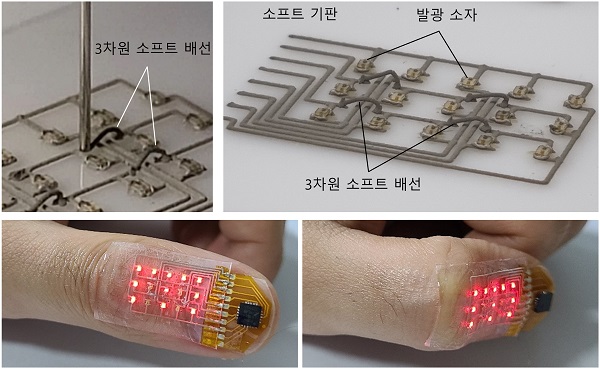
▲ Complex circuit configuration using omnidirectional 3D printing of soft conductors and temperature sensing and display skin electronics utilizing the same. (Top) A soft display that displays temperature by implementing a complex display circuit on a soft substrate using omnidirectional 3D printing of soft conductors and connecting sensors and a microcontroller. (Bottom) Attached to the skin and shown in actual operation.
A new concept 3D printing technology has been developed that allows for the free drawing of soft conductors with high elasticity and conductivity, raising expectations that it can be applied to skin electronics that are soft like skin in the future.
The Ministry of Science and ICT (Minister Lee Jong-ho) announced on the 21st that a research team led by Dr. Seung-Jun Jeong at the Soft Convergence Materials Research Center of the Korea Institute of Science and Technology (President Seok-Jin Yoon, hereinafter 'KIST') has succeeded in realizing user-customized freeform skin electronics using a new concept omnidirectional printing process technology.
This research was conducted with the support of the Ministry of Science and ICT's Nanomaterials Technology Development Project, KIST's major projects, and the Sejong Science Fellowship, and the results of the research were published as a cover article in Nature Electronics (IF 33.255) on April 21.
Unlike conventional silicon-based semiconductor devices, the advancement of skin electronics, which is soft like skin, is enabling human-machine interfaces that closely adhere to the human body, such as real-time health signal monitoring and neural circuit interfaces.
Skin electronics requires freeform designs and customized processes tailored to the user's body and intended use, while simultaneously necessitating the implementation of complex three-dimensional circuits for high integration. However, existing semiconductor processes or 3D printing technologies had limitations in producing circuits that could be freely deformed to fit the body with various curved surfaces.
A research team led by Dr. Seung-Jun Jeong at KIST has developed a technology capable of directly drawing soft conductors, a core material for skin electronics, in three dimensions, and using this, announced freeform skin electronics that operate stably even under mechanical deformation.
When fabricating circuits with three-dimensional structures using previously reported conductive inks, there were limitations such as the materials easily breaking or degrading in performance due to external impact or mechanical deformation. The research team developed a soft conductive material that utilizes the emulsifying action of the ink to enable free 3D printing in all directions while simultaneously drastically reducing the problem of nozzle clogging.
This allows for the free and direct drawing of soft electrodes in all directions that maintain high conductivity even when stretched by more than 150%, enabling the fabrication of complex three-dimensional flexible circuits tailored to the user.
The soft conductive material developed in this study is currently being reviewed for mass production potential through a specialized materials company, and it is expected to have a ripple effect if utilized in the fields of wearable and biomedical devices, soft robots, and the printing industry.
Dr. Seung-Jun Jeong of KIST stated, “The soft electrode material and process technology developed through this research will overcome the design limitations of existing standardized electronic devices and contribute to the production of wearable devices with new form factors. Furthermore, we expect that it can be utilized in fields such as the Internet of Things, interfaces for virtual and augmented reality, and bio-interfaces.”

Comments
Related news

Intel Unveils Next-Generation 'Core Ultra Series 3' and vPro Platform for Enterprise PCs
Intel has officially unveiled the "Intel Core Ultra Series 3" for next-generation enterprise PCs and the latest vPro platform, addressing a wide range of demands from enterprise notebooks to high-performance workstations.
2026.03.26by 배종인 기자
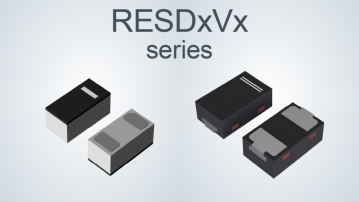
ROHM Launches ESD Protection Diode Compatible with High-Speed Interfaces of 10Gbps or Higher
Semiconductor specialist ROHM has developed the 'RESDxVx series' of ESD (electrostatic discharge) protection diodes capable of responding to next-generation high-speed data communication environments exceeding 10Gbps, simultaneously enhancing both signal quality maintenance required in high-speed interfaces and IC protection performance.
2026.03.26by 배종인 기자
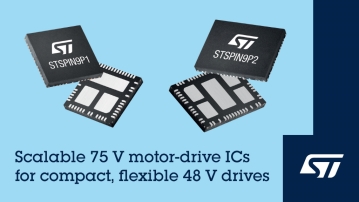
ST Launches 75V Drive IC Targeting 48V Industrial Motor Driving
ST Microelectronics has unveiled the 'STSPIN9P' series of 75V motor drive ICs tailored for 48V-class industrial drive system design. The new product family is characterized by half-bridge and full-bridge configurations that enable design scalability according to motor type and output conditions. Power supply circuits, protection functions, and current sensing circuits are integrated on-chip to simplify system configuration, and the devices are designed to support applications up to 500W maximum. The company plans to provide reference designs and demo boards to support development and evaluation in industrial automation, robotics, pumps, fans, lighting, and textile machinery.
2026.03.26by 배종인 기자

Nordic supports security updates for the entire lifecycle of IoT devices at a single fixed cost
Nordic Semiconductor, a global leader in low-power wireless connectivity solutions, has unveiled a single fixed-cost licensing model that delivers FOTA (Firmware Over-the-Air) and device management capabilities throughout the device lifecycle via nRF Cloud, and introduced a new firmware update solution to prepare for the enforcement of the European Union's Cyber Resilience Act (CRA).
2026.03.26by 배종인 기자
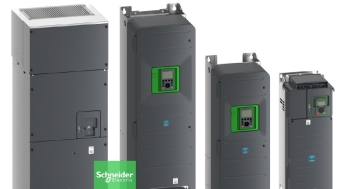
Schneider Aims for Building Energy Savings and Operational Stability with Next-Generation HVAC Drives
Schneider Electric has unveiled its next-generation HVAC drive product line 'Altivar HVAC'. The new product line's key features center on enhanced energy savings, system operational stability, and building management system integration. The products are divided into 'ATH200' for OEM and small equipment applications, and 'ATH600' for environments requiring continuous operation and advanced control. The company plans to expand the application scope from commercial buildings to facilities where HVAC system stability is critical, such as hospitals, airports, and data centers. The announcement includes over 30% energy savings, operation from -10°C to +60°C, Modbus and BACnet support, and compatibility with low global warming potential refrigerants.
2026.03.26by 명세환 기자











