



250 software companies worth 100 billion won will be created, with 563 billion won invested in software promotion.
 Published2023.04.21 10:15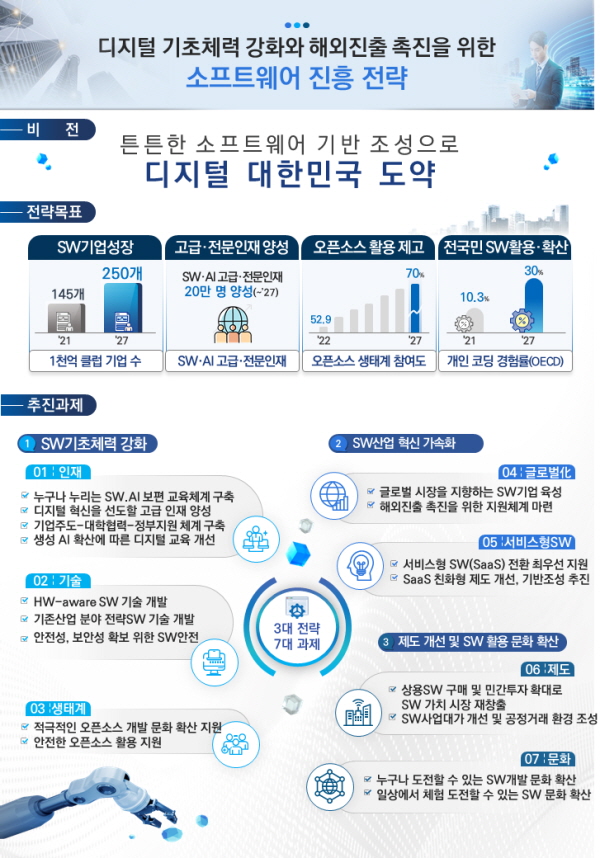
Promoting hardware-aware SW development and providing infrastructure to improve the open SW portal.
The government will invest 563 billion won this year in projects related to its software promotion strategy, aiming to foster 250 domestic software companies with sales of 100 billion won and over 10,000 software-as-a-service (SaaS) companies by 2027.
On the 21st, the Ministry of Science and ICT (Minister Lee Jong-ho) announced a joint "Software Promotion Strategy" with related ministries at the Emergency Economic Ministers' Meeting to strengthen the digital foundation and promote overseas expansion.
Accordingly, we will fully respond to the demand for information education, including doubling the number of hours for information subjects by 2025, and support the development of basic software and artificial intelligence capabilities for all citizens, thereby establishing a universal education system that everyone can enjoy regardless of region or income gap.
The contract garden system, which will be implemented starting in March of this year, will be applied to software-centered universities and other universities, and in order to expand the education model of the Innovation Academy, the development of ‘(tentative name) Project-X’ will be completed within the year and verified and expanded starting next year.
In addition, in response to the spread of generative artificial intelligence, we will actively pursue the cultivation of advanced AI talents through global joint research and industry-academia cooperation starting next year, and by 2027, we will achieve the Software · We will train 200,000 advanced and specialized AI talents.
We will also expand investments to proactively secure future software technologies, such as hardware-aware software (HW-aware SW).
By focusing on investing in software-based technologies to secure future competitiveness, we will improve our software technology level to 93% of that of leading countries by 2027.
First, we will pursue the development of hardware-aware software (HW-aware SW) this year.
With the recent proliferation of artificial intelligence and the resulting surge in data and computing power worldwide, power consumption is increasing, and carbon neutrality is becoming increasingly important. To address these issues, it is essential to optimize and reduce power consumption of AI-related hardware, including semiconductors.
To address this, we plan to first develop specialized system software that supports low power consumption and lightweight AI semiconductors, and to establish a system software development roadmap for various hardware, such as mobility and autonomous vehicles, within the year.
In addition, we will pursue strategic software development to enhance the competitiveness of existing industries such as manufacturing, shipbuilding, and space, and expand precision software safety diagnosis to ensure safety and security from the software development stage.
To revitalize the domestic open source ecosystem, the currently operating 'Open Software Portal' will also be improved to provide related infrastructure so that domestic developers and companies can easily share information and collaborate.
In addition, we plan to expand the foundation for open source utilization by expanding support for license verification to check for copyright issues that may arise when utilizing open source and strengthening training for open source experts, thereby increasing the participation rate of domestic companies in the open source ecosystem from 52.9% in 2022 to 70% in 2027.
Software as a Service (SaaS)) will also be fostered in earnest to promote a comprehensive restructuring of the domestic software industry.
First, we will support customized programs (KRW 30.5 billion by 2023) considering the growth stage of service-type software companies, and we will also launch a new project to support the development and commercialization of innovative service-type software that applies generative artificial intelligence.
We will also support the development of service-type software available to the public, including supporting related projects to develop AI-based digital textbooks, which are scheduled to be fully introduced in 2025, into service-type software.
In addition, we plan to establish a foundation for the expansion of service-type software by introducing a new direct purchase system for service-type software this year and supporting policy financing, thereby smoothly implementing the goal of fostering 10,000 domestic service-type software companies by 2026, as announced in the previous Digital Platform Government Realization Plan.
We are also committed to fostering software companies targeting the global market. Through these efforts, including fostering small and medium-sized software companies targeting the global market, establishing a support system to promote short-form exports and overseas expansion, we plan to foster the number of software companies with sales of KRW 100 billion in the 100 billion club, increasing from 145 in 2021 to over 250 by 2027.
We will also improve the system to strengthen the value guarantee of software.
We plan to complete revisions to subordinate statutes in the second half of this year to comply with the strengthened "Software Impact Assessment System," and actively identify leading cases to expand private investment-type software projects.
In addition, the software business unit will strengthen the software value guarantee system through revisions and other measures, and will operate a public-private joint research forum in cooperation with relevant ministries.
Lastly, we are also promoting the spread of a culture in which everyone can experience and utilize software.
Software that students and citizens can participate in and challenge, such as the online coding party that 2.4 million people participated in last year. We plan to expand the program and conduct various software campaign activities to familiarize citizens with software in their daily lives, thereby supporting an increase in the individual coding experience rate from 10.3% in 2021 to 30% in 2027.
Minister of Science and ICT Lee Jong-ho emphasized, “Software is the foundation that drives innovation and growth in new digital technologies, so it is most important to strengthen its fundamentals.” He added, “We will carefully monitor key policies such as fostering digital talent, developing basic technologies, and improving systems so that we can lay the foundation for a great leap forward as a model digital nation.”

Comments
Related news
.jpg)
[Monthly Planning - Developer Reality ②] “Industrial Manpower, Software Concentration Increasing”
[Editor's Note] "The brain (SW) exists, but the body (HW) does not"—a statement made by Geumsan CEO Lee Seung-min criticizing the treatment of embedded developers. As platform industry growth and the surge in IT services have driven active supply and demand for talent in software (SW), web, and mobile app sectors, there have been calls for balanced growth with embedded and hardware (HW) developers who have dedicated their passion to advancing the manufacturing sector that forms the foundation of Korea's domestic industry.
2022.10.25by 명세환 기자
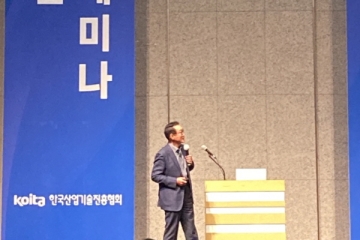
Lee Woo-jong, Vice President of Amotech, “SW-armed electric vehicles are the key to the future of cars”
Lee Woo-jong, Vice Chairman of Amotech, conveyed that the key to future vehicles is electric vehicles equipped with software, and communicated the trends and importance of the electric vehicle market.
2022.11.10by 성유창 기자
“Global IT spending expected to increase by 5.5% in 2023”
While spending on the devices sector is projected to decline due to economic slowdown, the increase in software (SW) and IT services spending is expected to exceed this decline, maintaining overall IT spending on an upward trajectory this year as well. Against this backdrop, IT services dependence and spending are likely to increase further due to skilled talent shortages and rising labor costs, and the related market expansion is anticipated.
2023.04.10by 명세환 기자
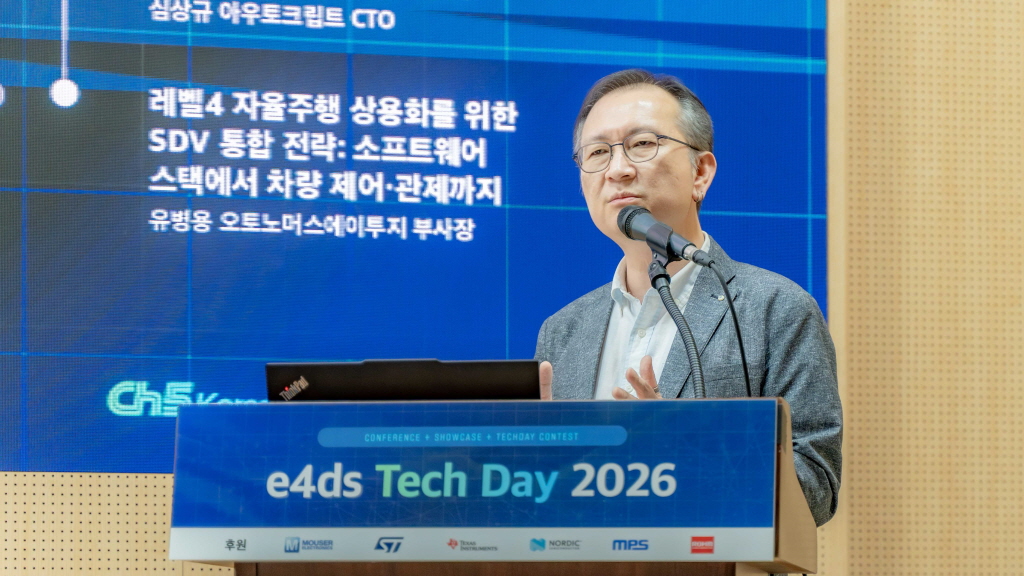
[e4ds Tech Day 2026 ⑨] Sim Sang-gyu, Autocrypt CTO: "In the Physical AI Era, Automotive Security Must Extend Beyond the Vehicle"
At e4ds Tech Day 2026, Sim Sang-gyu, CTO of Autocrypt, explained automotive cybersecurity strategies in the era of Physical AI and SDV (Software-Defined Vehicle). Automobiles are evolving as part of an ecosystem connected to AI, cloud, chargers, IoT, and robots, and he emphasized that the scope of security must expand beyond the vehicle interior to the entire connected environment. In particular, AI model tampering, adversarial attacks, OTA updates, and EV charger hacking were identified as major threats. He explained that response measures require zero trust, AI model integrity protection, intrusion detection, Security by Design and Default, and full lifecycle security management, and that proactive security system establishment beyond regulatory compliance is critical for securing future mobility competitiveness.
2026.10.12by 배종인 기자
NVIDIA to Invest $1 Billion in U.S. Science Over Next Five Years
NVIDIA has announced plans to invest $1 billion over the next five years to strengthen U.S. scientific and technological competitiveness. The company will enhance cutting-edge artificial intelligence research and development capabilities in key areas including quantum computing, healthcare, and energy security, while expanding support for higher education research institutions and cloud service providers. NVIDIA is participating as a major industry partner in the White House Office of Science and Technology Policy's Genesis Mission, and is promoting supercomputer construction in collaboration with national laboratories including Argonne and Los Alamos.
2026.10.12by 배종인 기자











