



High-performance ammonia synthesis at low temperature and low pressure
 Published2023.04.27 10:15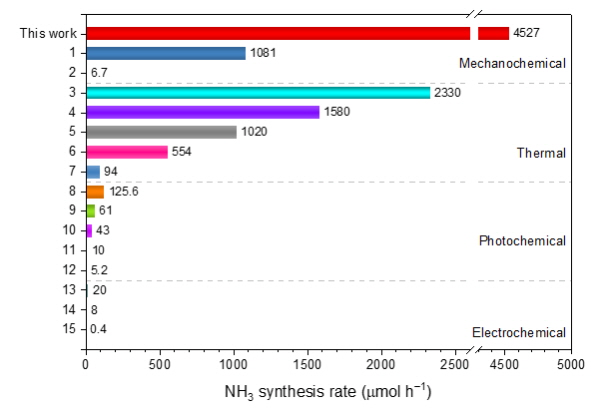
▲Comparison of the performance of recently reported dispersed ammonia synthesis methods. In the order of mechanochemical > thermochemical > photochemical > electrochemical, in this study, the mechanochemical ammonia synthesis method utilizing a potassium reaction promoter demonstrated overwhelming performance.
30% higher catalytic performance than existing technologies… Increased ammonia synthesis efficiency
A method has been developed to synthesize high-performance ammonia (NH3) with catalytic performance 30% higher than existing methods at low temperatures and low pressures, raising expectations that ammonia will be produced in local areas in the future.
A research team led by Professor Baek Jong-beom of the Department of Energy and Chemical Engineering at UNIST (President Yong-Hoon Lee) has developed a mechanochemical method for improving ammonia yield using a potassium reaction promoter.
Ammonia (NH3), a chemical compound synthesized from nitrogen and hydrogen through a chemical reaction, is widely used in fertilizers and the chemical industry and is gaining attention as a hydrogen carrier. Ammonia has a hydrogen storage density per unit volume 1.7 times higher than that of liquid hydrogen, allowing it to store large amounts of hydrogen. Furthermore, it liquefies easily at natural temperatures and pressures, making it easy to transport and distribute.
First, to synthesize ammonia, the triple-layer nitrogen gas bond must be broken. Since the early 1900s, ammonia has been mass-produced using the Haber-Bosch process, which involves reacting nitrogen and hydrogen under high temperature and pressure conditions using a catalyst. In particular, potassium oxide, which promotes the activity of iron catalysts in the Haber-Bosch process, plays a role in stabilizing potassium at high temperatures. However, potassium oxide contains oxygen, which hinders the breakdown of nitrogen bonds, thus lowering the performance of the iron catalyst.
To improve this, the research team devised a method for synthesizing ammonia at low temperature and pressure using mechanochemical methods. By using potassium as a direct reaction promoter instead of potassium oxide, they were able to effectively break nitrogen bonds. With this method, the research team achieved catalytic performance approximately 30% higher than that of potassium oxide and an ammonia yield (94.5%) approximately 12% higher than that of an iron catalyst alone (82.5%). Furthermore, ammonia was synthesized under milling conditions 3.5 times lower (100 rpm) than the milling speed (350 rpm) when using only an iron catalyst.
Professor Baek Jong-beom of the Department of Energy and Chemical Engineering said, “We have developed a method to produce ammonia more efficiently at low temperatures and pressures using a reaction promoter,” adding, “This will enable decentralization of ammonia production, allowing ammonia to be produced even in local areas.”
This study, which presents a new technology that can increase the energy efficiency of ammonia synthesis and accelerate the commercialization of mechanochemical methods, was published in the international academic journal 'Nature Communications' on April 22.

Comments
Related news
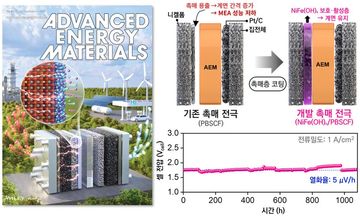
Materials Research Institute Develops Ultra-thin Coating Water Electrolysis Catalyst Technology
The Korea Institute of Materials Science has simultaneously resolved the performance and durability trade-off problem in water electrolysis catalysts by applying ultra-thin surface coating technology. Achieving 1.9 times higher performance compared to conventional catalysts while demonstrating 1,000-hour long-term stability, the institute has developed technology scalable to industrial water electrolysis systems through a simple process.
2026.10.07by 배종인 기자
Gigaphoton Develops Neon Gas Recycling System for ArF Excimer Lasers...Achieves 50% Recycling Rate
Gigaphoton announced that it has developed a gas recycling system for ArF excimer lasers and achieved a 50% neon gas recycling rate.
2026.10.02by 배종인 기자
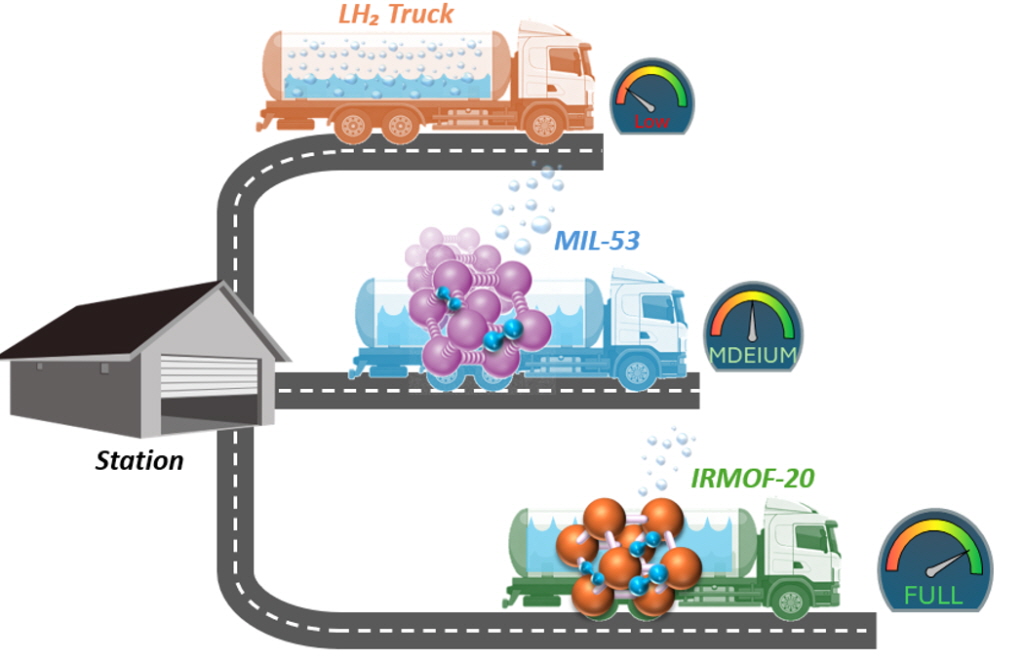
UNIST suppresses vaporization losses while maintaining 97% of liquefied hydrogen storage capacity
A research team led by Professor Oh Hyun-cheol from the Department of Chemistry at UNIST, in collaboration with Professor Moon Hoe-ri from Ewha Womans University and researchers from the Technical University of Munich in Germany, has verified technology that reduces boil-off loss occurring during liquefied hydrogen transportation and storage by utilizing metal-organic frameworks (MOF).
2026.09.30by 배종인 기자
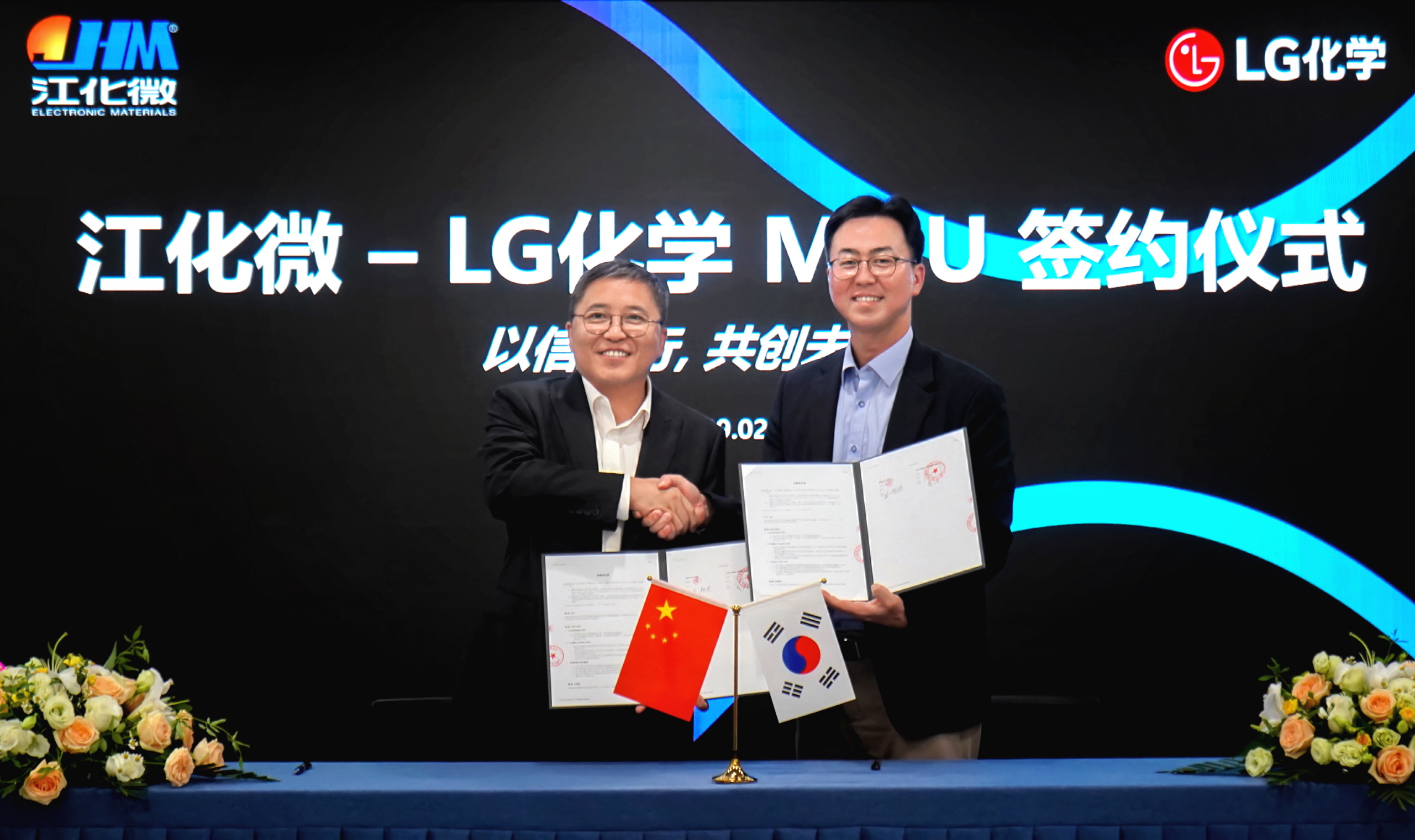
LG Chem Expands Semiconductor Cleaning Materials Business…Collaborates with China's Jianghua Wei on Ultra-high Purity IPA
LG Chem is moving to expand its ultra-high purity IPA (isopropyl alcohol) business, a core material for semiconductor processes. The company is building a local supply system in collaboration with a Chinese precision chemical company and strengthening its market strategy for AI semiconductors and advanced memory.
2026.09.14by 배종인 기자
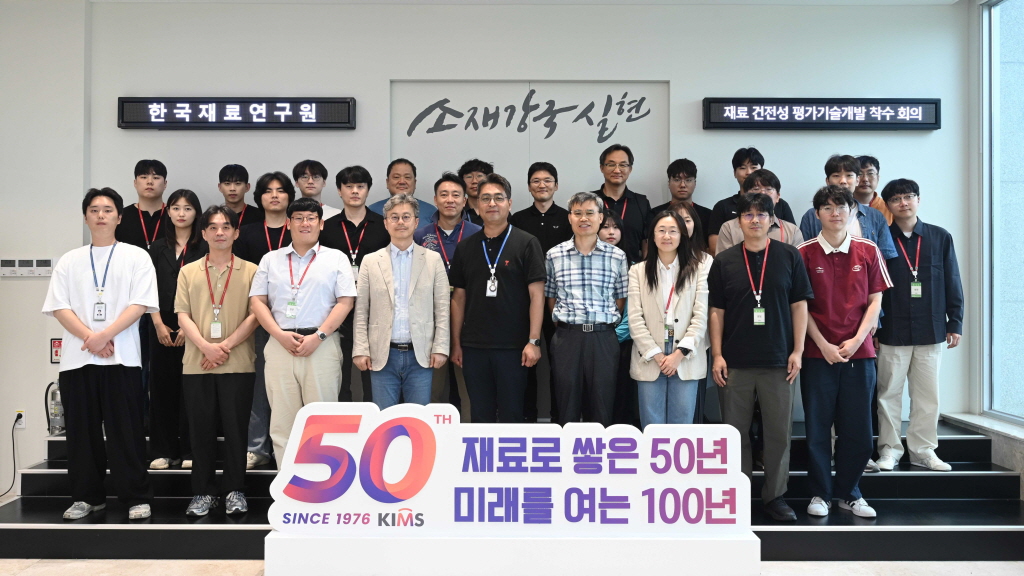
Korea Institute of Materials Science Begins Development of Anhydrous Ammonia SCC Integrated Evaluation Platform
The Korea Institute of Materials Science has begun developing an integrated evaluation platform for stress corrosion cracking (SCC) of high-strength steel for ammonia propulsion and transport vessels. By establishing a system to verify the safety of steel in anhydrous ammonia environments using domestic technology, the institute will strengthen the international competitiveness of the shipbuilding and steel industries and lay the foundation for reflecting domestic technology in regulatory and standard revisions by the International Maritime Organization (IMO) and other bodies.
2026.08.05by 배종인 기자











