


MS, “Integration of mega-AI cloud services is key”
 Published2023.04.28 12:11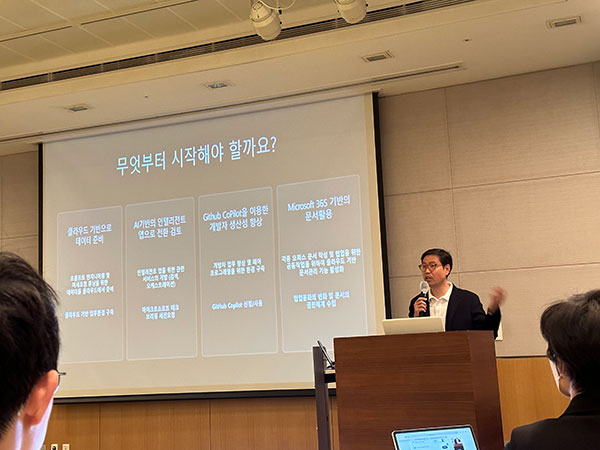
Generative AI Models Must Redefine Digital Productivity
MS Makes Large-Scale Investment in Cloud and AI… Q1 Up 7% Year-on-Year
Azure AI Services, Security Authentication and AI Development Support
Mega AI such as ChatGPT requires larger datasets and complex models. Experts argue that companies can enhance their competitiveness by developing customized AI services through the acquisition of high-performance computing infrastructure capable of improving scalability by combining mega AI with cloud services.
Lee Geon-bok, Senior Vice President at Microsoft Korea, stated, “Since using ChatGPT alone is limiting, combining it with mega-AI models and specialized services is crucial,” adding, “A company’s competitiveness lies not in simple generation, but in cultivating the ability to creatively provide to customers based on cloud services.”
At a seminar held by the Korea Institute of Future Technology Education (KECFT) on the 21st at the Federation of Korean Industries building in Yeouido under the theme of 'Key Technology Issues for Mega-AI and Advanced Strategies for Commercialization,' Lee Geon-bok, Managing Director at Microsoft Korea, explained trends since the launch of mega-AI and Microsoft's Azure Open AI services.
ChatGPT is a type of generative AI and is a new AI model based on existing machine learning and deep learning algorithms. Since generative AI was developed for the purpose of communicating with humans, its learning process is essentially complete; the emergence of such AI models has spurred the need to redefine existing digital productivity.
Unlike conventional methods that processed fixed data, models, and tasks, Generative AI utilizes data sources that combine text and images as a transformer model, in addition to content corresponding to a vision within a single domain. The multimodal capability, which signifies applicability across diverse fields, holds significant meaning.
Executive Director Lee emphasized, “Although OpenAI has kept the number of parameters for ChatGPT-4 private, the exact number of parameters has become meaningless, and ultimately, it is important to consider what services can be developed through ChatGPT.”
■ MS Cloud Revenue Rises, Driven by ChatGPT Integration
Microsoft announced on the 25th that its revenue for the first quarter increased 7% year-over-year to $52.086 billion (approximately 69.6 trillion won), and its earnings per share were $2.45. Net income also rose 9% year-over-year to $18.3 billion (approximately 24.5 trillion won). This exceeded the market forecast of $51 billion.
Microsoft announced that revenue from Azure and other cloud services increased by 27%, despite forecasts that its cloud business would be sluggish due to intensifying industry competition and the economic downturn. CEO Satya Nadella stated that daily users of the search engine Bing have reached 100 million since the integration of ChatGPT, and the number of customers using Azure Open AI services has exceeded 2,500. They expressed their determination to continue investing in AI in the future.
MS began its first investment in OpenAI, the developer of ChatGPT, in 2019, and subsequently entered into an exclusive licensing agreement for OpenAI models in 2020. The key details of the exclusive licensing agreement with OpenAI for four representative services—GPT-3, Codex, DALL·E, and ChatGPT—are as follows.
Microsoft continues to make massive investments of billions of dollars in the cloud and AI sectors this year as well.
■ MS 'Azure AI Service' Equipped with ChatGPT
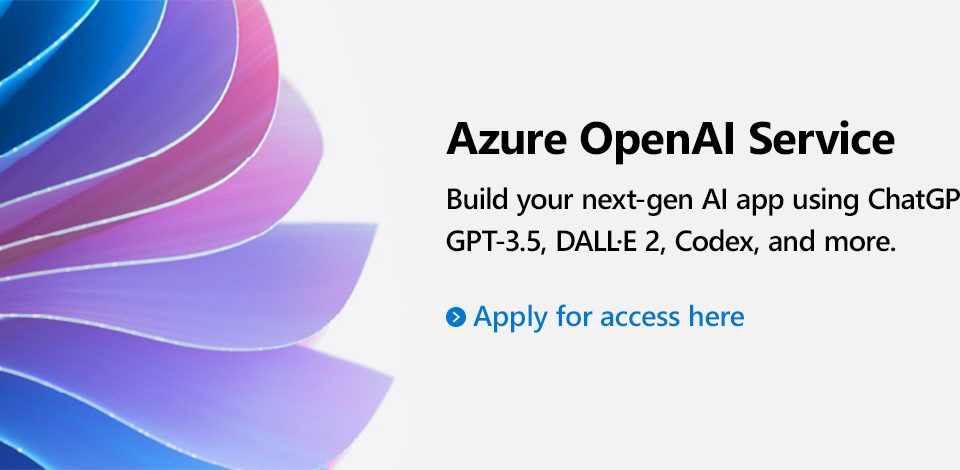
Microsoft provides optimized infrastructure by integrating massive AI into Azure. It officially launched the Azure Open AI service last January and added the ChatGPT preview to the Azure Open AI service last March.
Developers can leverage ChatGPT on the Azure cloud to improve existing bots, summarize call center conversations, generate new ad copy with personalized offers, and automate claims processing. The price is $0.002 per 1,000 tokens.
Microsoft's Azure AI service maximizes security compared to Open AI, providing enterprise-grade security keys and authentication, and allowing for direct management. In addition, it complies with SOC2, ISO, HIPAA, and CSA STAR compliance regulations and provides a service level of 99.95%.
In addition, from an ethical standpoint, data is collected, patterned, and continuously updated in the service based on six principles including fairness, stability, and privacy. The company explains that it has built Responsible AI, a system that blocks inappropriate questions or redefines answers through filtering based on the collected data.
Microsoft presents four steps for enterprises to develop and test services and solutions. First, collect and manage data through Azure AI services, and review related services to develop AI-based intelligent apps. Microsoft's GitHub Copilot supports developers in building environments on Azure for business enhancement and pair programming.
Executive Director Lee emphasized cloud adoption as a necessity, stating, “For companies, transitioning to the cloud to prepare and manage datasets for prompt engineering and fine-tuning will be the most fundamental preparation.” Finally, he mentioned the importance of shared value in utilizing cloud-based document management for collaboration, including various office tasks.
Comments
Related news
Mind AI: "Helping you create customized AI services in one place."
Maeum AI held an open event on the 5th at the aT Center in Yangjae-dong and through online channels to commemorate its name change. Maeum AI introduced professional services provided on the Maeum AI platform and unveiled the AI human 'M3'.
2023.04.06by 김예지 기자
.jpg)
Super-large AI, high-quality data acquisition... domain-specific service is essential
The KIEI Industrial Education Research Institute held a 'Seminar on Business Models by Sector Utilizing Generative AI Technology' on the 14th. The seminar covered △introduction to generative AI technology paradigms and utilization research △legal and regulatory frameworks related to generative AI △AI technology development and business strategies by sector.
2023.04.18by 김예지 기자
2023 World IT Show, Next-Generation K-Digital Technology at a Glance
The 2023 World IT Show, hosted by the Ministry of Science and ICT and others, will be held for four days from the 19th (Wednesday) to the 21st (Friday) at Seoul COEX. This year's World IT Show, marking its 15th edition, centers on the theme "K-Digital Changing the World's Daily Life." The exhibition brings together over 1,300 booths from 465 companies both domestic and international, including major ICT enterprises such as Samsung Electronics, LG Electronics, SKT, and KT. Starting with the Republic of Korea Impact Tech Awards ceremony, lectures on topics including △aerospace △quantum △ChatGPT △AI/DX △platform △UAM △robotics △5G have followed.
2023.04.20by 김예지 기자
Databricks, “Maximizing AI Integrated Platform Data Management”
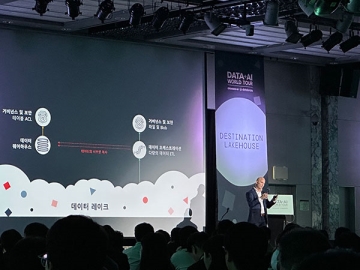
Databricks held its 'Data + AI World Tour' offline in Korea for the first time on the 25th at the InterContinental Harmony Bloom. At the event, Databricks introduced its latest solutions and shared domestic adoption success cases applying these solutions. Jang Jung-wook, CEO of Databricks Korea, said, "As a pioneer of the data lakehouse, we are focused on enabling everyone to access data and AI. This event is a very valuable opportunity to directly examine Databricks' product innovation trends."
2023.04.25by 김예지 기자
SK Hynix benefits from the surge in AI servers developed by ChatGPT.
As generative AI and technologies like ChatGPT transition from the technology sector to services and products, artificial intelligence is driving memory demand and leading to price increases in certain product categories. In particular, AI server shipments are expected to grow at double-digit rates annually, and the market is focusing on high-capacity server DRAM.
2023.04.25by 명세환 기자











