



Korea ranks third in the US semiconductor import market, failing to benefit from the US-China conflict.
 Published2023.05.10 10:03
Taiwan's market share doubles to 19.2%, ranking first, and strengthening its focus on high-growth items.
Since the 2018 US-China trade conflict, the share of Chinese products in the US semiconductor import market has been cut by one-third, while the share of Korean products has only increased slightly. It was analyzed that Taiwan filled the gap left by the decline in Chinese products.
The Federation of Korean Industries analyzed the market share of major countries in the U.S. semiconductor import market following the 2018 U.S.-China trade conflict.
As a result, Taiwan (+9.7%p) and Vietnam (+7.3%p) took advantage of China's decline in market share (-18.5%p) from 2018 to 2022 to rapidly increase their market share and strengthen their position as semiconductor production bases.
Although Korea's market share also increased, the increase (+1.8%p) was found to be relatively small.
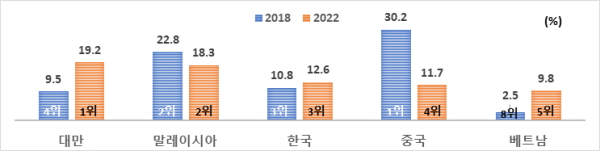
▲Major countries' market share and ranking of market share in the U.S. semiconductor import market (Top 5)
By country, China's share will fall by a third, from 30.2% in 2018 to 11.7% in 2022.
China maintained the top market share throughout the 2000s, but began to decline after 2018, falling to fourth place in 2022.
Taiwan's market share doubled from 9.5% in 2018 to 19.2% in 2022, rising from fourth place to first.
South Korea, which benefited from the memory boom in 2017 and 2018, rose to third place in market share in 2017 and maintained that position in 2022 due to China's weakening position.
Comparing Korea and Taiwan, Korea's market share exceeded Taiwan's by 1.3 percentage points in 2018, but due to Taiwan's recent rapid increase in market share, Korea's market share is expected to fall below Taiwan's by 6.6 percentage points in 2022, widening the gap between the two countries.
▲Korea and Taiwan's share of the US semiconductor import market
Since 2018, the United States has imposed various regulations, including import tariffs and export restrictions on Chinese companies, citing national security and strengthening its own supply chain.
First, additional tariffs of 10-25% were imposed on public imports three times in 2018, and this trend continued in 2019.
During the same period, the United States used the Entity List to restrict the export of parts and equipment made directly using American technology or software. As a result, sanctioned Chinese companies have had difficulty producing semiconductors and strengthening their semiconductor capabilities.
Taiwan and Vietnam have reportedly taken advantage of China's weakening position in the US semiconductor import market, which accounts for 33.4% of the country's total imports of computer parts, to increase their market share and enjoy windfall profits.
In the area of 'computer and other parts', the US imports from China decreased by $9.67 billion (-58%) from 2018 to 2022, but during the same period, imports from Taiwan increased by $7.56 billion (+327%), imports from Vietnam increased by $3.51 billion (+4038%), and imports from Korea increased by $2.58 billion (+52%), quickly filling the gap left by China.
As a result, from 2018 to 2022, 'computer parts, etc.' contributed 15.0%p to the decline in China's share of the US import market, while contributing 6.8%p, 3.5%p, and 1.0%p to the increase in Taiwan, Vietnam, and Korea's share of the US import market, respectively, indicating that this item played a key role in the restructuring of the US semiconductor import structure.
Taiwan and Vietnam have accelerated their market share expansion by strengthening their positions in high-growth items within the U.S. semiconductor import market.
First, imports of ‘other electronic integrated circuits’ from the U.S. increased by 77% (from $8.53 billion to $15.13 billion) from 2018 to 2022, and among these, imports from Taiwan increased by 119% (from $1.84 billion to $4.03 billion), contributing 1.6 percentage points to the expansion of Taiwan’s share of the U.S. import market.
The U.S. imports of items such as LEDs and solar cells/solar modules increased by 135% (from $5.61 billion to $13.16 billion) from 2018 to 2022, and among these, the import amount from Vietnam increased by 874% (from $390 million to $3.80 billion), leading to a 135% increase in imports from Vietnam.It contributed 3.3 percentage points to expanding the U.S. import market share.
Choo Kwang-ho, head of the Economic and Industrial Division of the Federation of Korean Industries, pointed out that “the countries that benefited the most from the restructuring of the U.S. semiconductor import market following the U.S.-China trade conflict in 2018 were Taiwan and Vietnam, while Korea’s market share only saw a slight increase.”
Vice Minister Choo emphasized, “As our government has recently been accelerating efforts to improve the domestic investment environment, including expanding tax credits for investment in advanced strategic industries and expediting investment permit processing, we should use the restructuring of the global supply chain as a turning point to strengthen the domestic semiconductor production base and diversify semiconductor export items.”

Comments
Related news

Intel Unveils Next-Generation 'Core Ultra Series 3' and vPro Platform for Enterprise PCs
Intel has officially unveiled the "Intel Core Ultra Series 3" for next-generation enterprise PCs and the latest vPro platform, addressing a wide range of demands from enterprise notebooks to high-performance workstations.
2026.03.26by 배종인 기자

ROHM Launches ESD Protection Diode Compatible with High-Speed Interfaces of 10Gbps or Higher
Semiconductor specialist ROHM has developed the 'RESDxVx series' of ESD (electrostatic discharge) protection diodes capable of responding to next-generation high-speed data communication environments exceeding 10Gbps, simultaneously enhancing both signal quality maintenance required in high-speed interfaces and IC protection performance.
2026.03.26by 배종인 기자
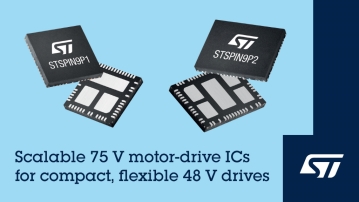
ST Launches 75V Drive IC Targeting 48V Industrial Motor Driving
ST Microelectronics has unveiled the 'STSPIN9P' series of 75V motor drive ICs tailored for 48V-class industrial drive system design. The new product family is characterized by half-bridge and full-bridge configurations that enable design scalability according to motor type and output conditions. Power supply circuits, protection functions, and current sensing circuits are integrated on-chip to simplify system configuration, and the devices are designed to support applications up to 500W maximum. The company plans to provide reference designs and demo boards to support development and evaluation in industrial automation, robotics, pumps, fans, lighting, and textile machinery.
2026.03.26by 배종인 기자

Nordic supports security updates for the entire lifecycle of IoT devices at a single fixed cost
Nordic Semiconductor, a global leader in low-power wireless connectivity solutions, has unveiled a single fixed-cost licensing model that delivers FOTA (Firmware Over-the-Air) and device management capabilities throughout the device lifecycle via nRF Cloud, and introduced a new firmware update solution to prepare for the enforcement of the European Union's Cyber Resilience Act (CRA).
2026.03.26by 배종인 기자
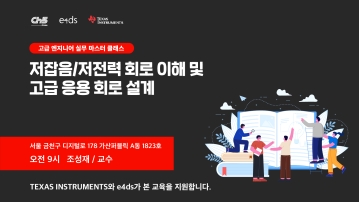
Practical Training in Low-Noise, Low-Power Circuit Design All in One Place… Training Fee Support
The "2026 Advanced Engineer Practical Masterclass" to strengthen competencies in high-sensitivity analog circuit and sensor-based system design will be held on April 16 at the e4ds Conference Center in Gasan-dong, Seoul. This program will be conducted as an offline paid hands-on training session, not online, and is targeted at engineers seeking on-site intensive learning. Texas Instruments will provide educational support for this training, allowing participation at 150,000 won, a 100,000 won discount from the original price of 250,000 won.
2026.03.26by 배종인 기자











