


IBM's quantum computer demonstrates performance surpassing that of existing supercomputers.
 Published2023.06.15 16:33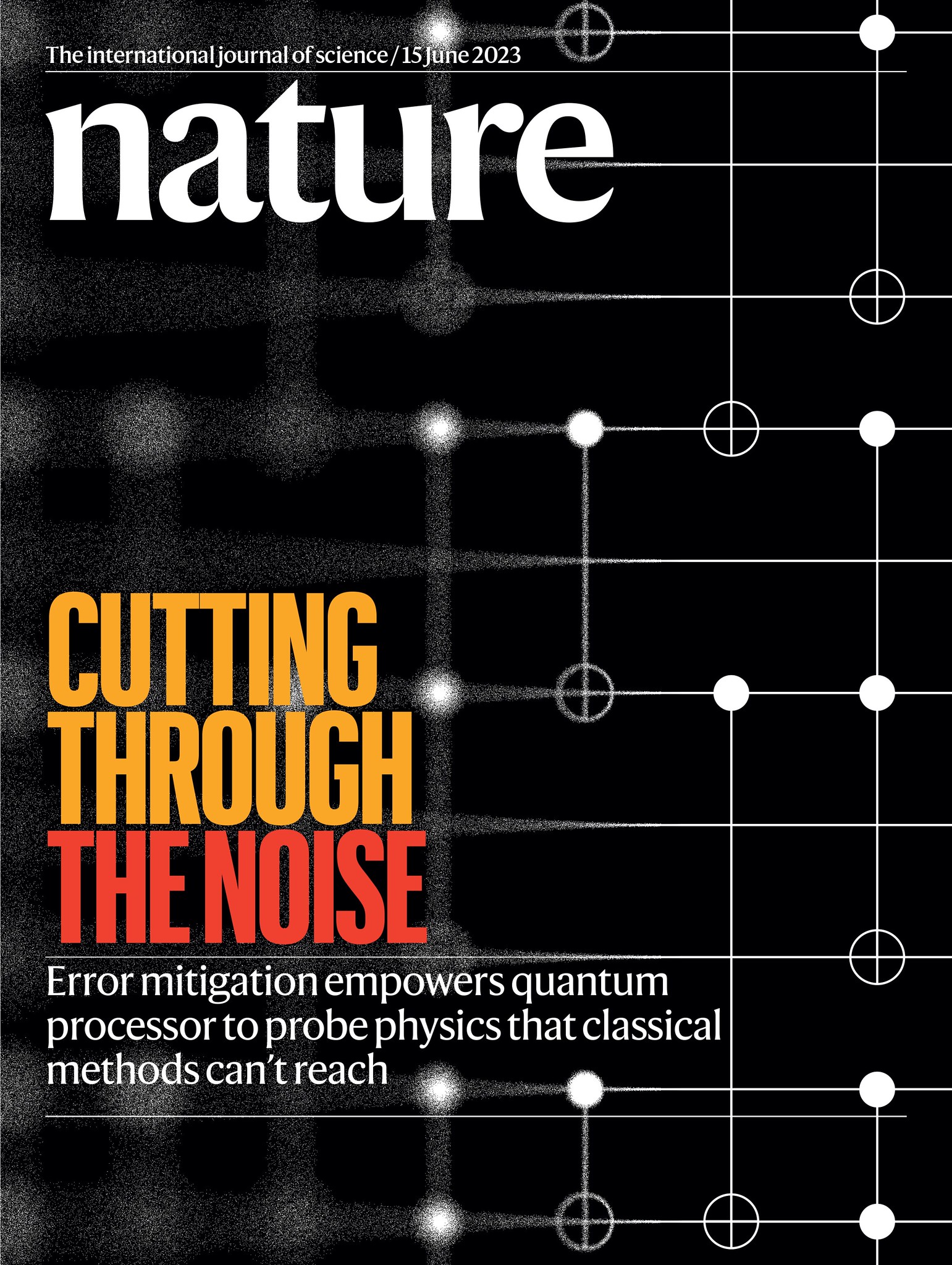
▲IBM's quantum computer research results featured on the cover of Nature (Image: IBM)
IBM's Quantum System to be Upgraded with 127 Superconducting Qubits
Quantum computers are entering the "quantum usability phase," the point at which they provide the performance and utility to be used as scientific tools to explore problems of a new scale that cannot be solved by conventional systems.
IBM announced new research findings on the cover of the scientific journal Nature on the 15th, demonstrating for the first time that quantum computers can produce results more accurate than conventional computing methods at scales of 100 qubits or more.
One of the ultimate goals of quantum computing is to model and simulate the natural properties of materials and substances, which cannot be efficiently computed with conventional computers. Being able to perform these calculations is a crucial step toward solving challenges such as developing more effective fertilizers, building better batteries, and discovering new drugs.
Current quantum systems are inherently noisy, resulting in significant errors that hinder performance. This is known to be due to the fragile nature of quantum bits or qubits and disturbances from the surrounding environment.
In this experiment, the IBM research team demonstrated that by understanding and mitigating errors inherent in quantum computers, they can achieve performance that surpasses simulations using classical computers. The research team said that they used the IBM 'Eagle' quantum processor consisting of 127 superconducting qubits to model magnetic materials and simulate the dynamics of 'spin', a fundamental element that constitutes magnetic materials, to create a large-scale 'entangled' state and accurately calculate physical properties such as magnetization.
To verify the accuracy of these calculations, a team of scientists at the University of California, Berkeley, ran simulations of the same material on advanced supercomputers located at the National Energy Research Scientific Computing Center (NERSC) at Lawrence Berkeley National Laboratory and Purdue University.
As the scale of material models has grown, quantum computers have consistently produced accurate results using advanced error mitigation techniques, while traditional computing methods have fallen far short of IBM's quantum systems.
“This is the first time a quantum computer has accurately calculated a natural physical phenomenon, surpassing existing approaches,” said Darío Gil, senior vice president and general manager of IBM Research. “This achievement is an important step forward in demonstrating that today’s quantum computers are capable scientific tools for problems that are very difficult, or perhaps impossible, to model with classical systems. It signifies that quantum computing is entering a new era of scientific application.”
IBM announced that based on this research, it will upgrade all IBM quantum systems running in the cloud or installed and operated by partners to at least 127 qubits.
These processors offer computational power that surpasses conventional computers for certain applications, and they also offer increased quantum coherence.It is expected to provide a long time (coherence time, stability indicator of qubits) and a low error rate.
This performance, combined with continuously evolving error mitigation technologies, will enable IBM's quantum systems to cross a new threshold known as "quantum utility scale." IBM defines this "quantum utility scale" as "the point at which quantum computers provide the performance and utility to be used as scientific tools to explore problems of a new scale that conventional systems cannot solve."
Meanwhile, research institutions and private sector leaders are working across industries where quantum offers immediate potential, including high-performance computing, high-energy physics, healthcare and life sciences, optimization, finance, and sustainability.

Comments
Related news

Intel and QuTech to Produce Large-Scale Silicon Qubits
As major IT companies like Google and IBM are accelerating their quantum computer development, Intel has achieved progress in the quantum computer development competition by successfully manufacturing silicon qubits on a large scale.
2022.04.15by 명세환 기자
[Planning] Quantum Computer Era, Fierce Security Market
As concerns grow that quantum computers could render modern cryptographic systems in information and communication technology vulnerable, a new market is opening up in cybersecurity. Competition among nations to secure a leading position in developing cryptographic systems resistant to quantum computer attacks is intensifying.
2023.01.09by 명세환 기자

Oxford Quantum Circuit 'Quantum Computer' Built at Equinix Data Center
Quantum computers as a service are being built in data centers, with announcements indicating supply as enterprise solutions.
2023.03.20by 명세환 기자
.jpg)
SalePoint Signs Multi-Year Partnership Agreement with AWS… Promoting Identity Security that Integrates Even AI Agents
Sailpoint has entered into a multi-year strategic partnership agreement with AWS and is moving forward with establishing an integrated governance system that manages both human and non-human identities together. The plan is to consistently manage access permissions in an environment where AI agents are increasing as work execution entities, while applying the principle of least privilege and automated policy enforcement. The two companies plan to jointly expand capabilities to manage the identities of various entities, including AI agents, within a single layer in the AWS environment. This collaboration is interpreted as a move to design security and governance together in corporate environments where AI adoption is expanding.
2026.03.26by 배종인 기자
.png)
Databricks Unveils Open AI Security Monitoring 'Lakewatch'
Databricks entered the security market on March 24 by unveiling LakeWatch, an open-source agentic SIEM. The core functionality of this product is to integrate and analyze security, IT, and business data in a single environment to support AI-based threat detection and investigation. The company explained that it reduces the limitations of existing security operations centers, which have had to forgo some data due to high cost structures, and enables large-scale data analysis and automation based on open formats and ecosystems. LakeWatch is currently offered as a private preview, with Adobe and Dropbox mentioned as early customers. Databricks also announced an expanded partnership with Anthropic as well as the acquisition of Antimatter and SiftD.ai.
2026.03.26by 배종인 기자











