



700 billion won invested in high-difficulty science and technology startups
 Published2023.06.21 10:56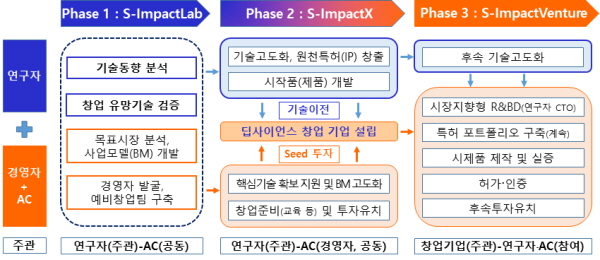
▲Key contents of the Deep Science Startup Activation Support (S-Impact (science impact))
Funding of KRW 450 billion will be provided to the Maejungmul Fund by 2027.
The government will leverage its world-class national R&D achievements to actively support deep science startups in fields expected to create new industries and markets, such as quantum technology, nuclear fusion, and synthetic biology. Deep science startups are challenging startups in emerging technology fields based on high-level scientific knowledge and R&D.
The Ministry of Science and ICT (Minister Lee Jong-ho) announced on the 21st that it had submitted the 'Deep Science Startup Activation Plan' to the Emergency Economic Ministers' Meeting and Export Investment Policy Meeting.
Accordingly, the government plans to invest 700 billion won in science and technology startup R&D by 2027, doubling the number of R&D startup technology companies from 2,879 in 2022 to 5,500 in 2027, and raising the five-year survival rate of startup companies from 75% in 2020 to 85% in 2027, among other challenging goals.
Looking at the main contents, first of all, in new growth fields that require high-level science and technology, researchers and managers will establish deep science startups by utilizing their respective strengths and capabilities, and promote cooperation and partnerships with research industry companies to accelerate corporate growth, thereby supporting technological innovation and startups in the field of deep science in parallel.
We will expand support to discover promising research results in the field of deep science through a competitive process and ensure that researchers receive systematic, specialized support from the patent application stage, enabling them to secure and utilize strong intellectual property.
We will establish a (tentatively named) Deep Science Startup Fund (up to KRW 450 billion by 2027) that can serve as a gateway to VC investment by supporting early growth, such as seed investment, in deep science startups. We will also promote the provision of various funds to deep science companies by including the deep science field in the policy financing target.
We will pursue comprehensive support, including institutional support to alleviate the budget burden for deep science startups to utilize essential research facilities and equipment, awarding extra points when selecting companies designated for military service, and supporting the infrastructure of innovation capacity-based clusters.
In addition, we will strengthen the planning-type startup support centered on public technology holding companies, and private specialized organizations will support public research at universities and research institutes.We will establish a private-sector-centered technology commercialization support system, including strengthening asset inspection authority to enable free exploration and utilization of the composition.
Here, we will enhance growth support to help startups overcome the valley of death and expand overseas by linking clusters with programs segmented by startup stage/ministry and providing package support, and jointly promoting global capacity building programs with overseas partner organizations.
In addition, when evaluating the innovation of innovative products, we will prioritize products in the field of deep science, and promote diversification in the types of trial purchase products (goods, software, services, etc.) and purchase methods (purchase, lease, subscription, etc.).
To ensure fair performance distribution and diversify compensation methods, we will establish specific performance-based compensation for the use of external experts, establish a basis for various forms of performance-based compensation, such as stocks, and enact laws to promote the utilization and dissemination of research results and research-based startups. To promote deep science startups, we will establish laws and systems to improve these.
In particular, we plan to establish guidelines that specify cases of conflicts of interest and prevention procedures that public and private researchers encounter during the research commercialization process, to ensure that vague fears do not become obstacles to starting businesses utilizing research results.
Oh Tae-seok, First Vice Minister of Science and ICT, said, “Now is the time to convert the scientific and technological research achievements accumulated through investments in science and technology into economic value,” and added, “The Ministry of Science and ICT will take the lead in activating deep science startups by linking them with the technology commercialization and startup policies of relevant ministries.”

Comments
Related news
Nvidia invests $5 billion in Intel
NVIDIA and Intel, leaders in global AI computing technology, are now forging ahead in providing cutting-edge solutions through NVLink-based architecture integration. NVIDIA and Intel have officially announced a strategic partnership and stated that they will jointly develop customized data center and personal computing products to accelerate diverse applications and workloads ranging from hyperscale to enterprise and consumer markets, thereby laying the foundation for the next generation computing era.
2025.09.22by 배종인 기자
.jpg)
Applied Materials Launches Environmental Protection Campaign to Mark World Cleanup Day
Applied Materials Korea (CEO Park Kwang-seon) is carrying out environmental cleanup activities with employees and their families around the Dongtan Sinricheon area on the occasion of World Cleanup Day, evolving into a company that engages with the local community beyond technological innovation.
2025.09.22by 명세환 기자
.jpg)
The combination of electrical and electronic technologies like AI, semiconductors, and electric vehicles with renewable energy will determine industrial competitiveness.
Professor Lim Chun-taek from Gwangju Institute of Science and Technology (GIST) stated in his keynote speech at the '2025 e4ds Tech Day' on the 9th, "Global energy investment is already shifting from fossil fuels to renewable energy, and the trend of electrification combined with electrical and electronic technologies is changing the industrial landscape."
2025.09.12by 배종인 기자
.jpg)
"Data Center Power Demand Surges: Distributed Energy is the Solution"
The power demand of data centers is surging rapidly alongside the accelerating growth of artificial intelligence (AI), cloud, and electric vehicle industries. In particular, the global power supply and demand structure centered on the United States is undertaking a massive infrastructure reorganization to adapt to this change, and Korea is no exception in this trend. As an alternative to overcome the limitations of the existing centralized power system, distributed energy systems and smart grid technologies are gaining attention.
2025.09.02by 배종인 기자
Huawei Begins Full-Scale Training of Young Korean Global ICT Leaders
Global ICT company Huawei Korea has signed a Memorandum of Understanding (MOU) with Dongguk University, Ewha Womans University, and Hanyang University, and will jointly implement a global education program to nurture next-generation ICT leaders.
2025.08.29by 배종인 기자











