



The US electric vehicle market grew 55% year-over-year.
 Published2023.07.24 15:28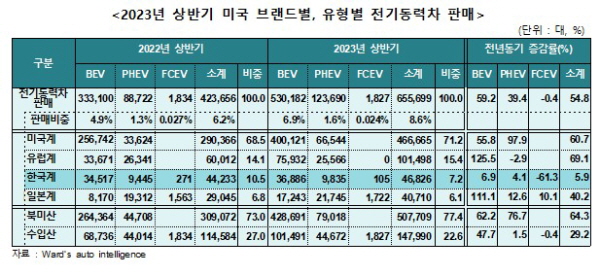
The U.S. electric vehicle market is expected to grow 54.8% year-on-year in the first half of 2023. Among these, Korean brands showed a good performance with a sales share of 7.2%, up 5.9% from the previous year.
The Korea Automobile Mobility Industry Association (KAMA, Chairman Kang Nam-hoon) released a report titled 'U.S. Electric Vehicle Market Trends in the First Half of 2023.'
According to the report, the U.S. electric vehicle market grew 54.8% year-on-year, accounting for 8.6% of total passenger vehicle (sedan + small truck) sales, driven by easing supply chain disruptions, intensifying price competition, and expanding new model launches.
By type, BEVs increased by 59.2% and PHEVs by 39.4%, while FCEVs decreased by 0.4% due to model aging and downsizing.
Sales of electric vehicles in North America in the first half of the year increased 64.3% year-on-year, and the sales share also increased by 4.4 percentage points from 73% in the previous year to 77.4%.
Sales by manufacturer country showed that American brands increased by 60.7% year-on-year, and their share expanded from 68.5% the previous year to 71.2%, leading the U.S. electric vehicle market.
European brands saw a 125.5% year-on-year increase in BEV sales, driven by expansion of new lineups, the start-up of electric vehicle factories in the US, and a stabilization of the supply chain, leading to a production recovery. Overall electric vehicle sales rose 69.1% year-on-year.
Korean brands saw their growth slow down due to the suspension of individual purchase incentives, but they performed well, selling approximately 46,800 units (7.2% market share), up 5.9% year-on-year, through efforts to recover sales, including expanding the proportion of commercial sales such as leases and rentals, strengthening their lineups, and providing corporate incentives.
Japanese brands saw a 40.2% year-on-year increase, driven by the expansion of new BEV model launches by major companies.
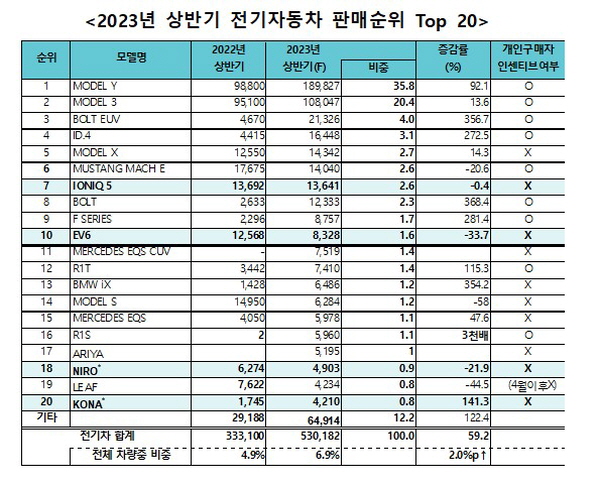
Looking at the sales ranking by model, Tesla's Model Y and Model 3 took 1st and 2nd place in pure electric vehicles (BEV), selling 56% of all BEV sales, and Korean brandsDespite the exclusion of personal purchase incentives due to the IRA Act, the IONIQ 5 and EV6 ranked 7th and 10th in sales, respectively, and were included in the BEV Best Top 10.
Meanwhile, after the IRA took effect, major companies' investment plans in the U.S. are expanding and their implementation dates are being brought forward.
By the first quarter of 2023, automakers and battery companies had invested approximately $115 billion in electric vehicles and batteries, leading to the construction of 24 battery factories.
Battery production capacity for electric vehicles in the United States is projected to increase from 55 GWh per year by the end of 2021 to 1,000 GWh by 2030, enough to manufacture more than 10 million pure electric vehicles.
Kang Nam-hoon, chairman of the Korea Automobile Mobility Industry Association, said, “As automakers are having difficulty making profits through electric vehicle sales, competition among companies will become more intense as the pressure to lower electric vehicle prices intensifies.” He added, “In order for the domestic automobile industry to secure competitiveness in the global market, it will become more important to establish a domestic electric vehicle ecosystem. To this end, it is necessary to utilize investment incentives such as the ‘Temporary Investment Tax Credit’ and the ‘National Strategic Technology Tax Credit’ to the fullest extent possible. It is necessary to continue and extend the investment support system so that companies can build a production base and make investments in a timely manner. In order to support parts companies that have had difficulties in transitioning to future vehicles, the ‘Special Act on Promotion of Transition and Fostering of the Ecosystem of the Future Automobile Parts Industry’ should be enacted as soon as possible and specific support measures should be prepared. In addition, domestic systems such as securing labor flexibility to promote investment by foreign-invested companies and enhance domestic production competitiveness should be strengthened.”“It must be accompanied by improvements,” he said.

Comments
Related news

[e4ds Tech Day 2026 ⑨] Sim Sang-gyu, Autocrypt CTO: "In the Physical AI Era, Automotive Security Must Extend Beyond the Vehicle"
At e4ds Tech Day 2026, Sim Sang-gyu, CTO of Autocrypt, explained automotive cybersecurity strategies in the era of Physical AI and SDV (Software-Defined Vehicle). Automobiles are evolving as part of an ecosystem connected to AI, cloud, chargers, IoT, and robots, and he emphasized that the scope of security must expand beyond the vehicle interior to the entire connected environment. In particular, AI model tampering, adversarial attacks, OTA updates, and EV charger hacking were identified as major threats. He explained that response measures require zero trust, AI model integrity protection, intrusion detection, Security by Design and Default, and full lifecycle security management, and that proactive security system establishment beyond regulatory compliance is critical for securing future mobility competitiveness.
2026.10.12by 배종인 기자

Practical HIL Construction Strategy for Automotive and Off-Highway Controller Validation
As vehicle E/E architecture transitions to zonal structures and shifts to software-defined vehicles (SDV), the number of controllers (ECUs) requiring validation and software complexity are surging dramatically. Meanwhile, real vehicle testing cannot provide repeated verification under identical conditions and entails lead time and safety concerns. This white paper explains the principles of HIL (Hardware-in-the-Loop) validation and the structure of the NI platform composed of PXI, SLSC, and VeriStand, and through two actual implementation cases—Camera Record & Replay HIL for In-Cabin Monitoring Controller (ICMU) and Forklift Controller (VCU) HILS—describes how controller-level regression testing becomes possible. Additionally, it explicitly states application boundaries and limitations, such as lack of A2B support.
2026.10.12by 편집부
Korea Automotive Research Institute Signs MOU with Italy National Institute for Wireless Communications
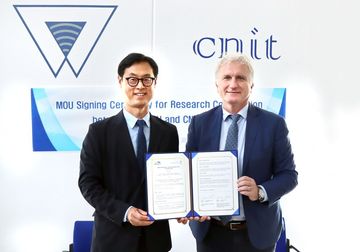
The Korea Automotive Research Institute will sign an MOU with Italy's National Institute for Wireless Communications and launch joint research on next-generation mobility technologies based on 6G, V2X, and connected vehicles. The two organizations will conduct research to apply advanced wireless communication technologies to vehicles and discover international joint projects to advance next-generation connected vehicle technology development.
2026.10.12by 배종인 기자
Color Accuracy Issues in Vehicle Interior Ambient Lighting and Intelligent LED Drivers
Vehicle interior ambient lighting is spreading across all price segments, and the level of color accuracy required of lighting designers is rising accordingly. This white paper quantitatively addresses why temperature drift and individual variations of RGB LEDs cannot be corrected by standard constant-current drivers, and explains an intelligent LED driver approach that integrates an MCU, calibration data, and a LIN network interface into the driver. It covers implementation details of the LITIX Interior TLD4020-3ET currently in production, portfolio roadmap, and evaluation/development environments, and clarifies application boundaries including lack of 48V support, lack of RGBi/ISELED support, and absence of direct optical degradation diagnostics.
2026.10.08by 명세환 기자
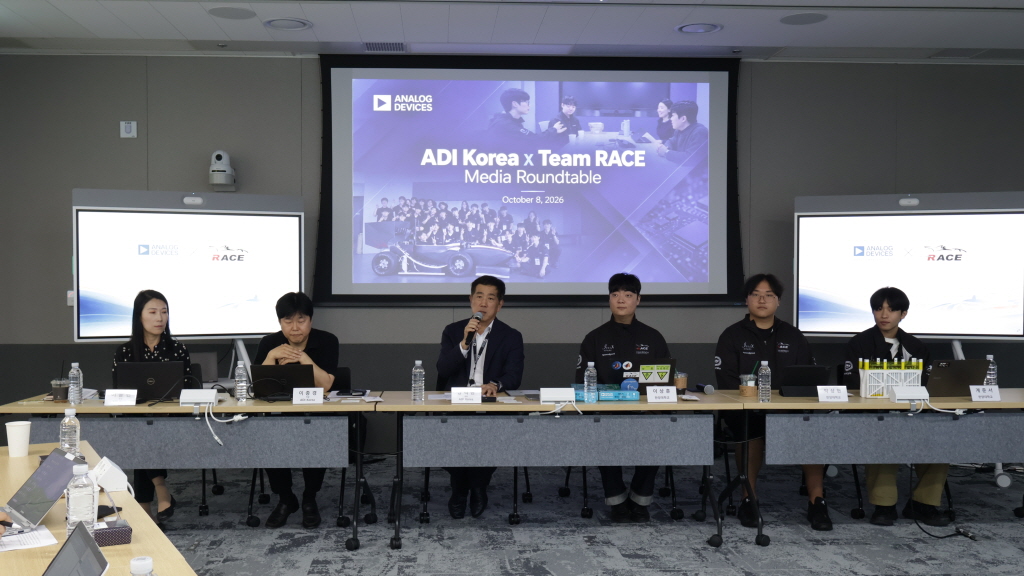
ADI, "Fostering Future Engineers Beyond Component Support"
Global semiconductor company Analog Devices (ADI) is drawing attention for moving beyond simply sponsoring university student car projects to serve as a partner in nurturing future engineers. Over the past three years, ADI has collaborated with Hanyang University's automotive research club Team RACE to support electric formula vehicle development, and recently has been providing technical consultation and semiconductor solutions to enable students to directly develop battery management systems (BMS), creating a model case of industry-academic cooperation.
2026.10.08by 배종인 기자











