



Personal Information Protection Commission Imposes Fine on OpenAI and Issues Improvement Recommendations
 Published2023.07.28 15:04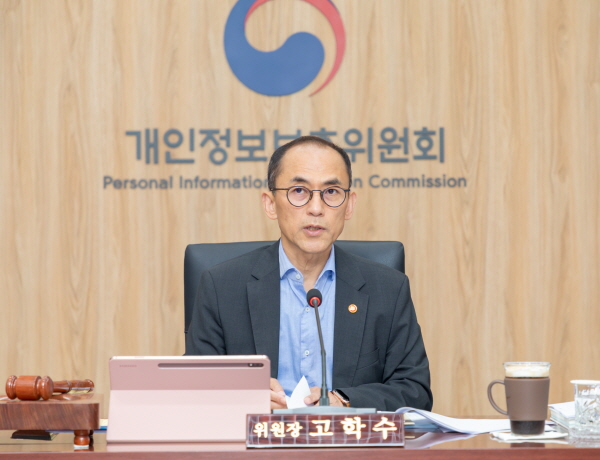
With the imposition of an administrative fine on OpenAI, which experienced a personal information breach, personal information protection for emerging generative AI and other cutting-edge technology services is being strengthened.
The Personal Information Protection Commission (Chairman Ko Hak-soo) held a plenary session on the 26th and decided to impose an administrative fine of 3.6 million won on OpenAI OpCo LLC (hereinafter "OpenAI"), which recently experienced a personal information breach, for violation of notification obligations, and adopted improvement recommendations including "establishment of recurrence prevention measures, compliance with domestic protection laws, and active cooperation with proactive fact-finding inspections by the Personal Information Protection Commission."
The Personal Information Protection Commission initiated investigations ex officio based on OpenAI's self-notification in March that a personal information breach had occurred on its ChatGPT service and related domestic and international media reports. In the process, the Commission also conducted verification work on overall compliance with domestic protection law obligations and personal information infringement factors across all service usage.
Between 17:00 on March 20, 2023 and 02:00 on March 21, some personal data of global users who accessed ChatGPT Plus—including names, email addresses, billing addresses, and the last four digits and expiration dates of credit cards—were exposed to other users. It was confirmed that 687 Korean users (based on Korean IP addresses) were included.
The cause of the breach was identified as an unknown error (bug) that occurred in an open-source based caching (temporary storage) solution implemented to increase service speed.
Following precise analysis through technical expert review meetings and other means, it was determined that OpenAI could not be said to have neglected generally expected protective measures, so no action was taken for violation of safety obligation requirements. However, an administrative fine was imposed for violation of notification obligations by failing to report within 24 hours of discovering the breach. The Commission adopted an improvement recommendation for OpenAI to conduct self-inspections of its personal information processing system and establish recurrence prevention measures.
Upon review of the personal information handling policy and actual subscription procedures, it was found that the policy is provided only in English, no separate consent procedure exists (presumed to be replaced by subscription), and issues regarding protection law compliance deficiencies were identified, including unclear custodian relationships, specific data destruction procedures and methods, and the absence of a clear domestic representative.
Additionally, there was an issue of restricting subscriptions for those under 13 years old, which is somewhat inconsistent with the domestic protection law's statutory guardian consent application age standard of under 14 years old.
However, during the investigation, OpenAI explained that it is a new business operator that recently began global services, and has been formally submitting opinions on compliance with domestic protection laws in accordance with amendments to the protection law through cooperation with the Personal Information Protection Commission. Accordingly, at this point in time, the Commission decided to recommend improvement and continuously monitor and verify implementation.
To examine privacy infringement factors as a cutting-edge technology, the Commission requested materials regarding data collection and usage (including personal information), sources of Korean language training data, efforts to prevent ethical issues, and methods to refuse data collection. However, OpenAI's explanations remained at a general and broad level, making clear analysis difficult.
Nevertheless, the Personal Information Protection Commission determined that early strengthening of personal information protection through fact-finding inspections and cooperative improvement is desirable in a situation where applicable legal provisions for newly emerging services (super-large scale and generative AI) remain unclear. The Commission decided to conduct proactive fact-finding inspections targeting major domestic and international AI services including ChatGPT to minimize personal information infringement factors, and also adopted an improvement recommendation requesting active cooperation from OpenAI.
This measure clearly establishes that domestic protection laws apply to global new services when Korean users are present. Going forward, the Personal Information Protection Commission plans to enhance personal information protection for Korean data subjects by issuing guidance documents for overseas business operators, substantially improving the domestic representative system, raising awareness of domestic regulations among major global personal information processors, and securing enforcement capabilities.
In particular, for cutting-edge technologies and services such as AI, the Commission plans to support safe service usage through proactive fact-finding inspections and other measures, with plans to continuously develop these efforts in detail going forward.

Comments
Related news
.png)
Databricks Unveils Open AI Security Monitoring 'Lakewatch'
Databricks entered the security market on March 24 by unveiling LakeWatch, an open-source agentic SIEM. The core functionality of this product is to integrate and analyze security, IT, and business data in a single environment to support AI-based threat detection and investigation. The company explained that it reduces the limitations of existing security operations centers, which have had to forgo some data due to high cost structures, and enables large-scale data analysis and automation based on open formats and ecosystems. LakeWatch is currently offered as a private preview, with Adobe and Dropbox mentioned as early customers. Databricks also announced an expanded partnership with Anthropic as well as the acquisition of Antimatter and SiftD.ai.
2026.03.26by 배종인 기자
Kaspersky Unveils Revamped 'NEXT' Combining SOC Integrated Management and AI Analytics
As enterprises increase demand for integrated management and automation in the construction and operation of Security Operations Centers (SOC), Kaspersky has disclosed updates to its B2B security product suite 'Kaspersky Next'. This update expands EPP, EDR, XDR, and SIEM integration through a single console based on OSMP, incorporates AI capabilities such as DLL hijacking detection and suspicious account takeover behavior identification, and includes integration with generative AI assistant tool KIRA. The company stated that in large-scale deployment environments, EDR Expert can reduce resource requirements by up to 30%, and XDR Expert by up to 60%.
2026.03.25by 배종인 기자

Samsung Electronics Smart Monitor Acquires First International Certification… Expanding Application Scope Following TVs
Samsung Electronics has received Common Criteria (CC) certification for 'Samsung Knox,' a security solution applied to its 2026 smart TVs and smart monitors. The smart TV has achieved certification for 12 consecutive years, while the smart monitor obtained industry-first certification this time. The evaluation was conducted focusing on core functions including kernel integrity monitoring, phishing site blocking, and unauthorized execution prevention. The company plans to expand the scope of security certification beyond TVs to monitors, responding to growing personal information protection requirements as connected devices proliferate.
2026.03.25by 배종인 기자

Teori Selected as AI Voucher Supplier… Supplying LLM Security Solutions
Cybersecurity company Theori has been selected as a supplier for the 2026 AI Voucher Support Program. The company plans to address information leakage and regulatory compliance issues that arise during generative AI adoption through its LLM security solution 'AlphaPrism'. The solution is designed to analyze the context of prompts and source code to identify sensitive information such as personal data and authentication keys, and to continue AI utilization through masking methods rather than simple blocking. The government's AI Voucher Program supports demand enterprises with up to 200 million won per project for solution purchase costs. Based on recent application cases at POSCO DX, Theori plans to respond to expanding demand for enterprise AI security.
2026.03.24by 명세환 기자
Cisco Unveils Agentic AI Security Framework at RSAC 2026
Cisco announced security capabilities targeting the entire process of enterprise AI agent adoption at RSAC 2026 held in San Francisco, USA. The core approach involves applying identity management and the principle of least privilege to AI agents similar to humans, testing for attack vulnerabilities before deployment, and automating threat detection and response through Splunk-based security monitoring during operations. Cisco also unveiled the "AI Defense: Explorer Edition" security validation tool for developers, the open-source framework "DefenseClose," and agent-type SOC functionality. As pilot deployments are increasing but actual operational transitions remain limited, this announcement is interpreted as focusing on how enterprises can implement security frameworks during the commercialization process of AI agents.
2026.03.24by 명세환 기자











