


Regulating the copyright of generative AI requires a phased approach tailored to the pace of development.
 Published2023.08.01 09:37
Opinions are divided on the fair use of public data for learning purposes.
Naver HyperClova X, Korea's largest AI, to be unveiled in August
With the copyright issue surrounding generative AI becoming a hot topic, experts have argued that AI innovation and copyright regulation must be harmonized.
The Korea Institute for Advancement of Technology and Information and the Korean Society for Artificial Intelligence Law held a forum on the 31st in the 10th floor conference room of Post Tower and online to explore countermeasures to strengthen the competitiveness of generative AI and ensure legal stability.
Recent AI-related copyright issues center around the question of whether training data is being copyrighted and the registration of AI-related copyrighted works. With the number of class action lawsuits now at seven, the battle between copyright holders and AI developers continues.
According to Professor Lee Dae-hee of Korea University, who presented on generative AI and copyright issues, Korea is expected to be significantly affected by the US ruling on AI.
Most recent lawsuits have involved novelists suing generative AI companies, claiming they are using the artistic style of a specific artist for profit.
For example, novelists have claimed that OpenAI has copied their works and exploited them for commercial gain. Kadrey filed a lawsuit against Meta's LLaMA, and Sarah Anderson also objected to Stable diffusion, arguing that the generated output is a derivative work of a specific image based on the training image.
However, Clarkson Law Firm failed to bring a copyright infringement claim against OpenAI and Microsoft. While it's possible to infer that the AI used training data, it's difficult to prove that the generative AI, which absorbs various images to create works, used its own work.
Amid the lack of case law itself, the professor said, “When assessing the degree of fair use of generative AI, the commercial nature is the most important,” and “Even if a portion of the original work is modified or summarized for an additional purpose, if the degree of similar commercial use is large, it is difficult to view it as fair use.”
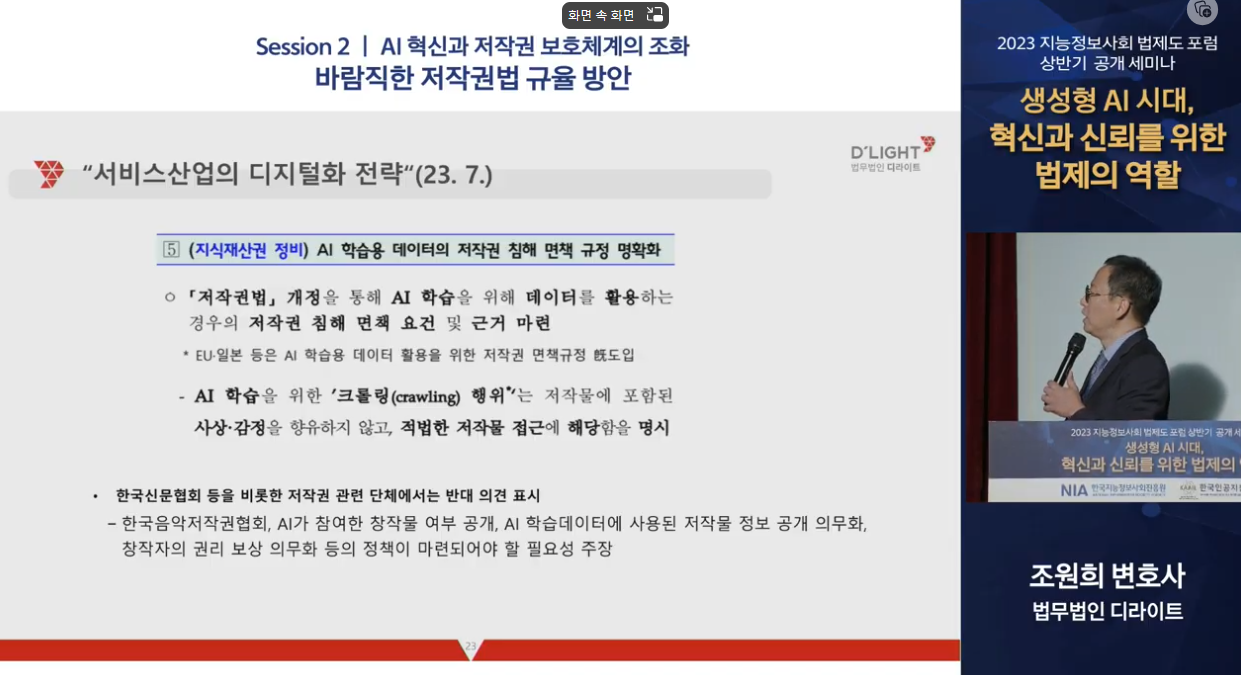
Next, attorney Wonhee Cho of Delight Law Firm argued that it is important to establish a copyright protection system that does not restrict the development of the AI industry.
Attorney Cho presented an overseas case. In the United States, AI inventions were denied copyright registration due to the lack of human involvement. However, there is a growing consensus that future technological advancements should be considered. The EU has a somewhat conservative stance, while the UK is prioritizing the use and development of AI by amending some provisions of TDM (text and data mining) with exceptions.
For example, Getty Images sued an AI image startup, but the company concluded that realistically, the number of images possible is limited, and AI technology can surpass the artistic style of a single artist. Ultimately, this means that by separating existing data from trained data, fair use issues can be viewed differently.
Japan recognizes learning data but includes exceptions for copyright holders and copyright protection, similar to Korea. While there's a provision that states that users must have legal access to copyrighted material, this too remains controversial.
Attorney Cho emphasized the importance of AI development in his proposal for AI copyright law regulation. He stated, "As a country developing an AI engine based on LLM, we face the challenge of addressing monopolies like OpenAI, Meta, and Google." He argued, "From a policy perspective, there's no need to follow the EU's regulatory approach to fostering the AI industry. Instead, a phased approach that takes into account the pace of AI technology development is necessary."
He also stated, “We must understand that the perspectives of AI technology developers and AI policymakers are very different,” and “I believe that public data, unless its use is explicitly restricted, is fair use if it is used solely for learning purposes.”
However, he added that even if learning is allowed, regulations are necessary, such as establishing standards to limit the use of crawling and learning data, and inserting source code to prevent copyright conflicts in advance. In other words, this means that no part of the work should be the output of AI.
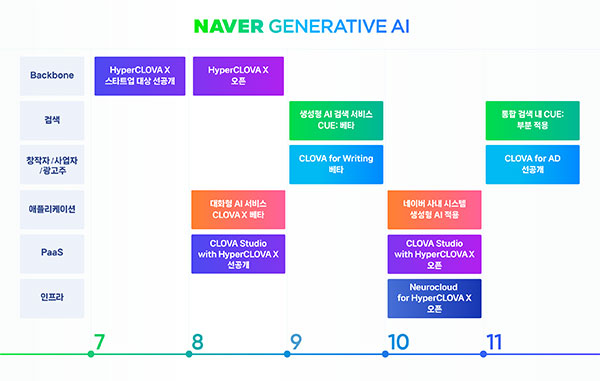
Meanwhile, Naver's 'HyperClova X', Korea's representative generative AI, is about to be launched. On the 21st, Naver announced its service lineup based on this and its launch schedule within the year, signaling the full-scale expansion of its ultra-large AI ecosystem.
HyperClovaX and conversational agent ClovaX are being launched as beta services. ClovaX is expected to be used as a productivity tool not only for answering questions but also for creating, summarizing, and writing.
Additionally, in September, the beta service of the AI-based search service 'Cue:', which is a creation-based AI tool, will be released, and in October, a version equipped with HyperClovaX will be released in the hyperscale AI tool Clova Studio.
HyperClova is a Korean-focused AI specialized in specialized fields such as commerce, finance, and law, with over 6,500 times the amount of Korean data learned by ChatGPT, and used 50 years of news blogs as training data.
As technological advancements through learning about creative works coexist with the hurdles of commercial use, ongoing discussions are needed to determine how to safely protect works while ensuring their usefulness to all.
Comments
Related news
.jpg)
SK Hynix, deficit ↓ with HBM3 and DDR5, recovery expected in the second half
Memory semiconductor results in the second quarter recorded consecutive losses due to sluggish demand recovery in consumer-oriented products such as mobile and PC as well as general servers. However, with the booming AI server market, orders are expanding in high-value-added product lineups such as HBM3 and DDR5, with gradual recovery anticipated.
2023.07.26by 명세환 기자
.jpg)
SKT's AI-based traffic signal optimization solution reduces vehicle travel times.
SK Telecom has developed a traffic signal optimization solution based on traffic data analysis extracted from an AI-based location data analytics platform and applied it to actual roads for the first time, achieving meaningful results such as reduced vehicle travel time.
2023.07.26by 배종인 기자
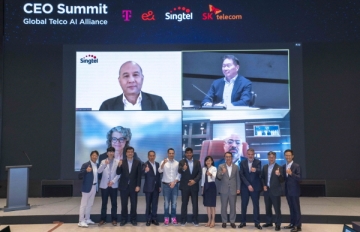
SKT Launches Global Telecom AI Alliance
SK Telecom (represented by President and CEO You Young-sang) held the 'Global Telco AI Alliance CEO Summit' with the attendance of SK Chairman Chey Tae-won, SKT President You Young-sang, and key executives from leading global telecommunications companies in Europe, the Middle East, and Asia. At the event, SK Telecom officially launched the 'Global Telco AI Alliance' centered on SKT, Deutsche Telekom, e&, and Singtel.
2023.07.28by 배종인 기자
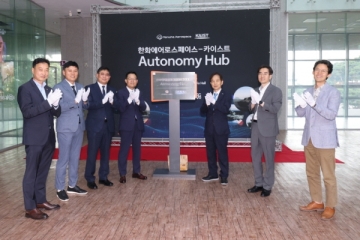
Hanwha Aerospace and KAIST Begin Full-Scale Development of Autonomous Military Unmanned Vehicles
Hanwha Aerospace is moving forward with autonomous driving technology development in open fields in partnership with KAIST. To this end, a unveiling ceremony for the 'Autonomy Hub' was held at KAIST in Daejeon on the 26th.
2023.07.28by 배종인 기자
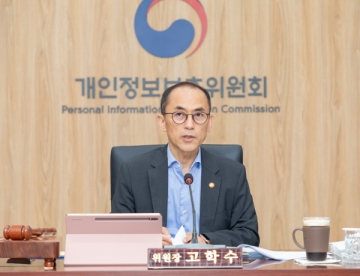
Personal Information Protection Commission Imposes Fine on OpenAI and Issues Improvement Recommendations
The Personal Information Protection Commission (Chairman Ko Hak-soo) held a plenary session on the 26th and decided to impose an administrative fine of 3.6 million won on OpenAI OpCo LLC (hereinafter "OpenAI"), which recently experienced a personal information breach, for violation of notification obligations, and adopted improvement recommendations including "establishment of recurrence prevention measures, compliance with domestic protection laws, and active cooperation with proactive fact-finding inspections by the Personal Information Protection Commission."
2023.07.28by 배종인 기자











