


US company VanderHaal completes electric vehicle development in eight months using MathWorks simulations.
 Published2023.08.02 11:16
.jpg)
▲Vanderhall's all-electric UTV, the Brolly (Image courtesy of MathWorks)
Vanderhal Completes UTV Design, Simulation, and Testing in Eight Months Using MathWorks Software
Control algorithm design and testing are performed virtually, minimizing risk during code deployment.
MathWorks announced on the 27th of last month that American electric vehicle manufacturer VanderHaal shortened the development process of its electric UTV (off-road utility vehicle) 'Brawley' by utilizing MathWorks' simulation software 'Simulink'.
“Electric vehicles are a fast-moving market, and if we had used traditional development methods, we would still be behind the competition and not delivering on our promise,” said Christopher Johnson, CTO of VanderHaal. “Simulink’s superior vehicle dynamics simulation eliminates the need to repeat extensive physical testing every time we make a code change.”
According to MathWorks, three engineers at VanderHaal completed the design, simulation, and testing of the Brolly prototype in eight months, a process that would normally take years.
The biggest difference of Broly is Four electric motors, one for each 35-inch wheel, are key elements to ensure high speed and turning ability on rough off-road.
This was a requirement that existing electric vehicle powertrain suppliers could not meet, so VanderHaal developed the powertrain and vehicle control system from scratch.
During this process, VanderHaal used Simulink to build a virtual car, simulate the powertrain and vehicle dynamics in real time, and evaluate how the control algorithms worked.
For example, we simulated what would happen in various situations, such as when a vehicle makes an emergency maneuver or when a high-voltage battery overheats, and implemented control algorithms accordingly to accurately determine how the vehicle would actually operate without physical testing.
MathWorks' Vehicle Dynamics Blockset was useful in designing vehicle control software.
Using this blockset, Vanderhal built a system that can independently control the output, speed, and velocity of each wheel by modeling the rotational speed of the wheel and the acceleration of the vehicle according to torque.
Additionally, VanderHaal modeled and simulated SOC (battery state of charge), the most important data for electric UTVs, using the Powertrain Blockset for automotive powertrain systems and simulation.
“Estimating the actual SOC of an electric vehicle battery is challenging when all metrics, including acceleration, are constantly changing, and Powertrain Blockset has been a huge help in this area,” said Johnson, CTO.
Comments
Related news

[e4ds Tech Day 2026 ⑨] Sim Sang-gyu, Autocrypt CTO: "In the Physical AI Era, Automotive Security Must Extend Beyond the Vehicle"
At e4ds Tech Day 2026, Sim Sang-gyu, CTO of Autocrypt, explained automotive cybersecurity strategies in the era of Physical AI and SDV (Software-Defined Vehicle). Automobiles are evolving as part of an ecosystem connected to AI, cloud, chargers, IoT, and robots, and he emphasized that the scope of security must expand beyond the vehicle interior to the entire connected environment. In particular, AI model tampering, adversarial attacks, OTA updates, and EV charger hacking were identified as major threats. He explained that response measures require zero trust, AI model integrity protection, intrusion detection, Security by Design and Default, and full lifecycle security management, and that proactive security system establishment beyond regulatory compliance is critical for securing future mobility competitiveness.
2026.10.12by 배종인 기자

Practical HIL Construction Strategy for Automotive and Off-Highway Controller Validation
As vehicle E/E architecture transitions to zonal structures and shifts to software-defined vehicles (SDV), the number of controllers (ECUs) requiring validation and software complexity are surging dramatically. Meanwhile, real vehicle testing cannot provide repeated verification under identical conditions and entails lead time and safety concerns. This white paper explains the principles of HIL (Hardware-in-the-Loop) validation and the structure of the NI platform composed of PXI, SLSC, and VeriStand, and through two actual implementation cases—Camera Record & Replay HIL for In-Cabin Monitoring Controller (ICMU) and Forklift Controller (VCU) HILS—describes how controller-level regression testing becomes possible. Additionally, it explicitly states application boundaries and limitations, such as lack of A2B support.
2026.10.12by 편집부
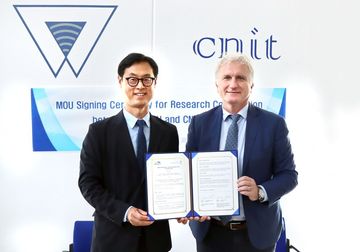
Korea Automotive Research Institute Signs MOU with Italy National Institute for Wireless Communications
The Korea Automotive Research Institute will sign an MOU with Italy's National Institute for Wireless Communications and launch joint research on next-generation mobility technologies based on 6G, V2X, and connected vehicles. The two organizations will conduct research to apply advanced wireless communication technologies to vehicles and discover international joint projects to advance next-generation connected vehicle technology development.
2026.10.12by 배종인 기자
Color Accuracy Issues in Vehicle Interior Ambient Lighting and Intelligent LED Drivers
Vehicle interior ambient lighting is spreading across all price segments, and the level of color accuracy required of lighting designers is rising accordingly. This white paper quantitatively addresses why temperature drift and individual variations of RGB LEDs cannot be corrected by standard constant-current drivers, and explains an intelligent LED driver approach that integrates an MCU, calibration data, and a LIN network interface into the driver. It covers implementation details of the LITIX Interior TLD4020-3ET currently in production, portfolio roadmap, and evaluation/development environments, and clarifies application boundaries including lack of 48V support, lack of RGBi/ISELED support, and absence of direct optical degradation diagnostics.
2026.10.08by 명세환 기자
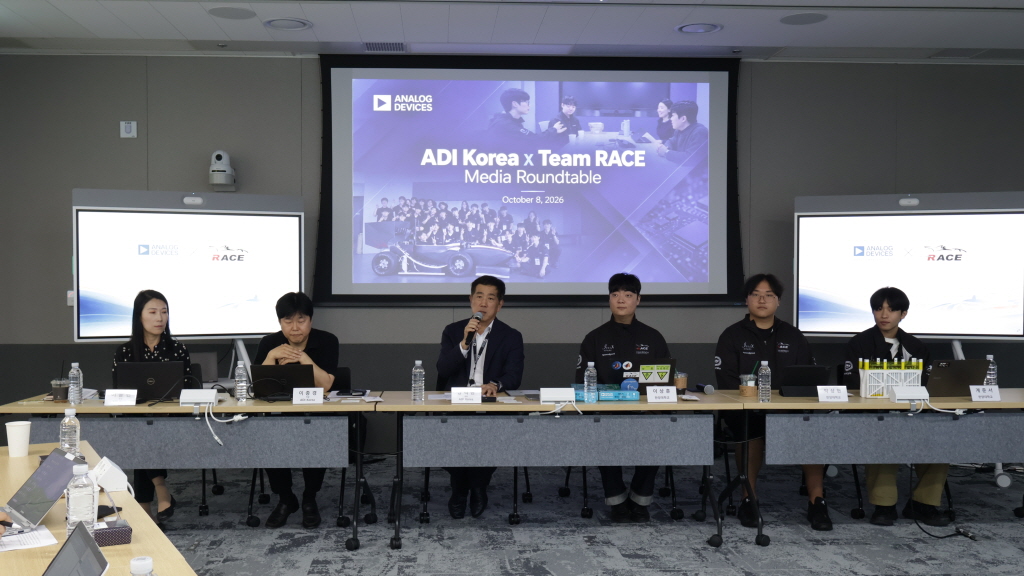
ADI, "Fostering Future Engineers Beyond Component Support"
Global semiconductor company Analog Devices (ADI) is drawing attention for moving beyond simply sponsoring university student car projects to serve as a partner in nurturing future engineers. Over the past three years, ADI has collaborated with Hanyang University's automotive research club Team RACE to support electric formula vehicle development, and recently has been providing technical consultation and semiconductor solutions to enable students to directly develop battery management systems (BMS), creating a model case of industry-academic cooperation.
2026.10.08by 배종인 기자











