



KIMM Localizes Key Automotive Semiconductor Equipment
 Published2023.08.08 09:25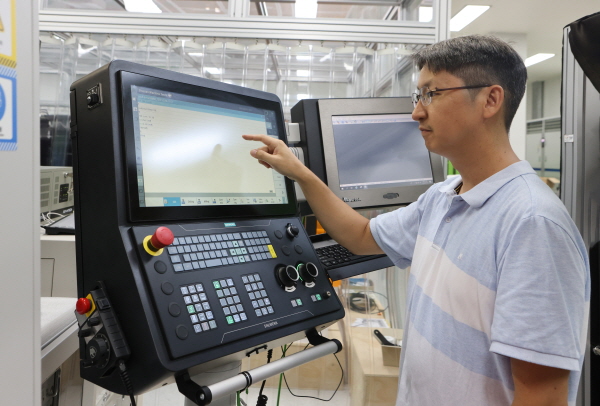
Dr. Ahn Sang-hoon of the Korea Institute of Machinery and Materials is operating the control system for the WaterNet/Laser Fusion Processing Machine.
With the rapid growth of electric vehicle technology leading to rising demand for high-value automotive semiconductors, the development of equipment that processes core automotive semiconductor components using both lasers and hydraulic pressure—the first of its kind in Korea—is raising expectations that it will help reduce reliance on imports and achieve cost savings.
The research team led by Principal Researcher Sang-hoon Ahn of the Optical Application Equipment Research Laboratory at the Korea Institute of Machinery and Materials (KIMM, President Sang-jin Park), under the Ministry of Science and ICT, announced on the 8th that they have succeeded in developing a laser-waterjet hybrid processing machine capable of freely processing high-strength materials that are difficult to process.
Automotive semiconductors are key components that control electronic equipment, engines, and more. Electric vehicles and autonomous vehicles require more electrical devices than conventional internal combustion engine vehicles, leading to an increase in the number of semiconductors used. With the newly developed laser-waterjet fusion processing machine, SiC, which is attracting attention as a semiconductor substrate for automobiles but is difficult to process due to its high hardness and previously relied on imported machines, can now be freely processed domestically.
The research team succeeded in developing the first domestic 200W green nanosecond laser, which had previously relied on foreign imports, and also developed a stable optical system capable of precisely maintaining the processing position for nine times longer than foreign products during product processing.
In addition, the research team designed the equipment so that high-pressure water produced by a high-pressure pump is passed through a water jet nozzle to form a laminar flow of more than 50 mm in length inside the processing device, and then a laser beam is focused to one point inside the laminar flow to process the product with a laser along the water jet stream.
Looking at existing laser processing equipment, nanosecond laser processing equipment used for splitting semiconductor wafers offers fast processing speeds but struggles with precise processing, while ultrashort laser processing equipment used for cutting display glass enables precise processing but has the disadvantage of slow processing speeds.
The newly developed laser-waterjet fusion processing machine can process materials precisely at high speeds, and can maintain a clean working environment by using a waterjet to expel large amounts of fine dust and smoke that were previously generated during laser processing. In addition, this fusion processing machine has the advantage of being 20% cheaper than imported fusion processing machines.
"I am pleased that we have succeeded in developing the nation's first laser fusion processing machine, contributing to strengthening the technological competitiveness of Korea's future semiconductor equipment industry," said Ahn Sang-hoon, a principal researcher at the Korea Institute of Machinery and Materials (KIMM). "I expect that this development will help secure competitiveness in the automotive semiconductor industry and contribute to expanding the market share of Korean companies."
Meanwhile, this research was conducted with support from the Ministry of Trade, Industry and Energy's 'High-Power Laser Fusion Machining Machine for Machining High-Strength Difficult-to-Machine Materials' project.
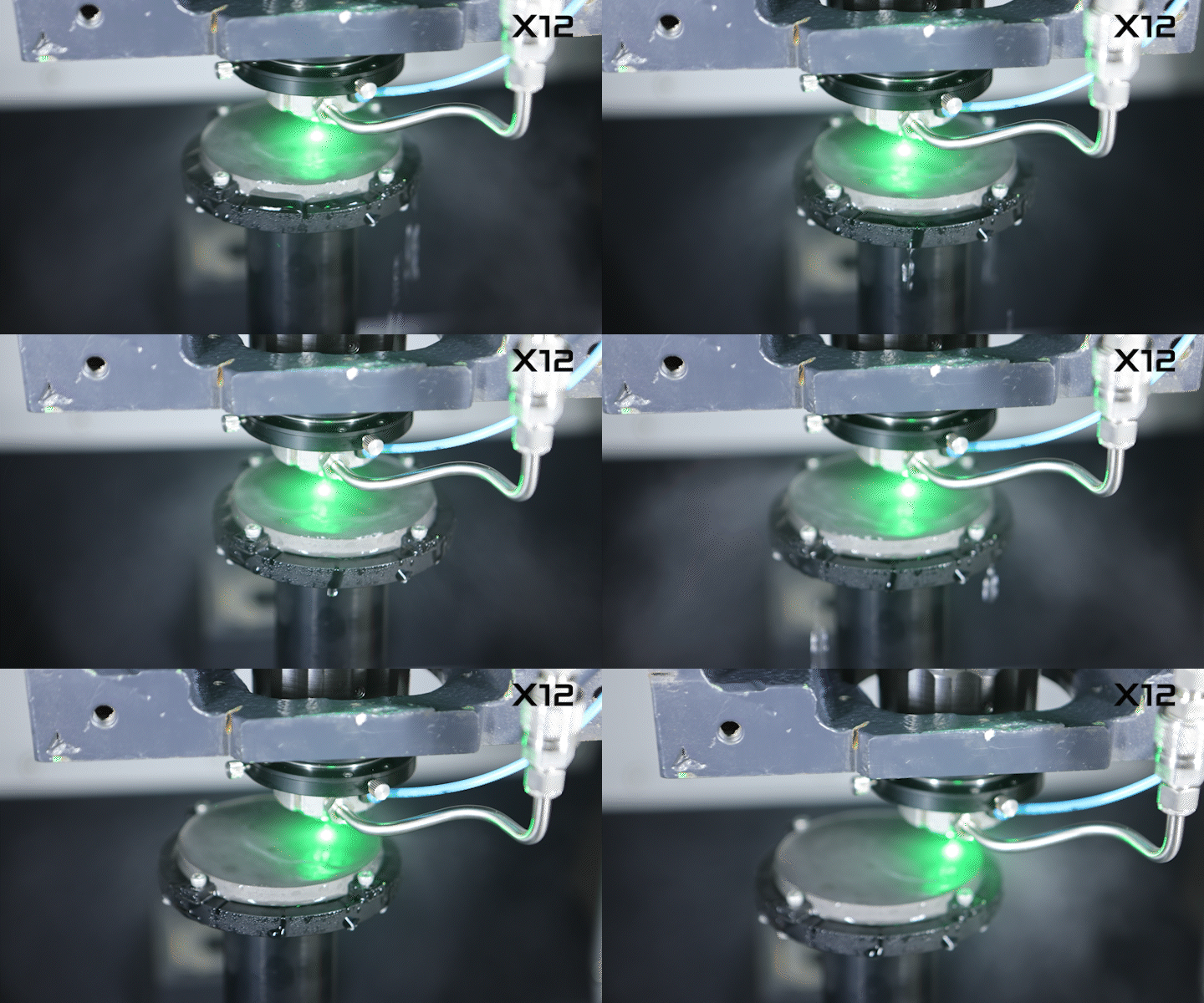
▲ A 10mm thick silicon archive is being processed using a waterjet-laser fusion processing machine.

Comments
Related news

Intel Unveils Next-Generation 'Core Ultra Series 3' and vPro Platform for Enterprise PCs
Intel has officially unveiled the "Intel Core Ultra Series 3" for next-generation enterprise PCs and the latest vPro platform, addressing a wide range of demands from enterprise notebooks to high-performance workstations.
2026.03.26by 배종인 기자

ROHM Launches ESD Protection Diode Compatible with High-Speed Interfaces of 10Gbps or Higher
Semiconductor specialist ROHM has developed the 'RESDxVx series' of ESD (electrostatic discharge) protection diodes capable of responding to next-generation high-speed data communication environments exceeding 10Gbps, simultaneously enhancing both signal quality maintenance required in high-speed interfaces and IC protection performance.
2026.03.26by 배종인 기자
ST Launches 75V Drive IC Targeting 48V Industrial Motor Driving
ST Microelectronics has unveiled the 'STSPIN9P' series of 75V motor drive ICs tailored for 48V-class industrial drive system design. The new product family is characterized by half-bridge and full-bridge configurations that enable design scalability according to motor type and output conditions. Power supply circuits, protection functions, and current sensing circuits are integrated on-chip to simplify system configuration, and the devices are designed to support applications up to 500W maximum. The company plans to provide reference designs and demo boards to support development and evaluation in industrial automation, robotics, pumps, fans, lighting, and textile machinery.
2026.03.26by 배종인 기자

Nordic supports security updates for the entire lifecycle of IoT devices at a single fixed cost
Nordic Semiconductor, a global leader in low-power wireless connectivity solutions, has unveiled a single fixed-cost licensing model that delivers FOTA (Firmware Over-the-Air) and device management capabilities throughout the device lifecycle via nRF Cloud, and introduced a new firmware update solution to prepare for the enforcement of the European Union's Cyber Resilience Act (CRA).
2026.03.26by 배종인 기자
Schneider Aims for Building Energy Savings and Operational Stability with Next-Generation HVAC Drives
Schneider Electric has unveiled its next-generation HVAC drive product line 'Altivar HVAC'. The new product line's key features center on enhanced energy savings, system operational stability, and building management system integration. The products are divided into 'ATH200' for OEM and small equipment applications, and 'ATH600' for environments requiring continuous operation and advanced control. The company plans to expand the application scope from commercial buildings to facilities where HVAC system stability is critical, such as hospitals, airports, and data centers. The announcement includes over 30% energy savings, operation from -10°C to +60°C, Modbus and BACnet support, and compatibility with low global warming potential refrigerants.
2026.03.26by 명세환 기자











