



SKT Publishes Korea's First 6G Direction White Paper
 Published2023.08.10 13:53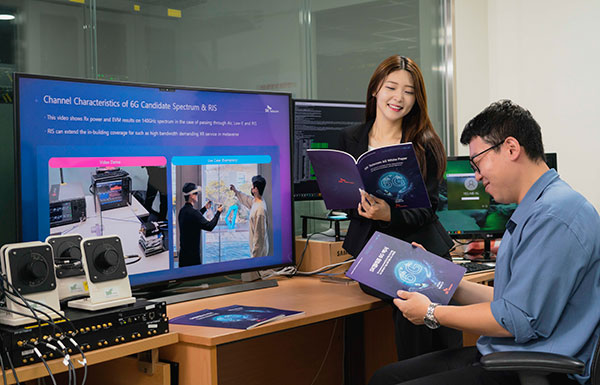
First domestic telecommunications company to include opinions on 6G methodology
Presenting Key 6G Characteristics, AI, and the Direction of Quantum Evolution
SKT presented a direction for 6G standardization and ecosystem building.
SKT released a '6G White Paper' on the 10th through the SKT Newsroom, presenting key requirements necessary for 6G standardization and the direction of future network evolution.
6G is expected to be commercialized in 2030. Following the agreement on the 6G framework recommendation by the Mobile Communications Standardization Working Group (WP5D) under the ITU-R last June, the process is undergoing initial stages of standardization, including the first discussion on 6G candidate frequencies at the World Radiocommunication Conference (WRC)-23 later this year and the planning of work to specify technical performance requirements at the WP5D starting in 2024.
For the first time among domestic telecommunications companies, SKT has exclusively published a white paper containing key 6G requirements, its perspective on 6G evolution methodologies, and opinions on frequency standardization trends to ensure the success of 6G standardization and technology and services.
SKT's 6G white paper contains an analysis of the outlook for promising 6G services, technological trends, and expected frequencies from the perspective of a telecommunications company, as well as development directions and methodologies.
The key 6G requirements presented by SKT include the discovery of 6G-exclusive products and services, simple architecture options, technologies to overcome coverage reduction, and technologies to reduce terminal heat and power consumption to enhance user experience.
SKT predicted that upon the commercialization of 6G, artificial intelligence, power saving, and quantum security would spread across the entire network, and that specialized technologies would be applied to each network area, such as the wireless access network, core network, transmission network, and air network, leading to evolution.
In particular, for 6G, the upper-mid band is expected to be primarily utilized, taking the previous failure of commercializing the 28GHz band in the mmWave band as a lesson.
SKT stated, “We are making efforts through collaboration with various overseas operators for the initial standardization of 6G.” In addition, we are continuing discussions by establishing R&D cooperation partnerships with telecommunications equipment manufacturers, IT companies, and others regarding 6G candidate technologies, such as AI-based base stations.
For example, last February, it jointly published the '6G Requirements White Paper' and the 'Base Station Power Saving Technology White Paper' with NTT Docomo. It also explained that it has participated in global consortium activities such as NGMN and IOWN, and has expanded cooperation with telecommunications companies in major countries including the United States, Japan, and Europe.
Meanwhile, the government announced the 'K-Network 2030 Strategy' last February and has been continuing activities to lead the next-generation network.
Jang Kyung-hee, Executive Chair of the 6G Forum, said, "Since mobile communication technology has the nature of an infrastructure industry that expands across all industries, we must strive to lead technology through 6G development."
Ryu Tak-ki, Head of Infrastructure Technology at SKT, stated, “We are working with many global telecommunications companies to secure leadership in 6G standardization and the technology ecosystem,” adding, “Based on expanding close partnerships with global telecommunications companies and manufacturers, as well as our 5G technology know-how and experience, SKT will lead not only the advancement of 5G but also the development of 6G technology to contribute to Korea becoming a leading global ICT nation.”
Comments
Related news
SKT, 5G 28GHz final allocation cancellation… subway Wi-Fi exception
The Ministry of Science and ICT has finalized the contents of its disposition regarding the revocation of 5th Generation (5G) 28 GHz frequency allocation to SKT, following the completion of the opinion hearing procedure under the Administrative Procedures Act.
2023.05.31by 김예지 기자

SKT and Innodeb Launch AI Video Surveillance Solution
SKT is launching an AI-based next-generation intelligent video surveillance solution together with Innodep, a CCTV control platform specialist.
2023.07.18by 김예지 기자
.jpg)
SKT's AI-based traffic signal optimization solution reduces vehicle travel times.
SK Telecom has developed a traffic signal optimization solution based on traffic data analysis extracted from an AI-based location data analytics platform and applied it to actual roads for the first time, achieving meaningful results such as reduced vehicle travel time.
2023.07.26by 배종인 기자
SKT Launches Global Telecom AI Alliance
SK Telecom (represented by President and CEO You Young-sang) held the 'Global Telco AI Alliance CEO Summit' with the attendance of SK Chairman Chey Tae-won, SKT President You Young-sang, and key executives from leading global telecommunications companies in Europe, the Middle East, and Asia. At the event, SK Telecom officially launched the 'Global Telco AI Alliance' centered on SKT, Deutsche Telekom, e&, and Singtel.
2023.07.28by 배종인 기자
SKT, Q2 Revenue 4.3064 Trillion Won, Growth Slows
SK Telecom's second quarter 2023 operating results showed slowdown in growth compared to the previous year, affected by factors including a decline in mobile telecommunications ARPU (average revenue per user) due to temporary intensification of competition.
2023.08.08by 배종인 기자











