


CEVA Launches NeuPro-M NPU IP to Support AI Inference
 Published2023.08.10 15:08
▲CEVA launches enhanced NeuPro-M NPU IP product family (Image: CEVA)
The use of low-power, low-cost inference processing using NPUs is increasing to realize AI inference technology from the cloud to the edge.
CEVA, a custom system-on-chip (SoC) company, today announced the launch of its enhanced NeuPro-M NPU.
NeuPro-M NPU is expected to meet the requirements of next-generation generative AI with industry-leading performance and power efficiency for all AI inference workloads from the cloud to the edge.
The NeuPro-M NPU architecture and tools have been redesigned to support transformer networks and future machine learning inference models, in addition to convolutional neural networks (CNNs) and other networks.
This enables NeuPro-M NPUs to seamlessly develop and run applications that optimize the capabilities of generative and traditional AI in communications gateways, optical networks, automobiles, laptops and tablets, AR/VR headsets, smartphones, and other cloud or edge environments.
The enhanced NeuPro-M architecture integrates The Vector Processing Unit (VPU) can be used for a variety of purposes and can support network layers that will be developed in the future. It also supports all activations and data flows, and can accelerate performance by up to 4x through true sparsity of data and weights.
Consumers can also address a variety of applications and markets with a single NPU product. NeuPro-M adds new NPM12 and NPM14 NPU products, which include two and four NeuPro-M engines respectively, to increase scalability required across a variety of AI markets.
Therefore, easy migration to high-performance AI workloads has become possible, and it currently consists of a total of four NPU product groups: △NPM11 △NPM12 △NPM14 △NPM18.
NeuPro-M delivers peak performance of 350 TOPS/W at the 3nm process node and is capable of processing over 1.5 million tokens per second on transformer-based LLM inference workloads.
The architecture is based on the NeuPro-M parallel processing engine and is supported by an innovative, comprehensive development toolchain based on CEVA’s architecture-aware network AI compiler, CDNN, to maximize the performance of consumer AI applications.
The CDNN software includes a memory manager for memory bandwidth optimization and optimal load balancing algorithms, and is compatible with common open source frameworks including TVM and ONNX.
“Transformer-based networks that power generative AI will require a dramatic increase in compute and memory resources,” said Ran Snir, vice president and general manager, Vision Business Unit at CEVA. “Meeting this increased compute and memory demand will require new approaches and optimized processing architectures.”
“The performance gains enabled by this architecture open up incredible possibilities for generative AI across use cases, from cost-sensitive edge devices to high-efficiency cloud computing,” he said.
ABI Research predicts that edge AI shipments will reach 2.4 billion units by 2023It is predicted that the number of edge applications will increase to 6.5 billion by 2028, at a compound annual growth rate (CAGR) of 22.4%. Generative AI is expected to play a key role in supporting this growth, and more sophisticated and intelligent edge applications are demanding more powerful and efficient AI inference technology.
In particular, large-scale language models (LLMs) and vision and audio converters used in generative AI can revolutionize products and industries, but they also pose new challenges in terms of performance, power, cost, latency, and memory when running on edge devices.
“Today’s hardware market for generative AI is highly concentrated, driven by a small number of vendors,” said Reece Hayden, senior analyst at ABI Research. “To make AI inference technology a reality, a clear strategy is needed for low-power, low-cost inference processing in the cloud and at the edge, using smaller models and more efficient hardware.”
“CEVA’s NeuPro-M NPU IP provides a proposition for deploying generative AI on devices with minimal power consumption,” he said. “Furthermore, the scalability of NeuPro-M allows it to be applied to use cases that demand ultra-high performance in network appliances or beyond.”
Advances in inference and modeling technologies are enabling new capabilities that leverage small-scale, domain-specific LLMs, vision transformers, and other generative AI models operating at the edge device level, transforming applications in the infrastructure, industrial, mobile, consumer, automotive, PC, and mobile markets.

Comments
Related news

CEVA Integrates Retune Wakeword Engine into Its Audio DSP
CEVA has collaborated with Retune DSP to unveil the Retune VoiceSpot Wakeword Engine optimized for its audio/voice DSP including CEVA-BX, CEVA-X, and CEVA-TeakLite. The engine is a high-performance embedded speech recognition engine that operates on wakewords and a small number of words, providing voice wake, command, and control functions in memory-constrained battery-powered edge devices.
2020.12.29by 강정규 기자

CEVA Unveils Software Solution to Improve Indoor AMR Pathway Accuracy
CEVA has launched MotionEngine Scout, a precision navigation software solution from Hillcrest Labs. MotionEngine Scout is utilized to improve the accuracy of intelligent navigation systems in indoor robots such as commercial robotic vacuum cleaners and autonomous mobile robots (AMRs). Additionally, Pixart's PAA5101 optical flow sensor is provided as standard.
2021.03.25by 명세환 기자

CEVA PentaG-RAN Accelerates 5G Infrastructure Rollout
Digital transformation continuously demanding higher cellular bandwidth at low latency is driving rapid growth in the 5G base station and wireless ASIC markets. Recently, network segmentation led by Open RAN initiatives and massive MIMO drives has drawn global silicon suppliers' attention to cellular infrastructure market opportunities.
2022.09.27by 명세환 기자

Intel Unveils Next-Generation 'Core Ultra Series 3' and vPro Platform for Enterprise PCs
Intel has officially unveiled the "Intel Core Ultra Series 3" for next-generation enterprise PCs and the latest vPro platform, addressing a wide range of demands from enterprise notebooks to high-performance workstations.
2026.03.26by 배종인 기자
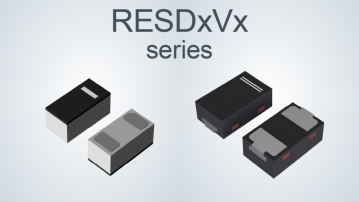
ROHM Launches ESD Protection Diode Compatible with High-Speed Interfaces of 10Gbps or Higher
Semiconductor specialist ROHM has developed the 'RESDxVx series' of ESD (electrostatic discharge) protection diodes capable of responding to next-generation high-speed data communication environments exceeding 10Gbps, simultaneously enhancing both signal quality maintenance required in high-speed interfaces and IC protection performance.
2026.03.26by 배종인 기자











