


The Korea Electrotechnology Research Institute (KERI) joint team was selected to build a large-scale power semiconductor infrastructure.
 Published2023.08.18 10:03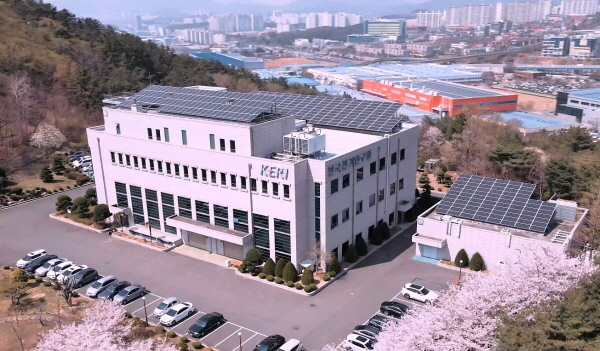
▲Korea Electrotechnology Research Institute Power Semiconductor Research Building
Full-cycle support from technology development to commercialization
The Korea Electrotechnology Research Institute (KERI) will build a large-scale power semiconductor infrastructure worth a total of 28.2 billion won in Gimhae, Gyeongsangnam-do, and will provide full-cycle support from technology development to commercialization for related companies.
A joint team of the Korea Electric Power Research Institute, Gyeongsangnam-do, Busan Metropolitan City, Gimhae City, Gyeongnam Technopark, Busan Technopark, and Dong-eui University Industry-Academic Cooperation Group, which has joined forces to foster and develop the power semiconductor industry in the southeastern region, was selected on the 18th as a target for the '2023 Industrial Innovation Base Construction Project' sponsored by the Ministry of Trade, Industry and Energy.
This project aims to directly and indirectly support domestic companies' technology development and commercialization efforts by establishing a "full-cycle demonstration support infrastructure" for the next-generation, high-efficiency power semiconductor industry based on compound semiconductors. The project period runs from July of this year to December 2027 (four years and six months), with a total project cost of approximately KRW 28.2 billion (KRW 10 billion from the national government, KRW 18.2 billion from local governments and in-kind funds).
Power semiconductors are essential industrial components that are essential wherever power is needed. They control the direction of current and power conversion, acting like muscles in the human body. As the era of 'electrification', in which electricity is central to most aspects of daily life, accelerates, the importance of power semiconductors is also increasing.
Among these, compound power semiconductors are composed of two or more elemental compounds. They offer superior power efficiency and durability compared to single-material power semiconductors like silicon (Si), with silicon carbide (SiC) power semiconductors being a prime example. The global competition for dominance in the compound power semiconductor market, which is projected to grow at an average annual rate of 7% through 2030, is fierce.
Although Korea's Korea Electrotechnology Research Institute (KERI) succeeded in domestically producing SiC power semiconductors, Korea still relies on imports for most of its compound power semiconductor demand, due to countries like Europe and Japan, which have secured advanced technologies and patents. To address this, the government announced a total of KRW 138.4 billion in funding for research and development (R&D) over the next five years, with the goal of establishing Korea as a leading player in compound power semiconductors. As part of this effort, a Ministry of Trade, Industry and Energy (MOTIE) public offering project will be launched.
With this project selection, the "Next-Generation Power Semiconductor Total Solution Center" will be built in Hallim-myeon, Gimhae-si, Gyeongsangnam-do, with a site area of 3,300㎡ and a building area of 2,640㎡, with completion targeted for 2025. The related equipment, valued at KRW 8.77 billion and comprising 24 types of equipment across eight fields, will provide integrated technical support across the entire power semiconductor lifecycle (materials/wafer -> design/chip -> module/package -> reliability certification -> verification).
In particular, Gyeongnam and Busan are expected to see even greater ripple effects as they are home to the largest upstream and downstream demand industries for power semiconductors in the country, including aerospace, shipbuilding and marine plants, railway equipment, home appliances, and automobile parts. As a power semiconductor cluster in the southeastern region of the country, the center will enhance corporate accessibility and workability for the development of the power semiconductor industry. It will also contribute to technological advancement through customized support for users and enhance product competitiveness through improved reliability. Furthermore, it aims to create 166 jobs by fostering specialized power semiconductor professionals and strengthening networking between industry, academia, and research.
Gyeongnam Province's Deputy Governor for Economic Affairs Kim Byeong-gyu, who spearheaded the business attraction effort, expressed his gratitude by saying, "A semiconductor-related base has finally been established in Gyeongnam Province," and "By establishing a total solution center, we will share the role of K-semiconductors centered in the metropolitan area and lead industrial innovation in the southeastern region."
KERI President Kim Nam-gyun said, “We will strive to foster the next-generation, high-efficiency power semiconductor industry, which is at the core of the electrification era, so that KERI can become an ‘anchor institution’ that invigorates the local economy.”
Meanwhile, KERI is a government-funded research institute under the National Research Council of Science and Technology (NRST) of the Ministry of Science and ICT. In the power semiconductor field, KERI holds over 120 intellectual property rights and has achieved technology transfers worth over KRW 3 billion over the past decade, boasting a leading position in Korea.

Comments
Related news
Intel Unveils Next-Generation 'Core Ultra Series 3' and vPro Platform for Enterprise PCs
Intel has officially unveiled the "Intel Core Ultra Series 3" for next-generation enterprise PCs and the latest vPro platform, addressing a wide range of demands from enterprise notebooks to high-performance workstations.
2026.03.26by 배종인 기자
ROHM Launches ESD Protection Diode Compatible with High-Speed Interfaces of 10Gbps or Higher
Semiconductor specialist ROHM has developed the 'RESDxVx series' of ESD (electrostatic discharge) protection diodes capable of responding to next-generation high-speed data communication environments exceeding 10Gbps, simultaneously enhancing both signal quality maintenance required in high-speed interfaces and IC protection performance.
2026.03.26by 배종인 기자
ST Launches 75V Drive IC Targeting 48V Industrial Motor Driving
ST Microelectronics has unveiled the 'STSPIN9P' series of 75V motor drive ICs tailored for 48V-class industrial drive system design. The new product family is characterized by half-bridge and full-bridge configurations that enable design scalability according to motor type and output conditions. Power supply circuits, protection functions, and current sensing circuits are integrated on-chip to simplify system configuration, and the devices are designed to support applications up to 500W maximum. The company plans to provide reference designs and demo boards to support development and evaluation in industrial automation, robotics, pumps, fans, lighting, and textile machinery.
2026.03.26by 배종인 기자
Nordic supports security updates for the entire lifecycle of IoT devices at a single fixed cost
Nordic Semiconductor, a global leader in low-power wireless connectivity solutions, has unveiled a single fixed-cost licensing model that delivers FOTA (Firmware Over-the-Air) and device management capabilities throughout the device lifecycle via nRF Cloud, and introduced a new firmware update solution to prepare for the enforcement of the European Union's Cyber Resilience Act (CRA).
2026.03.26by 배종인 기자
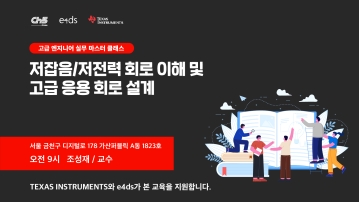
Practical Training in Low-Noise, Low-Power Circuit Design All in One Place… Training Fee Support
The "2026 Advanced Engineer Practical Masterclass" to strengthen competencies in high-sensitivity analog circuit and sensor-based system design will be held on April 16 at the e4ds Conference Center in Gasan-dong, Seoul. This program will be conducted as an offline paid hands-on training session, not online, and is targeted at engineers seeking on-site intensive learning. Texas Instruments will provide educational support for this training, allowing participation at 150,000 won, a 100,000 won discount from the original price of 250,000 won.
2026.03.26by 배종인 기자











