


Achieving Business Automation with AI-Powered RPA
 Published2023.09.15 16:14
Google Announces Vertex AI Connector for Google Cloud
We are now in the age of AI, and AI has reached the realm of business automation, driving the digital transformation of our daily lives. UIPath, a software robotics platform, is automating business processes to accelerate operational efficiency for businesses.
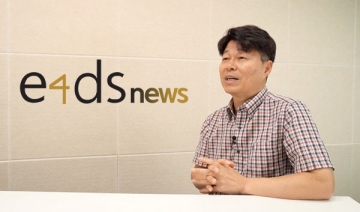
Bong-seon Lee, Managing Director of UiPath Korea, a global enterprise automation software company, introduced RPA trends and UiPath's business automation platform linked to them at the 'Innovative Technology and Utilization Case Seminar with Future Smart Factory Innovators' held at the KIEI Industrial Education Research Institute on the 14th.
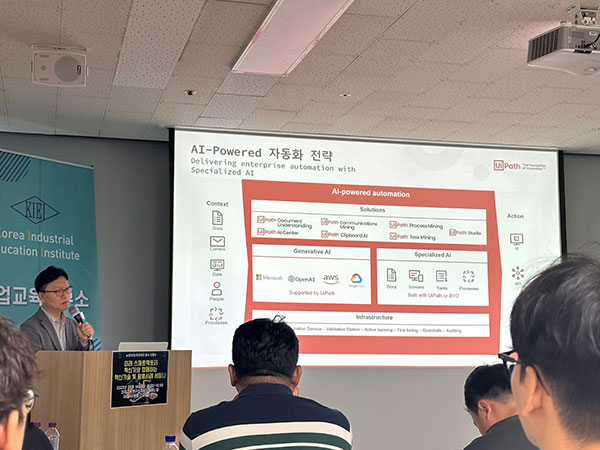
▲Bongseon Lee, Executive Director of the Industrial Education Research Institute UIPath Korea
'RPA (Robotic Process Automation)' is a technology that automates tasks by allowing software robots to perform business processes. For example, robots can replace employees with document tasks like data entry and email transmission, improving efficiency and productivity. The concept is that systems, software, and applications are all connected and operated automatically, with individual robots taking over repetitive tasks.
This was called UI automation, but recently, the trend has been to combine AI and RPA.
Gartner predicts that hyperautomation will become a trend. Hyperautomation combines various technologies, including RPA, AI/ML, natural language processing (NLP), and large-scale language modeling (LLM), to automate business processes.
Robots have already been widely adopted in manufacturing, and software robots are expected to revolutionize manufacturing in the future. Executive Director Lee stated, "UIPath's AI automation platform is a flexible platform that actively applies generative AI, such as ChatGPT, to work processes. AI enables end-to-end automation, even in areas previously unautomated."
Simply put, RPA is the hands and feet, and AI is the brain. By automating end-to-end process automation with AI-based software robots, integrated operations can be achieved, ensuring interoperability, efficiency, scalability, and flexibility.
“The purpose of UiPath is to collaborate between generative AI and specialized domain AI, that is, in the business field,” said the executive director.
Meanwhile, in August, UiPath unveiled the Google Vertex AI Connector for Google Cloud, which allows developers, data scientists, and machine learning engineers to integrate generative text and chat completion capabilities into their automation.
It supports easy integration of generative AI output into automation, enabling tasks such as summarizing, answering questions, and categorizing based on prompts. Users can utilize the connector to easily access PaLM 2, a large language model (LLM), including text generation.
UiPath said, “Vertex AI enables companies to quickly and seamlessly integrate ML models into business processes without complex coding or manual work.”
UiPath has expanded its partnership with Google Cloud. Customers can now automate Google Workspace workloads through connectors for Google-integrated services like Gmail, Google Calendar, Google Spreadsheets, and Google Drive.
Comments
Related news

Keysight provides digital twin and AI-based satellite solutions
With software test automation emerging as a key technical challenge in the satellite industry recently, Keysight is accelerating product and software development through digital twin technology and AI-based satellite solutions.
2023.06.08by 김예지 기자
Understanding Logistics Dynamics is a Prerequisite for Implementing AI in Logistics and Distribution
As workforce reduction in the industry is observed as a global trend, it has been suggested that facilities implementing logistics automation must necessarily be equipped with the capability to respond to "logistics dynamics."
2023.06.22by 명세환 기자
LG Uplus Provides 5G Communication Infrastructure for Logistics Robots
LG Uplus has signed a business agreement with Yugin Robotics, a specialized autonomous driving solution company, to expand its robot business from 'serving' to 'logistics' and achieve logistics center operation automation.
2023.08.07by 김예지 기자
Rockwell Acquires AMR Company Clearpath
Rockwell Automation, the world's leading industrial automation and digital transformation specialist, is acquiring Clearpath Robotics, a Canadian autonomous mobile robot specialist for industrial applications, to accelerate its autonomous production logistics solutions.
2023.09.12by 배종인 기자
[Interview] I2 CEO Lee Soon-yeol - “We will help SMEs achieve digital transformation based on robot automation”
I2, a company advocating industrial intelligence, has stepped forward to empower small and medium-sized enterprises that are bearing the brunt of difficulties such as rising prices and workforce shortages, based on its expertise in industrial sites. This publication met with I2's CEO Lee Soon-yeol to discuss the company's strategies and cases supporting digital transformation for small and medium-sized enterprises.
2023.09.12by 김예지 기자











