


Materials Research Institute supports R&D of core technologies tailored to local companies.
 Published2023.09.25 13:44
The Korea Institute of Materials Science (KIMS, President Lee Jeong-hwan), a government-funded research institute under the Ministry of Science and ICT, is producing concrete results, such as increased overseas sales for participating companies, through the 'Core Technology Customized Information Support Project' implemented in collaboration with the Gimhae Bioindustry Promotion Agency (GBIA, President Park Seong-ho).
In March 2021, the Korea Materials Research Institute and the Korea Institute for Biomedical Sciences (KIBS) signed a business agreement to foster new biomedical industries and advance specialized biomedical complexes. Since then, the two organizations have discussed joint research projects in biomedical materials technology and jointly supporting small and medium-sized enterprises (SMEs). This project marks the first concrete implementation of these initiatives.
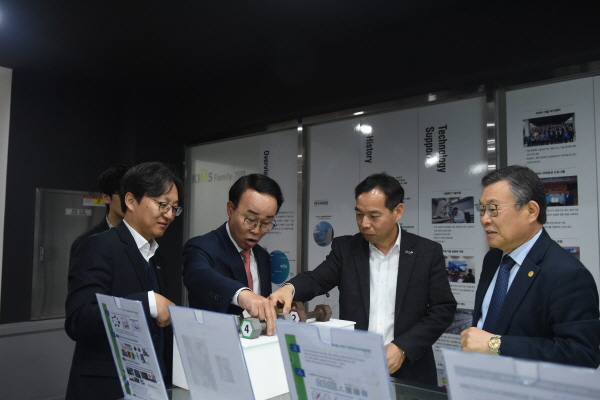
▲Director Park Seong-ho of the Gimhae Bioindustry Promotion Agency (second from the left) and officials from Gimhae City inspect the research results of the Korea Institute of Materials Science, and Director Lee Jeong-hwan of the Korea Institute of Materials Science (first from the right) explains the research results.
The "Core Technology Customized Information Support Project" provides optimized solutions for individual companies, reflecting their varying environments and circumstances. Gimhae City has 7,982 companies primarily producing metal, machinery, automobile, and shipbuilding components. However, approximately 77.2% of these companies are micro, small, and medium-sized enterprises (SMEs), employing less than 10 employees. This reflects a vulnerable management structure that precludes direct production and R&D for future new industries. Through this project, the Korea Materials Research Institute is supporting these companies by matching specialized research personnel with technologies in demand and comprehensively utilizing various infrastructures (personnel, equipment, technology, etc.) to improve the core performance of each company's flagship products.
Currently, three companies have been selected as beneficiaries of this project, and support has been provided through computer simulations to ensure material and component standard compliance, develop defense components, and develop core automotive components. This support has yielded quantifiable results, including KRW 3.9 billion in new domestic and international sales and the development of two new market opportunities. Furthermore, new hiring and process improvements are underway. Furthermore, four companies are receiving an additional KRW 750 million from the Korea Materials Research Institute's own resources to address bottlenecks related to mold lifespan enhancements, welding robot system development, material recycling, and high-durability coating technology.
Kimhae City Director Park Jong-hwan said, “The inter-agency cooperation between the Korea Institute of Industrial Technology and the Korea Institute of Industrial Technology Promotion to support businesses is gradually becoming visible,” and added, “Based on this achievement, I hope that we can continue to not only resolve the difficulties faced by local businesses, but also secure international competitiveness by utilizing the Korea Institute of Industrial Technology’s international network.”
Lee Jeong-hwan, the president of the Korea Institute of Materials Science, said, “As corporate support is one of the main missions of a government-funded research institute, we will continue to work hard to transfer the internalized, unique technologies of the Korea Institute of Materials Science to companies and promote commercialization,” and added, “Gimhae City and the Promotion Agency are actively hoping to cooperate with our research institute, and we will contribute to establishing a virtuous cycle cooperation model between government-funded research institutes and local governments that will live up to their expectations.”

Comments
Related news
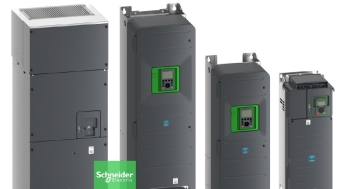
Schneider Aims for Building Energy Savings and Operational Stability with Next-Generation HVAC Drives
Schneider Electric has unveiled its next-generation HVAC drive product line 'Altivar HVAC'. The new product line's key features center on enhanced energy savings, system operational stability, and building management system integration. The products are divided into 'ATH200' for OEM and small equipment applications, and 'ATH600' for environments requiring continuous operation and advanced control. The company plans to expand the application scope from commercial buildings to facilities where HVAC system stability is critical, such as hospitals, airports, and data centers. The announcement includes over 30% energy savings, operation from -10°C to +60°C, Modbus and BACnet support, and compatibility with low global warming potential refrigerants.
2026.03.26by 명세환 기자
Ecolab Expands AI Data Center Cooling Business Through Acquisition of CoolIT
Ecolab has agreed to acquire CoolIT Systems, a liquid cooling company for AI data centers, for approximately $4.75 billion. The transaction is expected to close by Q3 2026, subject to regulatory approvals. CoolIT has been supplying direct-to-chip cooling-based coolant distribution units, cold plates, and manifolds, serving hyperscale data centers and colocation operators as customers. This acquisition is a measure to address the high-heat and high-density server environments created by AI proliferation. Ecolab plans to combine its water management and digital monitoring capabilities with CoolIT's hardware technology to expand its data center cooling business.
2026.03.26by 명세환 기자
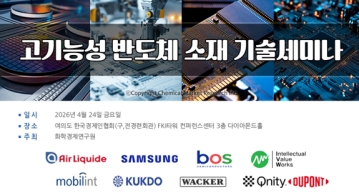
AI Semiconductor Era, Key is 'Materials Technology'… KIEC Holds Seminar on High-Performance Semiconductor Materials
With rapid growth in the global semiconductor market driven by expanded AI data center investments and increased demand for high-bandwidth memory (HBM), a specialized seminar examining next-generation semiconductor materials and packaging technologies will be held. The Korea Chemical Industry Institute will host a "High-Performance Semiconductor Materials Technology Seminar" on April 24 at the FKI Tower of the Korea Economic Association in Yeouido, Seoul. Applications to participate in the seminar are being accepted on a first-come, first-served basis through the Korea Chemical Industry Institute's official website, with early bird discounts available until March 27 and advance registration open until April 22.
2026.03.25by 배종인 기자
.jpg)
KIMS Shares Techniques for Industrial Application of Casting Technology
The Korea Institute of Materials Science held a casting technology seminar at its headquarters in Changwon, South Gyeongsang Province, and introduced core process technologies utilized in industrial applications. The seminar covered fundamental principles of casting processes and defect control methods, lightweight-oriented die-casting technology, and trends in aluminum casting alloys for mobility applications. At the conclusion of the event, consultations on industrial technical challenges were also conducted, providing an opportunity to expand the interface between research institutions and industry.
2026.03.25by 명세환 기자
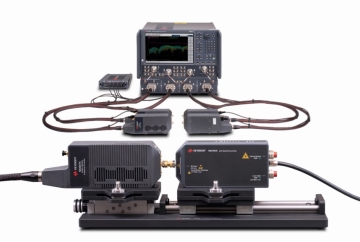
Keysight Launches 220GHz Optical Component Analyzer… Aims at Verifying Next-Generation Optical Transceivers
Keysight Technologies has introduced the N4378A optical wave component analyzer, which can measure the characteristics of opto-electronic conversion components up to 220GHz. This equipment is targeted at the rapidly advancing data center optical interconnection market driven by AI and cloud expansion, and supports single-sweep broadband measurements at 1310nm and 1550nm wavelengths. The device focuses on enhancing measurement accuracy and design verification efficiency in the development process of next-generation 1.6T and 3.2T class optical transceivers through optical modulator and photodetector verification, differential measurements for dual-drive optical modulators, and 0.5mm coaxial connector protection structures. Keysight demonstrated this equipment for the first time at OFC 2026.
2026.03.25by 명세환 기자











