


ETRI Leads International Standardization of IoT and Smart Cities
 Published2023.09.27 09:07
The Electronics and Telecommunications Research Institute (ETRI) is drawing attention for achieving its best-ever results at international standardization conferences related to Internet of Things (IoT) technology and smart cities, which are gaining significant prominence with the advent of the hyper-connected society.
ETRI announced on the 27th that it achieved its greatest results ever at the ITU-T Internet of Things and Smart Cities Study Group 20 (SG20) international meeting held in Arusha, Tanzania from the 13th to the 22nd, with 13 technologies developed under the leadership of its research team being approved as standards and 4 being adopted as new standardization projects.
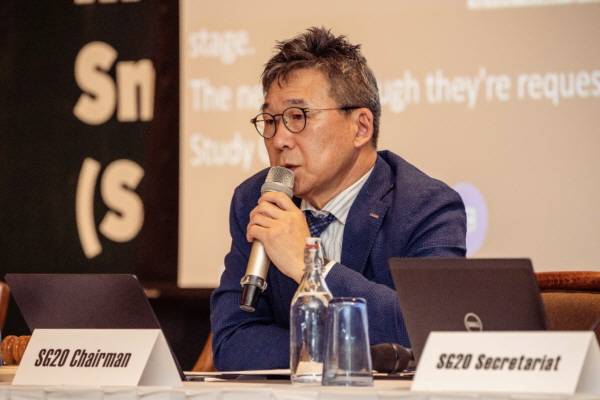
Dr. Kim Hyung-joon of ETRI speaking at the opening plenary session of ITU-T SG20.
The Study Group (SG20) is a research group that oversees international standards for Internet of Things and smart city applications and services.
Last March, Dr. Kim Hyung-joon of ETRI was elected as chairman.
At this meeting, over 400 experts from 47 countries around the world attended and engaged in heated discussions for the development of international standards.
ETRI, with a total of 11 standards experts including Dr. Kim Hyung-joon, the chief representative of the South Korean delegation, led standardization discussions on the direction of SG20 activities for the next ITU-T study period (2025–2028) and major issues such as digital twins, smart cities, and smart agriculture.
ETRI [developed] a total of 10 cases, including the Digital Twin Alliance for Smart Cities and delivery robot interoperability requirements, led by its research teamThe standard was pre-adopted.
Along with this, one standard, one annex, and one technical document were also finally approved.
In particular, four new standardization projects were adopted, including a delivery robot interoperability reference structure and a device discovery and management framework for service interoperability in heterogeneous IoT environments.
ETRI stated that the 'Digital Twin Alliance Standard for Smart Cities,' which has been pre-adopted as a standard, is expected to have significant potential for future utilization as a standard, as it provides a foundation for creating new services through an alliance that shares data and functions among various digital twins used in smart cities, such as those in transportation, environment, and healthcare.
Furthermore, the final approval of the research team's standard for IoT device camera detection information metadata is evaluated as having laid the foundation for securing global interoperability between IoT applications and services.
In addition, ETRI proposed establishing a new research project in the SG20 research group during the next research session to take charge of the standardization of smart city platforms, including digital twins.
This laid the foundation for securing the initiative by establishing the direction for the restructuring of SG20 in the next ITU-T study session.
At this meeting, in conjunction with the Metaverse Focus Group (FG-MV), a special session was held to introduce the activities and prospects of the FG-MV, and a forum was held for 'CitiVerse,' a service that provides smart city functions on the metaverse, to propose future directions for SG20 activities and explore cooperation methods among groups within the ITU-T.
Dr. Kim Hyung-joon of ETRI, International Chair of ITU-T SG20 and Chief Representative of the Korean Delegation, stated, “In the current situation where international interest in smart cities is rising, establishing technologies proactively developed by Korea as international standards is digital "It is a good opportunity to lead the era of transition," he said.
Based on this international standardization achievement, ETRI plans to strive to further revitalize international standardization activities so that industry, academia, and research institutes can secure global market leadership in key ICT technology fields.

Comments
Related news
ETRI Appoints Editor of International Standards for Autonomous Driving Levels
The Electronics and Telecommunications Research Institute (ETRI) assumed the role of editor-in-chief for the revision work of the autonomous driving level standards developed by SAE International, with Cha Hong-gi, a standards expert committee member, taking on the overall responsibility as of the 24th of last month.
2023.04.25by 배종인 기자
ETRI establishes international standards for NFC-based Internet communications.
The Near Field Communication (NFC)-based internet communication technology standard (RFC 9428), a low-power IoT communication technology proposed by the Electronics and Telecommunications Research Institute (ETRI), has been finalized as an international standard.
2023.08.10by 배종인 기자
ETRI, Establishment of International Standards for Digital Human Quality Assessment
The digital human quality evaluation framework proposed by the Electronics and Telecommunications Research Institute (ETRI) has received final approval as an international standard, and expectations are high that quality assessments for various services will be possible going forward.
2023.08.24by 배종인 기자
European Patent Applications Surpass 200,000 for the First Time… South Korea Maintains 5th Place, Led by Batteries and Telecommunications
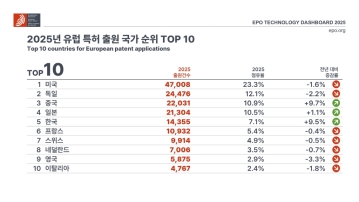
According to the European Patent Office (EPO)'s 'Technology Dashboard 2025', European patent applications last year reached 201,974, surpassing 200,000 for the first time. Korean companies and inventors filed 14,355 applications, representing a 9.5% increase from the previous year and maintaining 5th place by country. Battery, digital communication, and semiconductor technologies led the growth, with Samsung ranking as the top EPO applicant for the second consecutive year and LG reaching 3rd place. The presence of major domestic cities such as Seoul, Suwon, and Yongin was also confirmed. It was also revealed that Korea's European patent strategy is expanding beyond individual technologies to span the entire industry.
2026.03.24by 명세환 기자
SK Telecom First Applies AI-Based Network Operations at Gwanghwamun K-Pop Concert
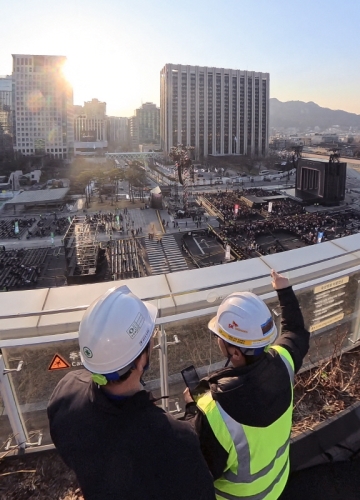
SK Telecom announced that it applied an AI-based network operation system for the first time at a large-scale K-pop concert held in the Gwanghwamun area of Seoul on March 21st, managing communication quality throughout the event. Mobile data usage during the three hours before and after the concert reached 12.15TB, approximately doubling compared to the same time slot the previous weekend. SK Telecom monitored traffic using the AI system 'A-One' in five-minute and 50-meter units to respond to potential overload situations, while also operating temporary communication facilities and on-site personnel in parallel. This case is interpreted as confirmation of the practical applicability of AI-based autonomous network operation in an environment where demand from dense events and foreign users increases simultaneously.
2026.03.23by 명세환 기자











