


Korea Electrotechnology Research Institute develops core power source for space exploration
 Published2023.10.16 08:20
The world's first precision temperature distribution analysis, with the highest performance in each section.
The Korea Electrotechnology Research Institute (KERI) has attracted worldwide attention by developing core power technology for space exploration.
KERI announced on the 16th that the team of Dr. Park Soo-dong, Dr. Ryu Byeong-gi, and Dr. Jeong Jae-hwan developed a 'new thermoelectric efficiency formula and high-efficiency layered thermoelectric power plant' that can improve the performance of nuclear batteries, which are the core of space probes, and successfully received verification from the German Aerospace Research Institute.
.jpg)
▲(From left) KERI's Dr. Ryu Byeong-gi, Dr. Jeong Jae-hwan, and Dr. Park Su-dong
Nuclear power plants are generators that convert radiation energy into electrical energy, and a representative example is the 'radioisotope thermoelectric generator (RTG)' used as a power source for space probes, exploration rovers, etc.
Radioactive isotopes (such as plutonium-238 and americium-241) decay spontaneously within sealed containers, generating high temperatures exceeding 400-700 degrees Celsius.
Nuclear batteries use the principle of generating electricity by taking advantage of the difference between this high heat and the low temperature of space (thermoelectric power generation).
In other words, the core technologies of nuclear power plants are a 'heating element' that uses radioactive isotopes and a 'thermoelectric power plant' that uses this heat to produce electricity.
Currently, full-scale development of heating elements is underway due to international restrictions. Although not available, domestic thermoelectric power generation device technology is evaluated as having international competitiveness in Korea, centered around KERI.
Nuclear batteries are implemented through a characteristic configuration in which thermoelectric semiconductors that exhibit the best performance in each temperature range from low to high temperatures are arranged in a layered form.
This is because the performance of thermoelectric semiconductor materials varies with temperature, so it is very important to arrange the semiconductor with the best performance according to the temperature distribution.
KERI's achievement is to clearly analyze this temperature distribution at a world-class level and, based on this, design and synthesize the optimal 'stacked thermoelectric power plant'.
First, the research team officially revealed the errors and limitations of the 'thermoelectric figure of merit (ZT),' which was the existing indicator proving thermoelectric power generation efficiency in the academic world, and succeeded in developing a 'new thermoelectric efficiency formula' that can produce accurate data.
Using this formula and KERI's proprietary thermoelectric stack design program, it is possible to predict millions of thermoelectric semiconductor stack combinations for high efficiency. Design and exploration times are also hundreds of times faster. This represents a significant innovation compared to existing methods that relied on the performance of individual thermoelectric semiconductors based on ZT or solely on past experience.
The KERI research team successfully synthesized a multilayer thermoelectric generator using this core technology. Furthermore, experiments confirmed that the efficiency was a whopping 3% higher than that of existing single-layer devices at temperatures above 500 degrees Celsius.
In addition, by securing the design and synthesis technology of devices that enable stacking of 2 to 4 layers at a height of several millimeters (mm), not only high efficiency but also miniaturization and lightweighting were achieved. This is an internationally competitive achievement that can be applied to the auxiliary power supply market for small satellites and exploration rovers, which are also attracting attention in the civilian sector.
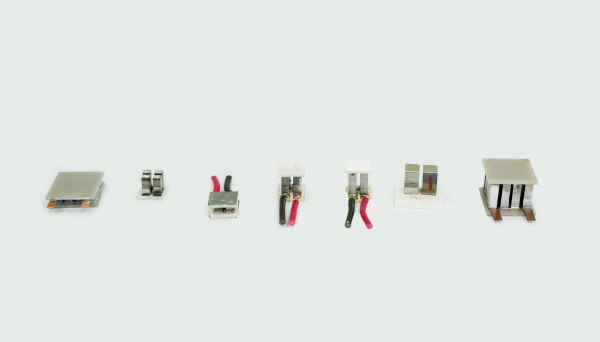
▲Various types of stacked thermoelectric power plants
Dr. Park Soo-dong of KERI said, “Our research institute was the first in Korea to conduct thermoelectric power generation research, and we have a long history and a wealth of original technology and practical data,” adding, “This achievement is the culmination of convergence research that incorporates mathematics and physics into materials science.”
KERI's technology has been validated by the German Aerospace Research Institute through international joint research supported by the Ministry of Trade, Industry and Energy. Dr. Park Soo-dong presented the technology to local companies at the Korea-Germany Thermoelectric Power Generation Workshop held in Dresden, Germany in late September, receiving rave reviews. KERI and the German Aerospace Research Institute are strengthening their cooperative relationship by sharing the goal of jointly developing a "hybrid layered composite thermoelectric power generator" utilizing other material systems, leveraging this achievement that has expanded the scope to the "element" level.
Pawel Ziolkowski, deputy head of the thermoelectric materials research department at the German Aerospace Research Institute (KERI) Cologne Materials Research Center, said, “KERI’s thermoelectric power generation technology boasts an internationally excellent level,” and “devices that apply the new concept of thermoelectric equations will greatly enhance the performance of nuclear batteries and contribute to expanding the scope of human space exploration.”
The research team believes that this achievement can be utilized in various industries, including aerospace and defense fields that utilize nuclear batteries, as well as cooling of communication equipment and optical devices, and temperature control of electric vehicle batteries, and plans to strengthen cooperation with related organizations and companies.
Meanwhile, KERI is a government-funded research institute under the National Research Council of Science and Technology of the Ministry of Science and ICT.

Comments
Related news

Intel Unveils Next-Generation 'Core Ultra Series 3' and vPro Platform for Enterprise PCs
Intel has officially unveiled the "Intel Core Ultra Series 3" for next-generation enterprise PCs and the latest vPro platform, addressing a wide range of demands from enterprise notebooks to high-performance workstations.
2026.03.26by 배종인 기자

ROHM Launches ESD Protection Diode Compatible with High-Speed Interfaces of 10Gbps or Higher
Semiconductor specialist ROHM has developed the 'RESDxVx series' of ESD (electrostatic discharge) protection diodes capable of responding to next-generation high-speed data communication environments exceeding 10Gbps, simultaneously enhancing both signal quality maintenance required in high-speed interfaces and IC protection performance.
2026.03.26by 배종인 기자
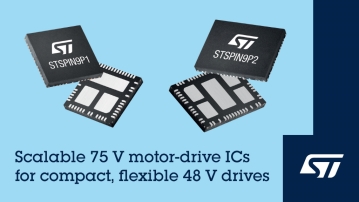
ST Launches 75V Drive IC Targeting 48V Industrial Motor Driving
ST Microelectronics has unveiled the 'STSPIN9P' series of 75V motor drive ICs tailored for 48V-class industrial drive system design. The new product family is characterized by half-bridge and full-bridge configurations that enable design scalability according to motor type and output conditions. Power supply circuits, protection functions, and current sensing circuits are integrated on-chip to simplify system configuration, and the devices are designed to support applications up to 500W maximum. The company plans to provide reference designs and demo boards to support development and evaluation in industrial automation, robotics, pumps, fans, lighting, and textile machinery.
2026.03.26by 배종인 기자

Nordic supports security updates for the entire lifecycle of IoT devices at a single fixed cost
Nordic Semiconductor, a global leader in low-power wireless connectivity solutions, has unveiled a single fixed-cost licensing model that delivers FOTA (Firmware Over-the-Air) and device management capabilities throughout the device lifecycle via nRF Cloud, and introduced a new firmware update solution to prepare for the enforcement of the European Union's Cyber Resilience Act (CRA).
2026.03.26by 배종인 기자
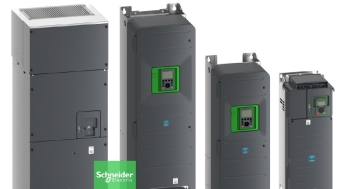
Schneider Aims for Building Energy Savings and Operational Stability with Next-Generation HVAC Drives
Schneider Electric has unveiled its next-generation HVAC drive product line 'Altivar HVAC'. The new product line's key features center on enhanced energy savings, system operational stability, and building management system integration. The products are divided into 'ATH200' for OEM and small equipment applications, and 'ATH600' for environments requiring continuous operation and advanced control. The company plans to expand the application scope from commercial buildings to facilities where HVAC system stability is critical, such as hospitals, airports, and data centers. The announcement includes over 30% energy savings, operation from -10°C to +60°C, Modbus and BACnet support, and compatibility with low global warming potential refrigerants.
2026.03.26by 명세환 기자











