



Stratasys successfully held its 3D Printing Forum 2023, its first event in four years.
 Published2023.10.16 13:59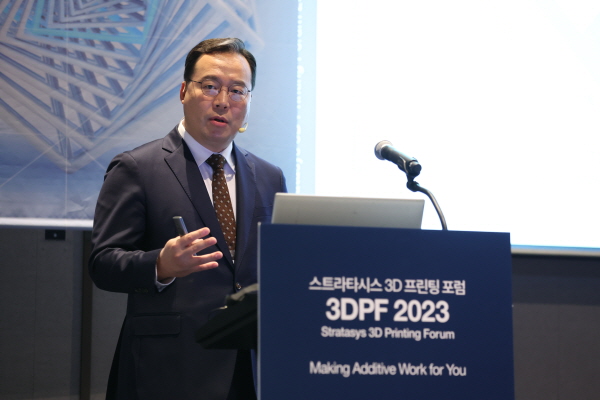
▲Moon Jong-yoon, CEO of Stratasys Korea, is giving the opening remarks.
Stratasys Korea (CEO Jong-yoon Moon), a global leader in 3D printing, successfully concluded the 3D Printing Forum 2023, held for the first time in four years.
Stratasys announced on the 16th that it successfully completed the 'Stratasys 3D Printing Forum 2023' held with domestic platinum partners at the DoubleTree by Hilton Seoul Pangyo Grand Ballroom on the 11th.
Stratasys Korea has prepared this forum to introduce 3D printing technology being applied to mass production processes and its success stories that are driving innovation in various industries, including automobiles, robotics, and healthcare.
The '3D Printing Forum', now in its 7th year, was an offline event held for the first time in four years since 2019 due to COVID-19, and was a great success with approximately 300 3D printing customers in attendance. This year, under the theme of 'Making Additive Work for You,' we shared the direction of Stratasys' additive manufacturing technology development and examples of manufacturing innovation through additive manufacturing from domestic and foreign manufacturing companies, providing insights necessary for digital transformation.
On this day, the welcoming speech by Stratasys CEO Jongyoon Moon and 'AM 2.0, From Prototypes to Mass Production' were started, followed by presentations on △Accelerating Mass Production with Additive Manufacturing Technology (Yann Raguel, Vice President of Industrial Business Division) and △Development Case of Pipe & Artificial Intelligence Robot Parts by Japan's Tryte Using FDM & Origin One Technology (Daekyung Kim, Pre-Sales & Application Engineer).
Stratasys, the world's first company to commercialize FDM (Fused Deposition Modeling), has technologies that can handle both prototype and mass production processes, including PolyJet, P3, SAF, and SLA, and is helping customers achieve rapid product development and mass production.
Siemens used Stratasys FDM 3D printers to produce tram bumpers, reducing production time and inventory costs. In addition to bumpers, the company is also producing door hinges, control panel covers, sensor holders, and air circulation grilles.
Equipped with SAF technology suitable for mass production, the H350 3D printer is time- and cost-competitive enough to replace injection molding, contributing to the stabilization of the parts supply chain. While injection molding requires a monthly production volume of over 10,000 parts to be profitable, the H350 is competitive even in small- to medium-volume production volumes of less than 10,000, enabling it to meet small-volume orders. Production of approximately 4,000 parts has been shown to reduce costs by 65% compared to injection molding. In particular, injection molding is difficult to manufacture complex parts with polygonal shapes, but H350 does not require separate support, allowing for free design implementation.
Stratasys also suggests a method of producing three different sized parts simultaneously by overlapping them to produce many parts at once, which can reduce mass production costs.
The H350 is being used to produce automotive parts such as ducts and grilles. Roush, a custom automotive manufacturer in the US, has used the H350 3D printer to reduce design development and mass production time from three to four months to eight weeks. The PA11 material, which is used, boasts excellent durability and chemical resistance, making it suitable for installation in actual vehicles.
“The H350 will be positioned as an eco-friendly mass production solution as it can utilize almost all materials, has very low maintenance costs and reduces power consumption by up to 27%,” said Vice President Yann Raguel.
One of the advantages of 3D printers is that they can simultaneously produce parts of various designs and make rapid improvements during the prototyping process.
Engineer Kim Dae-kyung shared a case study where a Japanese company utilized Stratasys' FDM 3D printers to develop robots capable of performing tasks that are difficult for humans to perform. The grippers, which function as the robot's hands, require lightweight construction to lift heavy objects. Parts manufactured using FDM 3D printers were able to replace aluminum, and component integration enhanced the robot's stability. Furthermore, Stratasys' F900 was utilized to produce large robot molds, reducing lead times and costs.
Trytec, a Japanese company specializing in special tools, produced medical assistive devices required for endoscopic surgery using Stratasys' high-speed, precision, semi-mass production 3D printer, OriginOne. Previously, if blood got on the lens during surgery, it took 30 seconds to take it out and wipe it off, but Trytec decided to develop a disposable medical auxiliary device that can clean the lens in just 5 seconds by spraying saline solution and CO2 during surgery.
This assistive device required microscopic holes, making it impossible to manufacture using conventional injection molding. However, OriginOne, a company that utilizes medical-grade materials and is capable of manufacturing precision parts, successfully developed the device. The company plans to manufacture over 100,000 units annually using OriginOne.
Engineer Kim Dae-kyung emphasized, “OriginOne’s most differentiated solution is its ability to control temperature, materials, and other factors according to customer needs.”
In his welcoming speech, CEO Moon Jong-yoon emphasized the importance of 3D printing in the digital twin, a trend in the manufacturing industry, and said, “Stratasys is the world’s number one company that has secured trust in its 3D printing technology and products from customers through its 36 years of growth.” He added, “We will further expand 3D printing, which is contributing to digital transformation and realizing business value, and contribute to the innovation and success of the Korean manufacturing industry.”
Meanwhile, on this day, major domestic and international customers from various industries that are using Stratasys solutions, including Park In-baek, team leader of LG Electronics AM Solutions; Jeon Hyeon-hee, senior researcher at Korea Aerospace Industries (KAI); Jang Jin-soo, officer at the Army General Maintenance Depot; Hong Jae-ok, CEO of GLUCK Co., Ltd.; Kim Young-shin, design team leader at Silfeed Co., Ltd.; and Lim Seong-han, professor of mechanical engineering at Dankook University, introduced actual application cases.
An exhibition zone set up on one side of the event hall displayed parts and products from domestic and international additive manufacturing cases in aviation, automotive, electronics, fashion, medical, and consumer goods applications, which were introduced in the presentation, to help the audience understand.

Comments
Related news
Stratasys to Participate in SIMTOS 2022
3D printing solutions leader Stratasys will showcase three new products for the first time in Korea at 'SIMTOS 2022'.
2022.05.19by 강정규 기자
Stratasys Acquires Covestro's 3D Printing Materials Business
Stratasys, a leading provider of 3D printing solutions, has acquired Covestro's additive manufacturing materials business, accelerating the development of next-generation materials in manufacturing alongside its partners.
2022.08.23by 강정규 기자
Stratasys Launches New PolyJet 3D Printer, the J55™ Pro
3D printing solutions company Stratasys has launched a new PolyJet 3D printer, the "Stratasys J55™ Pro," for engineering prototype manufacturing.
2023.02.08by 김예지 기자

Peugeot uses Stratasys 3D fashion technology in the interior of its 'Inception Concept Car'
Peugeot has achieved resolution levels in vehicle interiors that were previously impossible with conventional methods by utilizing Stratasys's 3D fashion technology.
2023.08.02by 성유창 기자
Stratasys Presents Direction and Strategy for Manufacturing Innovation Through 3D Printing and Additive Manufacturing
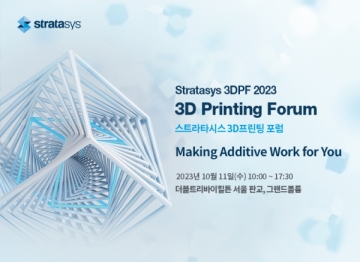
Stratasys will hold the "Stratasys 3D Printing Forum 2023" at the Grand Ballroom of DoubleTree by Hilton Seoul Pangyo starting at 10:00 a.m. on October 11.
2023.09.20by 배종인 기자











